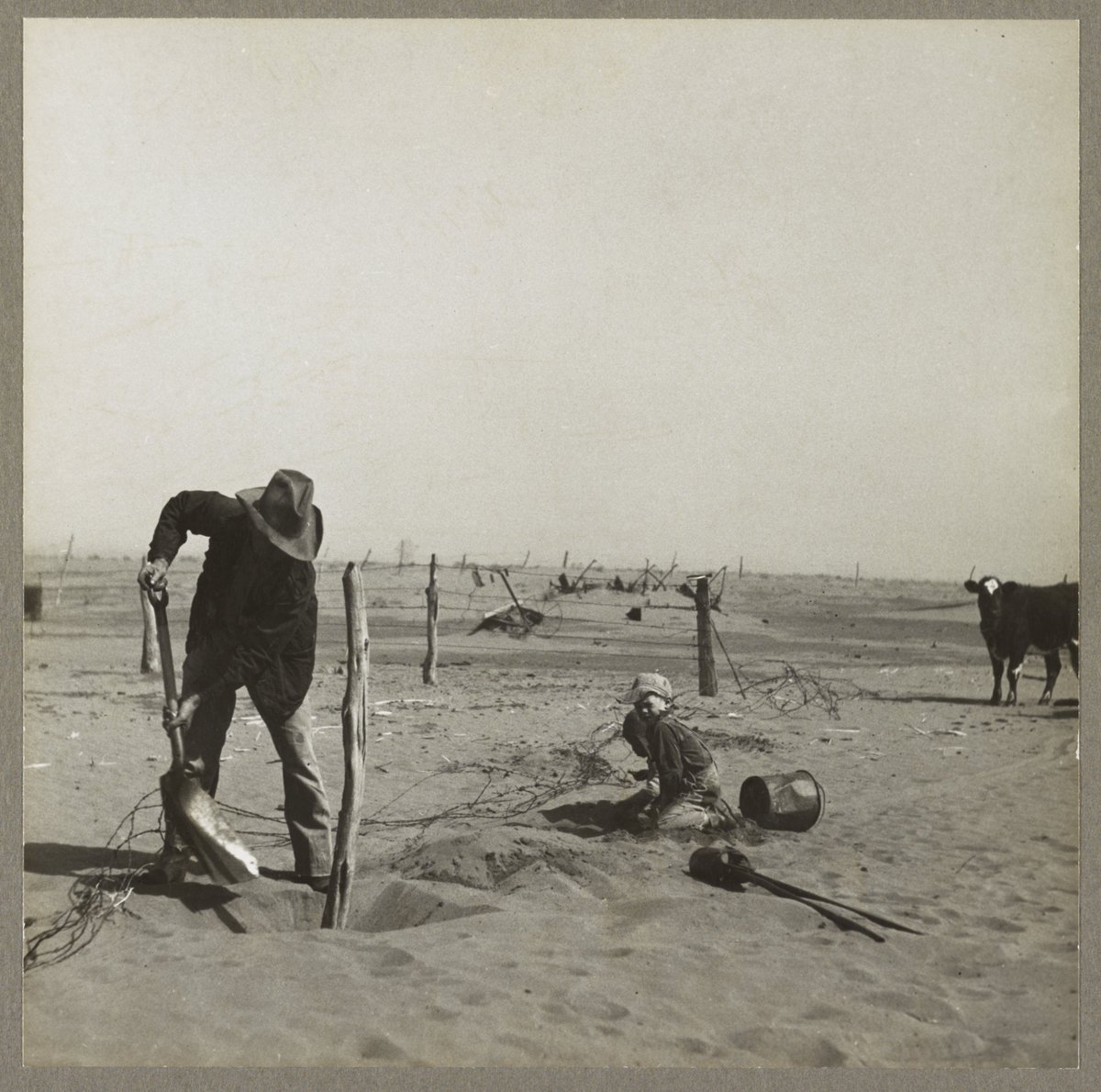
The Dust Bowl was made by expert advice, and the advice was to plough up grazing land and grow crops on it.
School files it under weather. A drought came, the wind got up, Steinbeck wrote a book. Nature did it, and nobody's name is on it.
Plenty of names are on it.
The southern Plains had been grassland since the ice went. Buffalo grass and blue grama, a mat of root that had sat through every drought for thousands of years with 30 million bison standing on it. Rainfall out there runs 10 to 20 inches a year. The first surveyors took one look and wrote Great American Desert across the map, meaning graze it, and leave the plough at home. John Wesley Powell, the explorer who had actually walked the ground and went on to run the US Geological Survey, told Congress as much in 1878 and again, with maps, in 1890. Congress thanked him and carried on.
Then a professor at the University of Nebraska, Samuel Aughey, announced that breaking the sod released moisture and changed the climate. A land promoter called Charles Dana Wilber boiled it down in 1881 to four words: rain follows the plow. The railroads, who had several million acres of desert to sell, reprinted it by the cartload. It was what everyone wanted to hear, it came with charts, and it was science.
Washington joined in. The Enlarged Homestead Act of 1909 handed 320-acre blocks of dry grassland to anyone who would break them. In 1917 the government guaranteed wheat at over $2 a bushel and told farmers wheat would win the war. Then the tractor arrived, and a man who could turn 3 acres a day behind horses could turn 50. Between 1925 and 1930 more than 5 million acres of native grass on the southern Plains went under, in what the locals called the Great Plow-Up. The cattle came off and the wheat went in. When the wheat price collapsed at the end of the decade, farmers ploughed up more grass to make the same money from a lower price, which is the sort of decision a spreadsheet makes.
The rain, having not read Professor Aughey, stopped in 1931.
Wheat has the root system of a doormat. With the grass gone there was nothing holding Kansas down, and Kansas left. In May 1934 it fell on ships 300 miles out in the Atlantic. On 14 April 1935, Black Sunday, a wall of topsoil thousands of feet high rolled across the Plains and turned the afternoon into midnight. Children died of dust pneumonia behind wet sheets nailed over the windows. 100 million acres were damaged and around 2.5 million people packed up and left.
That spring a soil scientist called Hugh Bennett was giving evidence to a Senate committee when the sky over Washington went brown with what had recently been Oklahoma. He got his Soil Conservation Service within weeks.
Then the federal government did something your textbook skips. It bought back more than 11 million acres of the wrecked cropland, put it down to grass again, and put cattle on it. It is still there. They're called the National Grasslands, nearly 4 million acres of them, grazed under permit to this day, and they have not blown anywhere since.
So America has run the experiment at full scale. Take land that only grass will hold, remove the grazing animal, and grow human food crops on it because the experts and the price say so. It took 5 years to plough and 10 to bury a region.
Every few months now a report lands explaining that pasture is wasted land, and that if we only took the cattle off we could grow crops there instead. It has charts. It is science.
Ask them what follows the plough this time.
@BadgedPatriot Have the grandkids roll them.
Emphasize accuracy, insuring good work.
Offer snacks.
Stack rolled coins on the table “to look at.”
Tell the grandkids to take them as they’re going home.
It’s only a surprise the first time, but still fun.
I learned it from my grandpa.
@MrPitbull07 They need to thoughtfully discuss how they approach money before moving forward.
Time, energy, money. Life is a series of exchanges. They need to be sure they’re on the same page.
@MustangMan_TX Saginaw and Haslet are just outside Ft Worth city limits. There has been exponential growth all around. Infrastructure improvements were an afterthought, so thousands of cars are now idling on 2-lane roads trying to get to their overbuilt neighborhoods.
@sportsiren@AdamSchefter Everyone knows there are two games going on every game day: the ballgame on the field and the political, broadcasting, NIL game.
Arch has experience in the first and is quickly kearning to play the second.
@RGIII The sideline interviews seem to have gotten LONG but talking to the reporters is part of the deal.
Act like you’ve won before.
Not a good look, Sark.
@OldSaltCityAce@goneers Reductions in fraud will cut benefits.
The millions of people receiving what isn’t theirs won’t go quietly.
Politicians don’t like noise and controversy, so there’s no motivation to fix it.
Increased tariffs won’t make Congress wiser. They’ll just spend more.
@Texas_Nana_ Oh, Nana. That sounds much like my September, 2000.
Get ready.
When I lost my composure and told God just what I thought about His handling of things, He whispered calm, peace and hope to me.
I wouldn’t want to repeat that time, but God showed up and I’ve not been the same.
@rayengroves Sometimes taking a break is good.
It gives both of you room to breathe.
Try again when you both have a new perspective (and perhaps a new goal incentive).
The relationship with your child is the most important thing.