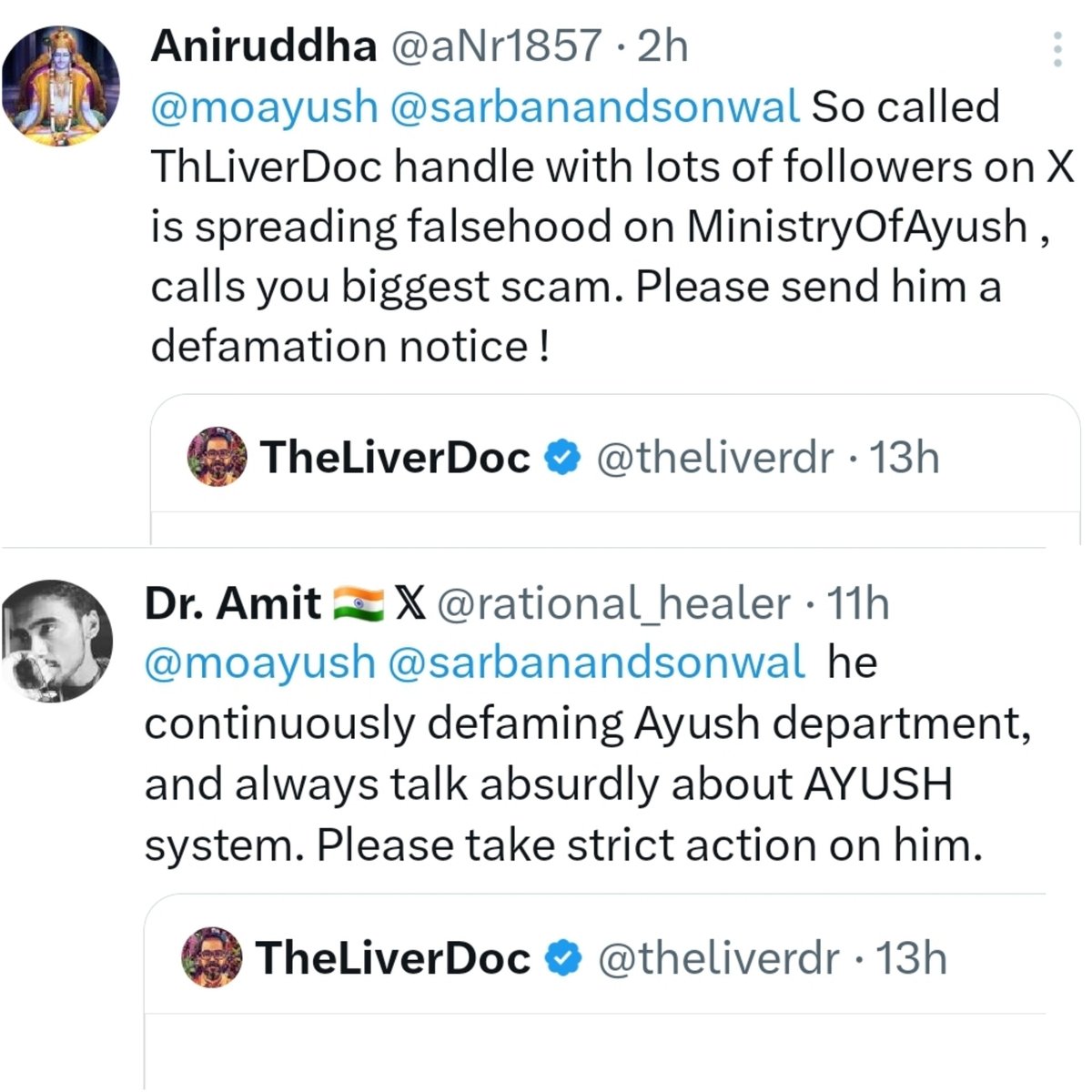
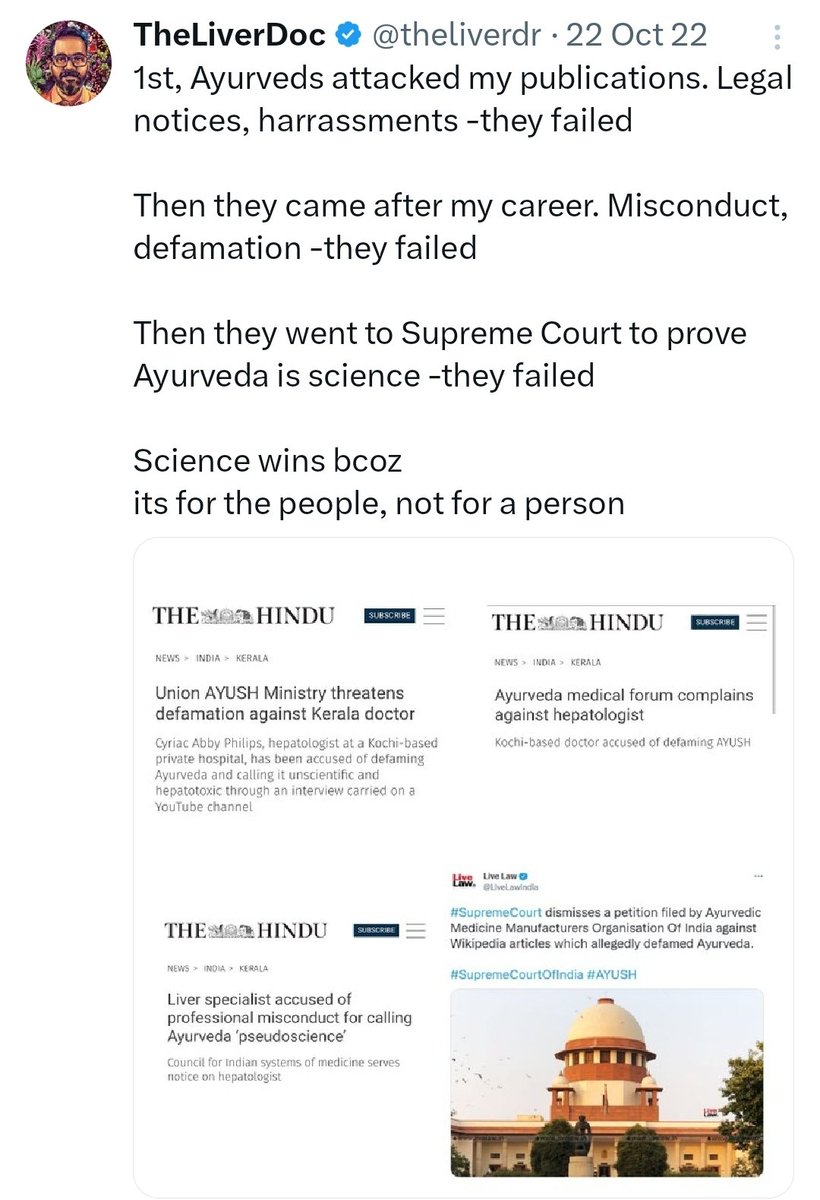
Since 2017 I have been calling out the unscientific practices in AYUSH through evidence-based peer reviewed publications
2024 is fast approaching. 7 years & there has been absolutely zero attempts or convincing rebuttals on any matters raised, except cry defamation all the time
(1/8) Yesterday I said it was wild how many talented people struggle to sell themselves during interviews
Lots of people asked how to do it
I've interviewed 100's (if not 1,000's) of ppl, and done a bunch interviewing myself, so here are 5 simple elements of selling yourself
And final note, if you're a manager/leader, hiring is the most important thing that you do
It's silly how little time most managers spend thinking about attracting, hiring and retaining talented teammates
The Telecommunications Bill, 2023 which is listed for introduction and passage today in the Lok Sabha is another action to cement authoritarian control over the rights of ordinary citizens. Its impact will be felt directly in four clear ways.
First, there is a clear power for the Union Government to regulate and license OTT services such as Whatsapp, Signal, Gmail etc.. Here, the unfounded hope and the underserved servility in statements that OTT regulation is excluded from the ambit of regulation of the Telecommunications Bill, 2023 is not borne from its text. The Union Government may prescribe license conditions that may vary as per “telecommunication service” [Section 3(1)(a) and Section 3(1)(b)] and require prior registration that may be used for the government to weaken privacy and increase snooping in future. While the phrase, “OTT”, or “Messaging Services” or even, “Email” are not expressly mentioned in the Telecommunications Bill as in the draft version they at the same time have not been expressly excluded from the definition of, “telecommunication service” which means, “any service for telecommunication” [Section 2(t)]. Further, the phrase, “telecommunication” is defined to include, “transmission… or reception of any messages….”. Hence, internet based messaging and email services are *included*.
Second, the Telecommunications Bill, 2023 extends the colonial powers of interception of your communications without any safegaurds. This is first done through powers of to notify standards and conformity assessment that will include encryption [Section 19(f)]. This may even be under grounds of national security [Section 21]. Encryption is a technology that is used in internet based messaging to ensure only the sender and receiver read the message in plain text. Any person snooping in on the message during the course of transmission cannot read it. However, standard setting powers may be used to create backdoors, introduce message traceability [identifying the author of a message], or to create block lists of words [as done in China on WeChat]. This becomes clearer when you look at the powers of interception that require intercepted messages to be disclosed in an “intelligible format” [Section 20(2)]. There are no procedures and safeguards in the text of the law and the existing procedure under Rule 419-A of the Telegraph Act that has been abused will continue [Section 61]. For instance the Government of India now even refuses to provide an aggregate date on the number of interception orders that it issues. It is a completely unaccountable and secretive system of surveillance without any oversight by courts or parliament that is being made more severe without any reform.
For those stating that the present Telecommunications Bill, 2023 contains exemptions for, “press messages”, I encourage you to read more carefully. While it does create a sub-classification for, “correspondents accredited with the Central or State Government”, it does not offer any heightened protection (such as an additional procedural safeguard or reason) for the same conditions [Section 20(3)]. There is also no no-obstante clause, hence this does not override any other provision under any other law. Hence, it is merely clever drafting for it reverts to the same process for interception as it applies to any other person [Section 20(2)(a)].
Third, India suffers from the highest number of Internet Shutdowns in the world. These injuries have been felt acutely across our country by people resident in Manipur, Rajasthan, Odisha, West Bengal, Jammu & Kashmir etc. Here, the Telecommunications Bill, 2023 restates the power to impose internet blackouts without any statutory safeguards despite court cases and recommendations by the Standing Committee for IT [Section 20(2)(b)]. These could have been in the form of mere transparency, such as the duty of the State Governments to send copies of orders to the Department of Telecommunications and then for the DOT to maintain a central directory of orders however is not part of the legislative text. This will also not be done under the rules, as the previous Telecom Suspension Rules will continue [Section 61].
Fourth, the Telecommunications Bill, 2023 continues the, “kartavaya kaal” style of imposing penalties on ordinary Indians as has also found expression under the Data Protection Act, 2023. It prohibits, “false particulars, suppress any material information… while establishing their identity for availing telecommunications services”. This means KYC may be required even for OTT applications like Whatsapp. In addition to this there is a vague penalty when people, “fail to share information as required under this act” [Section 29]. The fine for this is Rs. 25,000 after which a daily fine of Rs. 50,000 till you are compliant. Further, there is a marked preference for biometric identification [Sec. 3(7)]. This may mean another attempt by the Government to force people to use Aadhaar as the single point of sign-up (mandatory) despite the Supreme Court in K.S. Puttaswamy clearly stated this was impermissible.
Finally, it merits use to examine the larger environment in which this Telecommunications Bill, 2023 is being passed. First, democracy is today suspended in India with a large number of opposition MPs suspended in parliament. Meanwhile other laws that increase state power, decrease accountability and transparency and threaten ordinary citizens are being passed. The fist of the state is becoming tighter on our digital lives with the Broadcasting Services Bill, 2023; Data Protection Act, 2023; the Post Offices Bill, 2023; Criminal Procedure Identification Act, 2022; IT Rules, 2021.
In all of these proposals and laws, the same model of vague drafting, centralisation of power through delegated rulemaking is proposed. Second, the Government is failing to answer the clear challenges of rising inequality that manifest in digital India. For instance, it has failed to address or even acknowledge the sluggish pace of growth in the number of new mobile and data users in India. From double-digit growth rates through 2016 to 2020, it slumped to about 4 per cent in 2021 and 2022, according to Telecom Regulatory Authority of India data. In the first quarter of 2023 it grew just 1.7 per cent over the last quarter of 2022. Have we heard a word from the ministry of telecom on what is proposed to overcome this? There won't be a word on it for there is nobody left or permitted in Parliament to raise these questions as the Telecommunications Bill, 2023 is passed through a voice vote.
Shame, shame, shame.
The LVM (large vision model) revolution is coming a little after the LLM (large language model) one, and will transform how we process images. But there’s an important difference between LVMs and LLMs:
- Internet text is similar enough to proprietary text documents that an LLM trained on internet text can understand your documents.
- But internet images – such as Instagram pictures – contain a lot of pictures of people, pets, landmarks, and everyday objects. Many practical vision applications (manufacturing, aerial imagery, life sciences, etc.) use images that look nothing like most internet images. So a generic LVM trained on internet images fares poorly at picking out the most salient features of images in many specialized domains.
That’s why domain specific LVMs – ones adapted to images of a particular domain (such as semiconductor manufacturing, or pathology) – do much better. At @LandingAI , by using ~100K unlabeled images to adapt an LVM to a specific domain, we see significantly improved results, for example where only 10-30% as much labeled data is now needed to achieve a certain level of performance.
For companies with large sets of images that look nothing like internet images, I think domain specific LVMs can be a way to unlock considerable value from their data. Dan Maloney and I share more details in the video.
In the hills & valleys of Mizoram, voters are hungry for change. They want development. They want better roads. They want job opportunities. They want to stand shoulder to shoulder with their Northeast sisters.
This election, they voted for exactly that.
https://t.co/nvcKh1GCjT
people should take “identity sabbaticals” — run away to somewhere no one knows you and start a new life with a new social identity, for about 6-12 months
In a landmark judgement NGT directed NHAI to come up with an innovative road design to ensure an eco-friendly road layout. @ayesha_minhaz, reports on our data led legal campaign, and what it means to other groups who are fighting to save trees.
https://t.co/bFhGzLZMA4
@theliverdoc my doc keeps prescribing Montec LC for my kid when he falls sick. If I remember you had shared a post earlier on it, can you share it again? Other things to look out for and how to counter the arguments of the doc when they keep pushing for their medicines will help
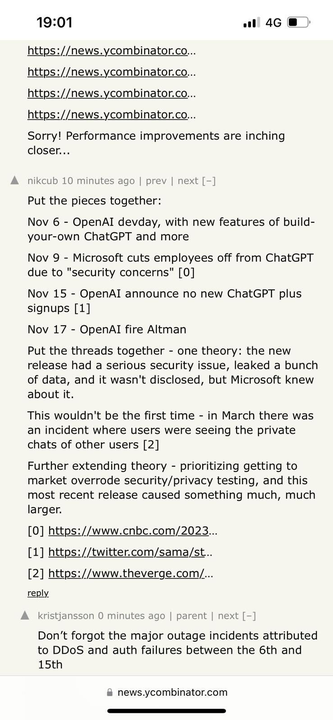
So far what I’ve gathered is that Sam Altman was fired on a Google Meet link
Open AI is literally owned by Microsoft and even they don’t use Microsoft Teams 😂
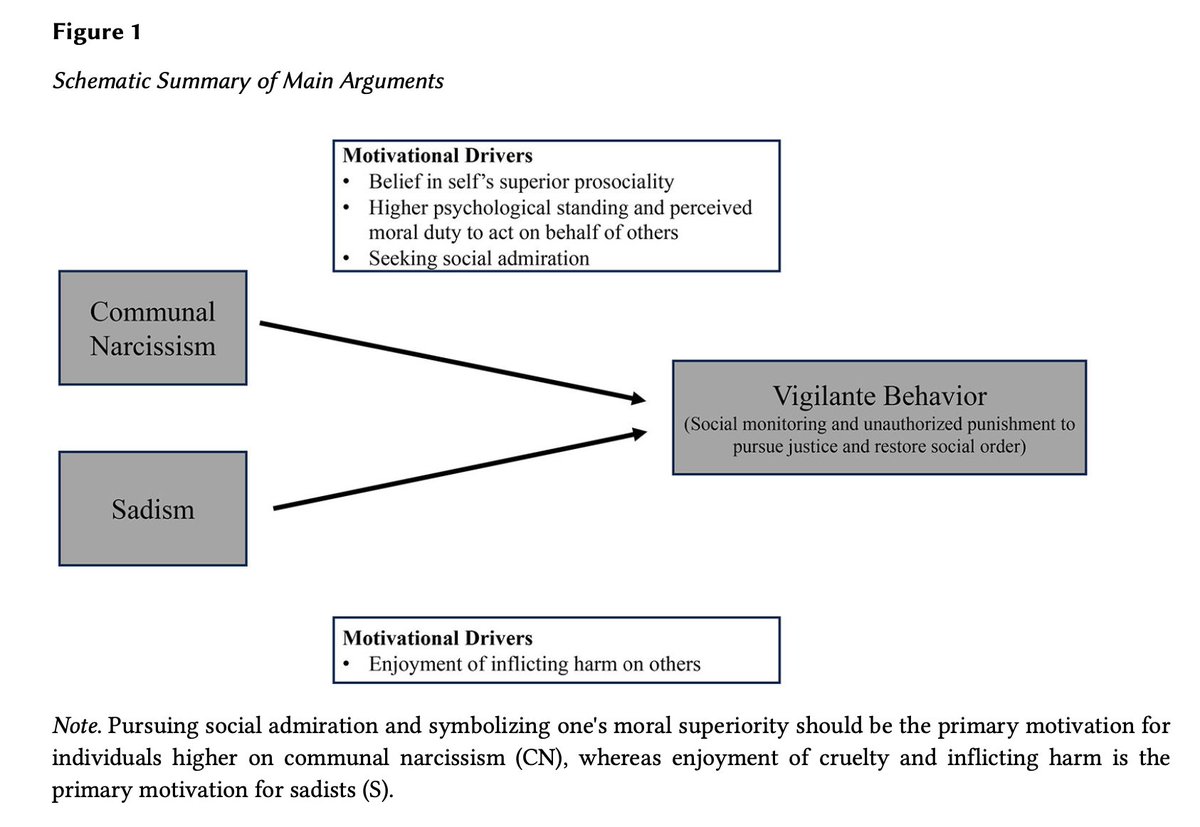
Vigilantes (those who monitor others for moral wrongdoing and take it upon themselves to punish others) are particularly high in communal narcissism (belief that one is exceptionally beneficial to other people) and sadism (enjoying harming others):
https://t.co/KEmUZRvZUQ