I think the suggestion that OpenAI's internal codebase is the peak of intelligence is pretty funny. Hitting theoretical minimum perplexity and deterministically generating it is full AGI well beyond solving every math problem.
How much of the correlation with the AI indices has to do with the indices being overweighted on such a task? Seems to suggest an issue with the capability index. Fable 5.2 can't seem to figure out how to look up verl's documentation to properly configure an experiment this morning.
@vikhyatk give it like 1 more month someone on holiday break at Anthropic or OpenAI is going to get bored and throw 5000 ClaudeGPT Fabstra 11.5 ProMax agents at it
More models being added and benchmarked soon. Engine is still quite simple, and kernel set small. Are there any models in particular that academics are interested in training outside of this family (gpt-oss, gemma, etc.)?
I'm not so sure about pace: there are tons of ideas being suggested, few of which are a material gain or progress. On this end, the "pace" isn't really too much of an issue, even in crowded spaces. There are tons of blind spots if you go looking, and progress in it is a good thing even if you get scooped. For me, it has nothing to do with the pace, but the quality of work and people.
There are just so many zero-effort papers clouding the space where the authors themselves make no effort to understand the work. I can understand that this was always an issue to some extent, but it's quite bad now. People submit and resubmit 17 single-author papers every round and expect everyone else to pick up the slack. Others sign up for reciprocal review and never bother to read the paper. Some complain about one side or another, but these two groups consist of the same people.
Reading papers nowadays gives you little information, and reviewing for conferences has become absolutely terrible because no one involved is putting in due effort. It's very demoralizing. Why even bother participating?
Doing research is still nice, and it's a privileged position to be in, but all of the stuff around it sucks. It's worth it if you can somehow ignore all of this. I'm lucky that my colleagues at @uwcse are fantastic.
No. The SFT traces need to come from somewhere. You could try rejection sampling to create a dataset, use that to SFT, then use that model to rejection sample again, but then you've just created a rudimentary RL algorithm that's unstable and probably much less efficient.
Looking at the paper, even when SFT "beats" their RL baseline, it's not by much. When it doesn't it falls short by a huge margin. I would love to see the error bars on this.
In practice this process involves either an oracle model (usually RL is in this process) or specialist models trained with RL and recombined into a final one with SFT, OPD, whatever else exists now. Even if SFT is "the right way", that doesn't mean RL isn't useful for training.
Peeve with LLM code: even with Fable 5.2, I'm running into this.
If I tell it to do something, like "let's add support for a few common evals", it will appropriately re-use some prior utility that exists in the code. This is good.
However, this prior utility is supposed to be for trivially verifiable math evals using a string match (e.g., DAPO-Math), and was named as such. What it did was add a new function in the math file that allowed it to be used for QA questions other than math.
Thus, the new evals were running on a utility named Math<something>, with some helper functions to post-hoc make it work with QA. Not only is this a little confusion to people who would use the code in the future, it creates a precedence for future agents to reason that this is acceptable. The next task, which was to add support for a different type of verifier that wasn't a string match, added more duct tape on top of this function yet again, in the name of "code reuse".
Clearly this will lead to accelerated accumulation of technical debt and sloppage over time. Restructuring slightly reduced the code surface to maintain and search over. This is quite basic stuff as far as code organization goes. The next few tasks went very quickly and outputs looked great.
In cases where it's not a PR to some long-standing open source repo, I think it would be nice if it pointed this out to the user and asked whether it's okay to re-structure the code slightly to make the base code more reusable/extensible by default.
It does great in asking me for clarification or approval for decisions elsewhere! This seems like a bit of a mismatch between "complete this coding task ASAP" and what things might look like in reality.
Excited to share Grasping the Future!
We taught a model something people do effortlessly: handling objects.
It generates the whole interaction in 3D, both hands, their fingers and the object, as one motion. It learned from internet videos.
https://t.co/h2vw2N518T 🧵
(1/8)
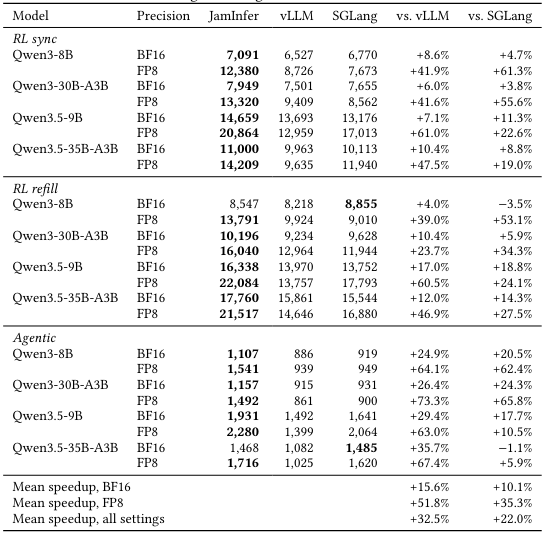
For the past 11 months, I've been working on a SOTA RL and inference framework called Jam.
In this article, I discuss the architecture of Jam, starting with response generation with JamInfer and turning them into updates for the model with JamRL.
https://t.co/pe3BGmQBRc
For the past ten months, I've been working on a SOTA RL and inference framework called Jam.
In this article, I discuss the GPU and kernel optimization principles that allowed me to write kernels with 34% higher inference throughput than vLLM or SGLang.
https://t.co/ZVxI043kdl
I'm not so sure about pace: there are tons of ideas being suggested, few of which are a material gain or progress. On this end, the "pace" isn't really too much of an issue, even in crowded spaces. There are tons of blind spots if you go looking, and progress in it is a good thing even if you get scooped. For me, it has nothing to do with the pace, but the quality of work and people.
There are just so many zero-effort papers clouding the space where the authors themselves make no effort to understand the work. I can understand that this was always an issue to some extent, but it's quite bad now. People submit and resubmit 17 single-author papers every round and expect everyone else to pick up the slack. Others sign up for reciprocal review and never bother to read the paper. Some complain about one side or another, but these two groups consist of the same people.
Reading papers nowadays gives you little information, and reviewing for conferences has become absolutely terrible because no one involved is putting in due effort. It's very demoralizing. Why even bother participating?
Doing research is still nice, and it's a privileged position to be in, but all of the stuff around it sucks. It's worth it if you can somehow ignore all of this. I'm lucky that my colleagues at @uwcse are fantastic.
it's hilarious how many have taken the bitter lesson to mean just scaling up transformers. it's about scaling, but innovations in algorithmic primitives can lead to much more efficient scaling