New survey on Continuous Diffusion and Flow Language Models is out! 🌊💬
One of my first papers, back in early 2025, was on continuous simplex flows. After working on discrete diffusion, I wanted to try controllable sequence generation with flow matching, which naturally operates in continuous spaces. But at the time, I found them much harder to train well than discrete diffusion. 🥲
2026 has changed this picture completely! 🚀 It’s been super exciting to watch continuous LMs take off, but with the rapid advancements, it’s also becoming harder to keep up with all the new work across pre-training, few-step generation, guidance, and scaling 🥹
So together with @chandavidlee, @FEijkelboom, and @jw9730, we put together a survey that consolidates the continuous LM literature and its key insights into 37 pages. It covers everything from the early work before the so-called “winter” of continuous LMs to the wave of new papers in 2026 🌟
More in thread! 🧵
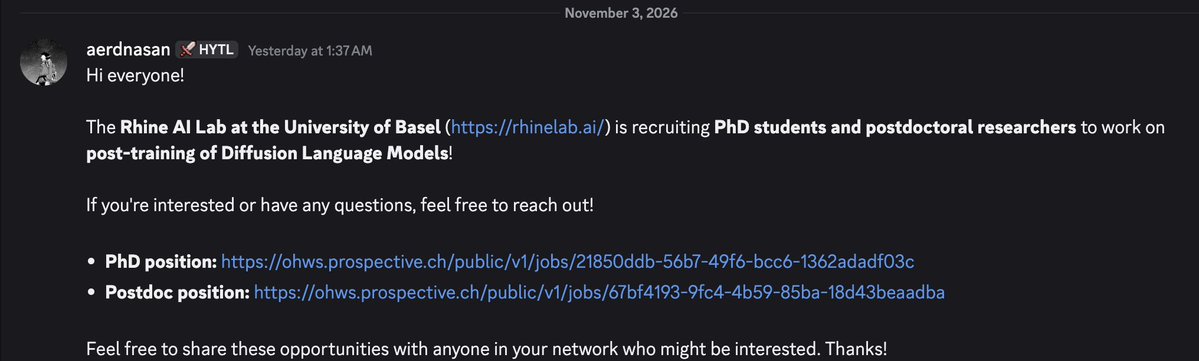
The Rhine AI Lab at the University of Basel (https://t.co/2t8HsxoduL) is recruiting PhD students and postdoctoral researchers to work on post-training of Diffusion Language Models!
PhD position: https://t.co/6fR6ikhZeY
Postdoc position: https://t.co/qHsKGmwZRc
cc: @ilijabogunovic
Join our discord to learn more: https://t.co/0WcpGsasyh
Happy to share our most recent work:
An ODE-based Sampler for Discrete Diffusion Models
- we introduce a probability-flow analogue for discrete diffusion: deterministic dynamics that preserve its time marginals.
- we derive a principled discretization and efficient implementation for both MDM and UDM.
- this allows a theoretically grounded consistency distillation objective.
https://t.co/lOMB1zQL5i
Joint work with @samsongvch, @ericxing, @EricMoulines, @AlainDurmus and Giacomo Zanella
We are very excited about this direction and believe that it can be pushed much further!
(1/n)
So a career update: I've joined @modal leading Developer Relations in Europe!
To celebrate, I won't do resets like @thsottiaux but I'll do one better, and give out free Modal credits.
Tell me what you're building with @modal in Europe and I'll pick a few projects to fund!
🔥 Diffusion LMs promise what autoregressive models can’t: fixing their mistakes.
But new ones often change the noise and the sampler at once. Which matters?
We tested it on the hypersphere. Noise: 0.8 points. Sampler: 25.
We introduce Spherical Brownian Diffusion 🌐 👇🧵
intuition: don't lock in tokens early! instead feed back in the average embedding value (weighted by the intended output probs), all the way through to the end.
this is really interesting, I wonder if it changes its mind on 'confident' tokens early on?
A looped transformer has to know when to stop, and its state has to stay bounded while it loops.
We introduce Spherical Fixed-Point Reasoners (SFPRM) 🌐: loop on the unit sphere, where each step is an angle, and stop once the angle is small enough.
🧵 (1/9)
Interesting contrarian take! While everyone in diffusion LMs is seemingly trying to figure out how to get rid of self-conditioning, they asked: what if self-conditioning is all you need?
Also brings to mind the recent data-space iteration paper https://t.co/oIsq6gggKp
Discrete diffusion models sample tokens independently at each step, losing uncertainty from earlier predictions.
Loopholing uses self-conditioning to pass a continuous state between steps but still samples at each step.
Could we go all the way with self-conditioning? 🤔
🧵1/7
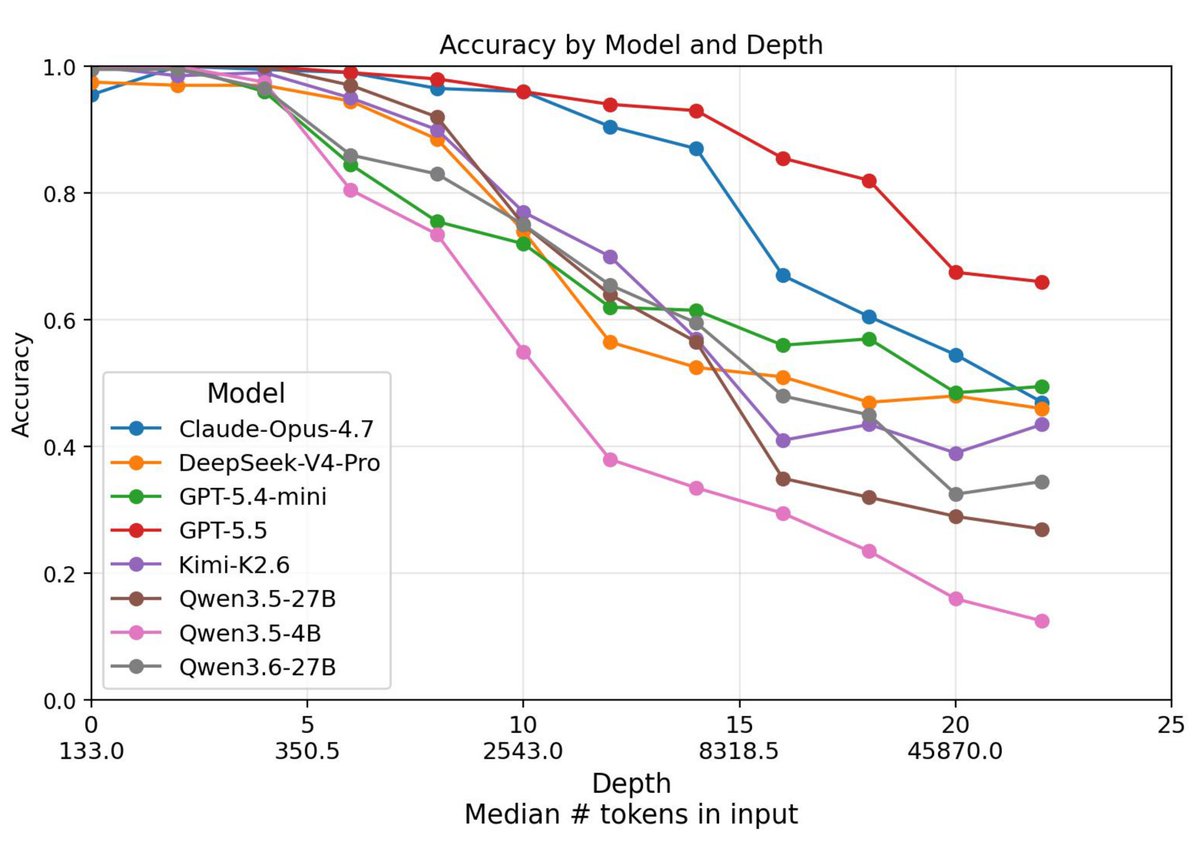
Frontier LLMs can tackle hard problems like Navier-Stokes. But can they solve proofs that are 22 steps deep? 🤔
Meet ProloNg, a Prolog benchmark to evaluate how deep LLMs can go.
Most of the 8 models we test approach chance beyond depth 10 📉
🧵1/7
➰ Self-Conditioning (SC) in Diffusion Language Models can be a polarizing topic ☯️ Indeed, using SC means we need to carry two states during sampling. While recent work attempts at getting rid of SC, we ask the opposite question: what if we get rid of diffusion? 🧐