1/ Russia has suffered a "crushing defeat" at Lyman in eastern Ukraine, with multiple regiments routed, heavy losses, and a "collapse of the front". Crippled soldiers are reportedly being sent into battle in a last-ditch effort to prevent disaster. ⬇️
https://t.co/WEZJ6chf40
Wounded Russian servicemen have been trapped for the fifth day without food or water in the collapsed basement of a building hit by a Ukrainian aerial bomb. A striking video from the series "why you shouldn’t sign a contract and go to the so-called special military operation."
In a video farewell, fifteen Russian soldiers, preparing to be sent into a final one-way meat assault, declare: “The Russian people are being killed here.”
Their unit having already lost between 1,000 and 1,200 men, demanding criminal charges against the commanders and senior leadership who sent them to die.
Ex-Google CEO Schmidt: Ukraine used to be the small, fast, smart innovator, Russia big and slow. That's changed, and that's a big threat.
Wars are dynamic now. If you're not doing something to address new developments, don't complain after a bad outcome. 1/
Towed artillery pieces are hard to destroy using FPVs, but the barrel itself is often targeted with a shaped-charge warhead.
A Ukrainian 2P22 “Bohdana-BG” 155-mm howitzer was seen with stand-off “hedgehog” protection made of unraveled steel cables attached to the barrel.
A Ukrainian Khizhak remotely operated weapon station has been integrated onto a helicopter for anti-drone missions.
UGV Robotics-developed Khizhak system was supplied to aviation with support from the @CharityPrytula and has already been used to shoot down Russian Shahed drones.
Air-defense veteran Marko: Ukraine built a big sword in drones and missiles, we now launch more at Russia than Russia launches at us. But our shield, electronic warfare, we built too slowly
Some of our jammers spent years in cities blocking navigation and have zero experience 1/
Ukrainian military programmers built a system called Hrafit that pushes a short alert straight to a soldier's phone the moment a Russian FPV drone or glide bomb starts closing in.
The system fuses mostly all available radio-technical intelligence and surveillance into a single picture https://t.co/sSS83shmXC
We have now recorded over 450 acts of Russian and Belarusian hybrid warfare and state-sponsored terrorism since February 2022. Of the 454 incidents, 44 are "probable" Russian intelligence-sponsored and are still under investigation.
Link at the end of 🧵
1/8
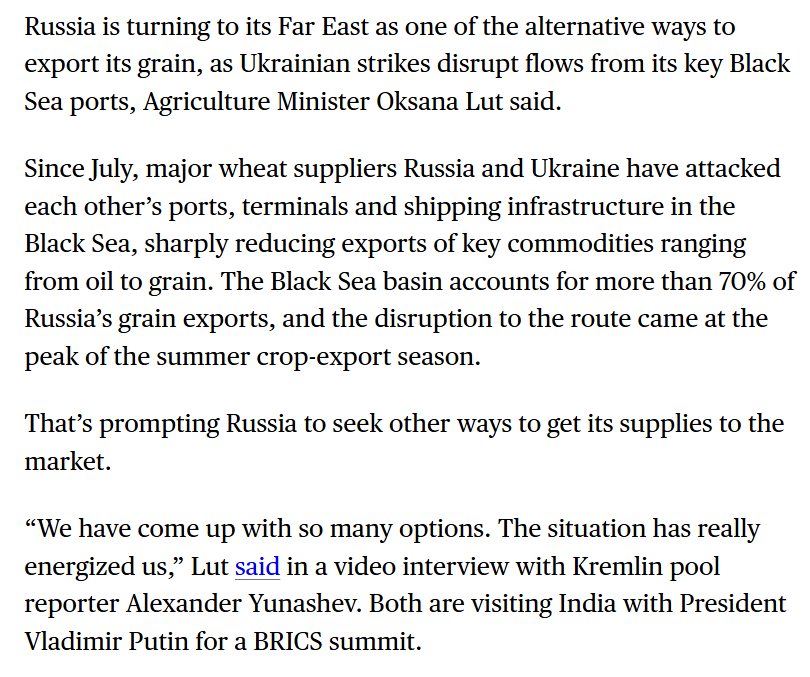
"Russia is turning to its Far East as one of the alternative ways to export its grain, as Ukrainian strikes disrupt flows from its key Black Sea ports, Agriculture Minister Oksana Lut said.
Since July, major wheat suppliers Russia and Ukraine have attacked each other’s ports, terminals and shipping infrastructure in the Black Sea, sharply reducing exports of key commodities ranging from oil to grain. The Black Sea basin accounts for more than 70% of Russia’s grain exports, and the disruption to the route came at the peak of the summer crop-export season."
https://t.co/YVzok1q9Rd
⚡️Ukraine thwarts FSB assassination plot against defense company head.
Ukraine's Security Service (SBU) said it foiled an FSB plot to assassinate the head of a Kyiv defense company after a 63-year-old suspect allegedly planted a car bomb and planned to flee to Russia via Poland. Polish police arrested him, and Ukraine is seeking his extradition.
https://t.co/1mCFdKmaUr
For the first time since the beginning of the war, Ukrainian long-range strike drones reached the Yamalo-Nenets Autonomous Okrug located in northern Russia, at the time breaking the distance record (+2,800 kilometers from the border with Ukraine).
The target of the Ukrainian OWA-UAV raid in Yamalia was the Condensate Preparation for Transportation Plant located in the city of Novy Urengoy. The plant is a critically important facility of the Russian gas industry, responsible for the extraction of unstable gas condensate from the deep, geologically complex Achimov and Valanginian deposits of the Urengoyskoye oil and gas condensate field so that it can be safely transported via pipelines.
As a result of the strikes, a fire broke out on the territory of the object.
The Governor of the Yamalo-Nenets Autonomous Okrug, Dmitry Artyukhov, confirmed the fact of the attack, although claimed that it was repelled, and that the fire was caused by the good old drone debris.
1/ Russian warbloggers warn of an alarming development: Ukraine's long-range drone strikes into Russia are reportedly being guided by Starlink connections, which potentially provides drones with precise and unjammable navigation across the entire country. ⬇️
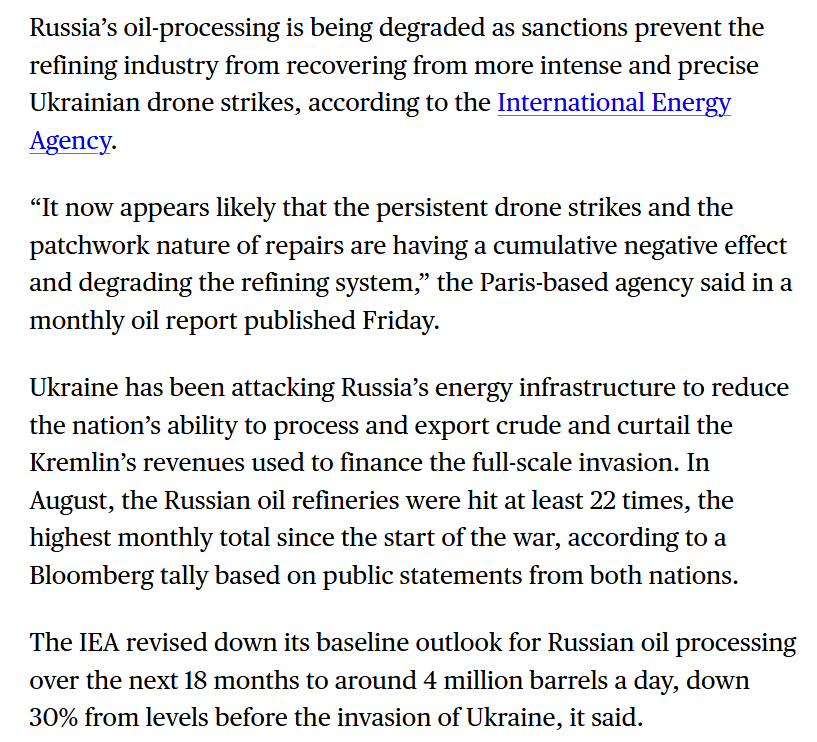
"Russia’s oil-processing is being degraded as sanctions prevent the refining industry from recovering from more intense and precise Ukrainian drone strikes, according to the International Energy Agency.
'It now appears likely that the persistent drone strikes and the patchwork nature of repairs are having a cumulative negative effect and degrading the refining system,' the Paris-based agency said in a monthly oil report published Friday.
Ukraine has been attacking Russia’s energy infrastructure to reduce the nation’s ability to process and export crude and curtail the Kremlin’s revenues used to finance the full-scale invasion. In August, the Russian oil refineries were hit at least 22 times, the highest monthly total since the start of the war, according to a Bloomberg tally based on public statements from both nations.
The IEA revised down its baseline outlook for Russian oil processing over the next 18 months to around 4 million barrels a day, down 30% from levels before the invasion of Ukraine, it said."
https://t.co/JQpn9HWYTo
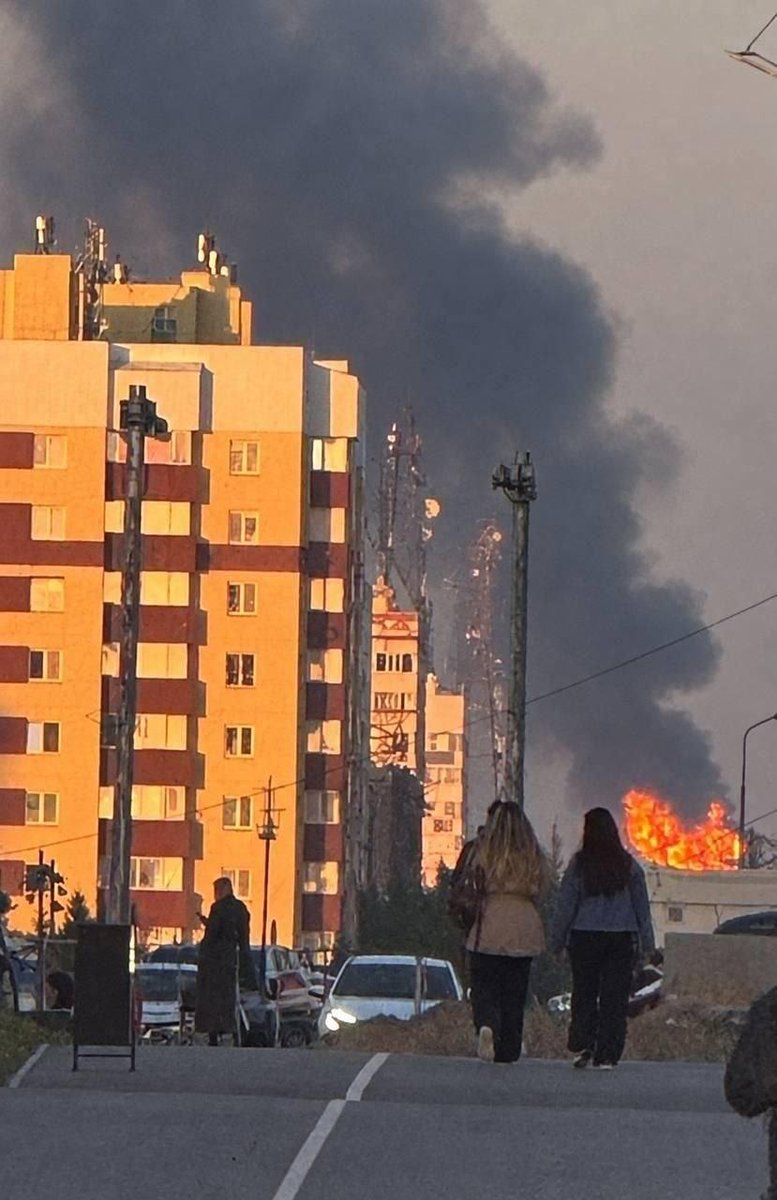
The key Russian oil pipeline pumping station in the city of Perm continues to burn roughly 18 hours after it was hit in a Ukrainian drone raid.
Seen here, the glow of the burning Russian facility on the horizon.
The US Marines have released their vision for ground combat out to 2040. While remaining centred on the role of humans, it has significant injections of autonomous systems, data-informed decision-making, and other tech to inform new warfighting concepts. Well worth a read for how Western military institutes respond to lessons from Ukraine. https://t.co/UxYT7GkhFh
Robots deliver ammo, water and food. Robots pull out the wounded. Robots take the place of people where it's most dangerous.
112,000 UGV logistics and evacuation missions since the start of the year. 25,143 in August alone, over three times the January figure.
Read more:
https://t.co/YlCkmLP1vY
This Ukrainian robot alone held position for 45 days. It’s called TWW127.
Robots don’t bleed. Saving manpower is the top 1 priority of the Ukrainian army, United24.
NC13 Commander “Makar”: Strike UGV direction is the newest and least studied. But its potential is the biggest.1/
According to NC-13 data, 75 percent of the robotic vehicles the unit dispatches into the kill zone reach their designated targets and successfully complete their missions. “Don’t worry,” https://t.co/OzdXZW49ok
After lagging behind in a number of drone technologies, Russia 🇷🇺 is slowly catching up on Ukraine 🇺🇦
Despite persistent lag in certain key sectors, specifically drone connectivity, bombers, UGVs, and mid-range strikes, ground has been made up in a number of areas.
🔸Interceptor drones: Despite a critical lag that peaked in May and June, Russian drone operators have managed to increase interceptions of Ukrainian mid- and long-range drones and heavy bombers. There is still work to be done, particularly regarding Ukrainian ISR capabilities, but Russia started from a significant disadvantage. Substantial resources have been diverted to C-UAS (Counter-Unmanned Aircraft Systems) efforts.
🔸Long-range strikes: With the arrival of a series of jet-powered drones (and even missiles), including the Geran-4, Geran-5, S8000 Banderol, and others, Russia is improving strike precision and effectiveness while using fewer drones. The Geran-4 has been used extensively as a counterpart to the FP-2 for mid-range strikes, while also continuing to conduct long-range missions.
🔸Mid-range strikes: Russia's biggest issue is a lack of connectivity, which limits the range of many drones; the deployment of Rasvet satellites will take time. Nevertheless, the BM-35 mid-range drone, including a new jet-powered version, appears to be seeing renewed activity in the distance. Meanwhile, the Molniyah (low-cost and mass-produced) and the Gerbera (a Shahed decoy, sometimes carrying a warhead) are conducting strikes both at the front and further behind.
🔸FPV drones: Russian FPV drones, whether fiber-optic or standard models, continue to outnumber their Ukrainian counterparts, carrying out massive daily strikes along the front line. The Russian military was not particularly behind in this area to begin with, but it continues to make progress. Only problem ? Ukrainian jamming that can prevent entire directions from using classic drones for few hours...
🔸The organization of Russia's drone forces continues to strengthen. Unlike Ukraine, which employs a wide variety of drones, Russia concentrates production on a few specific models; this allows for mass production but carries potential risks in the event of Ukrainian strikes or the obsolescence of certain systems. The gradual reorganization of drone teams within Russian units (a topic frequently discussed by @kriegsforscherD ), the large-scale training taking place in schools, and continuous preparations for a long war are all concerning developments for the future, not only for Ukraine but for Europe as well.
At present, I believe Ukraine still holds an advantage in several areas, particularly those involving Starlink, electronic warfare, and FPV drones. This lead could widen if the right decisions are made, especially regarding the procurement of specific drones and technologies. However, Russia has managed to narrow the significant gap that existed up until the spring and continues to expand its long-range strike capabilities...
Russia's Bureau 1440 announced that it launched the second batch of Rassvet satellites into space yesterday. The first batch was launched in March.
https://t.co/86L4F9aVbF
Russia is significantly increasing its strikes on Ukraine with new means – cheap cruise missiles, which they launch from ground and air platforms (including from UAVs). More details in the thread
S8000 “Banderol”. The range is 500 km. The weight of the warhead is 120 kg. As of August 2026, it can be launched from a Mi-28 helicopter and a heavy UAV “Orion”.
S-71K and S-71M. So far, these missiles are not used so often by the Russians, but active development of these new weapons is ongoing, which can strike at a depth of 500 and 800 km, respectively, while having a 250 and 65 kg warhead. As of August, launches are being carried out from the Su-57. In the near future, the Su-35S, Su-30SM and Su-34M will also have this capability.
“Dan-T”. A rather promising Russian cruise missile, which as of August has the ability to be launched from a ground platform and a large number of air platforms. The missile's flight range is 500 km with a 135 kg warhead. Launches can be carried out from the Su-25SM3, Su-30SM, Su-34, Su-57, and Mi-28.
Geran-5. Despite the rather good production volumes of these cruise missiles (in May 2026, the monthly figure was approximately 200 units; now it has been significantly increased), we do not see them often yet. This missile can be launched from both ground platforms and Su-25SM3.
"Filin". One of the promising developments from the manufacturers of the Russian "Molniya". The Russians claim that this is a strike UAV, not a cruise missile. But we can assume that this is a debatable issue. The flight range will be 1200 km with a 50 or 100 kg warhead.
In my opinion, in 2027 we should expect an extremely large number of problems from these cheap missiles, which are difficult to intercept. The Russians plan to produce about 10,000 missiles of the Dan-T alone in 2027. It should also be expected (in my humble opinion) that a large number of these weapons will be able to be launched from ground platforms, ships, airplanes, and aviation. We need significant help to combat new threats.
Presumably, ground-based launcher for the Russian cruise missile Dan-T.
Liutyi is too well built to be a suicide drone, so even shifting into a more TB-2 role is imo a wise decision. Spending 200k on a propeller attack drone is moronic.
A Ukrainian “FP-1” long-range strike UAV is hit by a Russian anti-aircraft missile that sets off the UAV’s warhead.
The shaped-charge explosively formed penetrator (EFP) that forms part of these multi-effect Ukrainian warheads can be clearly seen shooting ahead.