@rohanpaul_ai Anthropic’s model intelligence will grow far beyond human intelligence. They will be best positioned to understand how to harness that intelligence to create value.
Today, we're launching Foundry Management, formed by @a16z and Atlas Holdings to help founders build AI companies inside the industrial world.
The hardest constraint in physical-world industries is often not the technology, but getting close enough to mission-critical work to understand what should be built. Foundry gives you a place to begin.
We recruit a small, select group of some of the top technologists and give them premiere access to the Atlas portfolio, representing $26B in annual revenue across metals, paper, packaging, building products, automotive supply chains, energy, and logistics.
You'll work alongside the operators and management at these businesses to build products and technologies that unleash AI in these industrial contexts. When it demonstrates the potential for an independent business, a16z and Atlas will support its creation, with you leading it as founder and CEO.
There’s a great deal of the future left to build inside the industries already around us.
Come build it with us: [email protected]
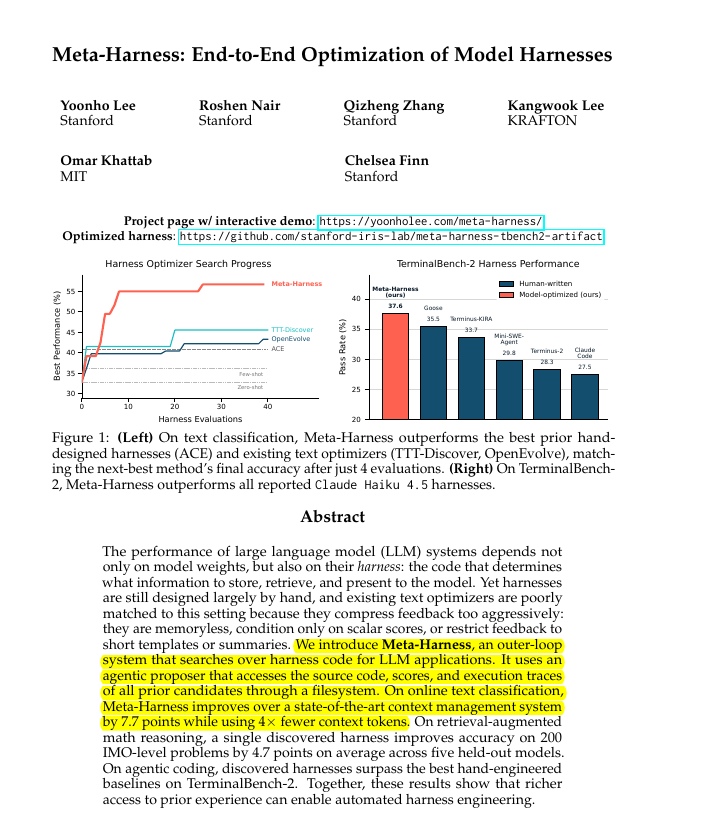
Stanford + MIT paper on Model Harnesses shows that AI performance depends not just on the model itself, but on the surrounding system code — the “harness”.
This is what decides what to store, retrieve, show to the model, and how the workflow runs. With the same underlying LLM, changing the harness can create up to a 6× performance gap on the same benchmark.
They conclude the harness around a model matters as much as the model itself.
The paper introduces Meta-Harness, an outer-loop system that automatically improves harness code. Instead of giving the optimizing agent only a score or a short summary of past attempts, it gives the agent rich access to prior code, logs, and execution traces through a filesystem-like setup.
The idea is that better diagnostic visibility lets the system improve the harness more intelligently.
What it found is pretty significant.
- On online text classification, a 7.7-point improvement over a strong SOTA context management, while using 4X fewer context tokens.
- On retrieval-augmented math reasoning, an average gain of 4.7 points across five held-out models on 200 IMO-level problems. On agentic coding, the discovered harnesses beat strong hand-engineered baselines on TerminalBench-2.
The paper shifts attention from “which model is best?” to “how is the whole AI system designed?”
For real deployments, harness design affects reliability, tool usage, context management, and failure recovery.
----
Paper – arxiv. org/abs/2603.28052
Paper Title: "Meta-Harness: End-to-End Optimization of Model Harnesses"
After such a consequential week for AI, with the leading labs demonstrating real progress, today's news feels especially timely: @SVAngel is launching Project Blueprint, a comprehensive effort to forge consensus among industry leaders and lawmakers around durable solutions to the hardest AI policy challenges so that all Americans can benefit from AI's opportunities. And we've brought on @JayCarney to run it. https://t.co/0qb7MIGknd
We are encouraged by the reaction of Sam Altman, Dario Amodei and Demis Hassabis to the launch of Project Blueprint:
Sam Altman, co-founder and CEO of OpenAI: "We have before us a technology of immense and still-unfolding wonder. I believe AI has the power to heal people, to discover cures and to deliver abundance on a scale the world has never known before. But we need a way for the world to build trust in the technology so that we can all get to share these benefits. National safety requirements for the most capable systems are a great first step, ideally building towards a global framework for advanced AI models. I’m glad Ron is bringing the people building AI and policymakers together to help move that work forward.”
Dario Amodei, CEO and co-founder, Anthropic: "AI is advancing faster than our institutions can adapt, and the most important decisions about how it is developed and deployed will be made in the next few years. If those decisions are to serve the public, they can't rest with AI companies alone. Industry and policymakers need to work through them together, with an honest, shared understanding of what these systems can do. We're glad to support Project Blueprint's effort to make that possible."
Demis Hassabis, chairman and co-founder of Google DeepMind and the chief scientist of Alphabet: "We have long said that AI development needs to be both bold and responsible. We support bringing industry and lawmakers together around public policies that promote both innovation and safety."
Greg Brockman says OpenAI pointed Astra at its own systems until it ran out of vulnerabilities to find:
"We took 25% of our production engineers and said, 'Sorry, all your projects are on hold. You are now defending. You are now up-leveling our security architecture. You're going to use the models to find all the holes.' And we found a number of serious issues, and we fixed them."
"We found some new problems, but eventually it saturated. We basically have found, to our knowledge, all of the P0s, all of the critical problems that Astra is smart enough to find. And of course, there will be a new model, there will be a new round."
"You want to be in this tight loop of new cyber capability drops, you deploy it against your systems, you find the new holes, and ideally, you've managed to automate this, what we call defense factory. That's what we're building internally."
"There are ideas, for example, formally verifying all of software, that are possible with AI."
@gdb@bhorowitz