Before the IMF started controlling our government policy we were a fast growing industrial country.
Umaskini si bahati wala si nguvu za uchawi
🏭Rivatex (Rift Valley Textiles) – Eldoret
▸ Employed over 5,000 workers at peak
▸ Cotton farming supported thousands more
▸ Collapsed after cheap second-hand clothes (mitumba) and Asian imports
🏭KICOMI (Kisumu Cotton Mills)
▸ Backbone of Kisumu’s industrial economy
▸ Employed thousands directly and indirectly
▸ Collapse devastated Nyanza cotton belt
🏭Mountex / Mount Kenya Textiles – Nanyuki
▸ Major employer in Central Kenya
▸ Shut down after import liberalisation
🏭Thika Cloth Mills
▸ Key part of Thika’s “industrial town” identity
▸ Could not compete with low-priced Asian textiles
Influx of mitumba (second-hand clothes)
Removal of protective tariffs under SAPs by IMF
🏭Miwani Sugar Mills – Kisumu
▸ One of East Africa’s oldest industries
▸ Employed thousands
▸ Collapse affected entire Kano Plains economy
🏭Mumias Sugar (decline phase started 1990s)
Peak employer of over 6,000 workers
Undercut by cheap imported sugar (COMESA loopholes)
🏭Chemelil Sugar Company (repeated shutdowns)
🏭Kenya Cooperative Creameries (KCC – old KCC)
▸ Near collapse in 1990s due to liberalisation
▸ Local dairy farmers ruined by milk imports.
🏭Kenya Engineering Industries (KEI) – Nairobi
▸ Could not compete with imported finished metal goods
🏭East African Foundry Works
▸ Produced manhole covers, pipes, machine parts
▸ Cheaper Chinese imports killed local casting industry
🏭Railway Workshops – Nairobi & Kisumu
▸ Thousands employed maintaining rolling stock
▸ Decline followed collapse of Kenya Railways investment.
🏭Associated Vehicle Assemblers (AVA) – Mombasa
▸ Assembled Peugeot, Nissan, Land Rover
▸ Employment declined as fully-built imports became cheaper
🏭CMC Motor Group (assembly operations)
▸ Reduced local assembly in favour of imports
🏭Kenya Tractor & Machinery Assembly Plants
▸ Undermined by imported second-hand machinery.
🏭Pan African Paper Mills – Webuye
▸ Employed over 5,000 workers directly
▸ Supported entire Webuye town
▸ Collapsed after cheap imported paper and mismanagement
🏭Timsales (plywood & timber products)
▸ Shrunk operations after influx of imported plywood/furniture
🏭Bata Shoe Factory – Limuru (decline phase)
▸ Once employed thousands
▸ Cheap plastic shoes from Asia wiped out local shoemaking
🏭Kenya Leather Development factories
▸ Hides exported raw, finished leather imported back cheaply
🏭Fish processing & canning factories – Kisumu
▸ Employed hundreds
▸ Collapsed as imported frozen fish and EU standards barriers hit
🏭Dawa Limited (decline phase)
▸ Faced pressure from Indian generic imports
🏭Household goods & soap factories
▸ Many shut down due to cheap imported detergents
@MwangoCapital 39b Shillings is just a drop in the ocean - literally. The fraud must be quite extensive.
If the US authorities dig a little deeper, the entire of South B, C and Parklands will suddenly become empty shells.
The worst thing to ever happen to Africa (besides slavery and active colonialism) is to have leaders with no vision other than bettering their own lives.
What do you mean you have been President for 20 years and there is not a single good thing you have done for your country?
Why give farmers new seeds when they already have climate resilient ones they’ve bred, tried and tested for generations?
Farmers should be free to breed, save, sell, and exchange their own seeds not be made dependent on seed corporations
Stop corporate control of seed systems
My people, remember on November 18th when I promised I would share more milk results once they came in?
Well, yesterday we finally received 5 new samples, and here’s exactly what they showed.
First, the camel milk sample from Eastleigh.
My people, that one came back with added formalin, indications .
The result was 1.69 mg/kg, which is extremely high.
That is not natural. That is someone adding chemicals into milk that people drink every day.
Now for the good news:
Milk from KCC and Ilara came out completely clean.
No detectable formaldehyde at all.
We also collected a sample from an informal milk seller in a Nairobi slum.
This one showed very small traces of formaldehyde.
But here’s something many people don’t know, and this is important for honesty and accuracy:
Milk can naturally produce tiny amounts of formaldehyde on its own.
Usually up to around 0.3 mg/kg.
So that sample with 0.28 mg/kg from a milk dispenser could actually be natural, not adulterated.
Not every trace means someone added chemicals, and because I’m committed to giving you the full truth, I have to explain both sides clearly.
Then there’s the other milk sample from Karatina, and this one was the most concerning.
It’s the only sample that showed elevated aflatoxin M1.
Aflatoxin is not something to joke with, and seeing it in milk, especially at that level, is a serious concern for consumer safety.
The good part?
The rest of the samples, including the camel milk sample, were all okay for aflatoxin M1.
We are waiting for more other results
My people, let me also say this so you understand the standard we are comparing against:
In the European Union, formalin in milk is completely banned.
Not "limited", not "regulated", banned.
So when we see it appearing here at home, especially at high levels, it should concern all of us.
Every sample we tested was analyzed in ISO/IEC 17025 accredited labs, using the gold-standard methods:
ISO 14501:2021 for aflatoxin M1
AOAC SMPR 2020.011 for formaldehyde
Lastly ;
My people, let me speak from the heart for a moment
to thank you.
To every single Kenyan who has supported this initiative through our till number 6280853, you are the reason these tests are happening.
Not government.
It’s you, the people.
The more you support, the more samples we test.
The more we test, the more truth we uncover.
And the more truth we uncover, the safer our families become.
We move together, my people.
Always.
Can you correct this headline? It's the Kenya government that rejected the fears, not the Kenya people. The government is in the pocket of the Western capital. It doesn't represent the people.
It always amazes me how the West is very reliant on narratives and media distortions, rather than on reality. It's a sign of weaknesses and decline.
Parklands Residents Association has moved to the Court of Appeal seeking urgent orders to stop all developments in Parklands area that are violating residents and the general public's fundamental rights.
My people, what hurts most about that New York Times exposé isn’t the headlines, it’s the truth we already know.
Our sisters, our mothers, our daughters are being sent to Saudi to suffer.
Some are tortured.
Some are beaten.
Some never return home alive.
Out there, they have no rights. No protection. No dignity.
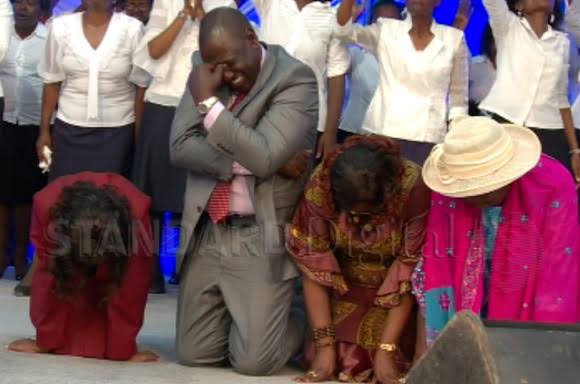
Yet every Sunday, you will see the First Family in church,
kneeling, praying, crying,
fully aware of the pain they are causing Kenyan families.
My people, this is why 2027 is not just another election.
It is survival. It is justice. It is memory.
We must remember.
The revelation by New York Times that Ruto’s wife and daughter are the owners of the largest agency exporting Kenyans to UAE and larger Asia, where they are abused, misused, and sometimes killed, doesn’t come as surprise some of us.
Following up on an issue about 3 Kenyan girls killed in UAE and those Kenyans who were rescued from Myanmar, the agency linked to the First Family was mentioned many times.
This agency is whispered to be working with known human trafficking gangs from places like Nigeria, Dubai, wider Asia, etc to lure Kenyans looking for employment opportunities, with fake jobs before they are trafficked and used as scammers.
The sad part is that as the President and his family continue to make profits out these desperate Kenyans looking for jobs, those they trafficked continue to suffer with some being killed.
I’ve just read that Washington Post exposé, and let me speak plainly:
What you've read there is just 20% of what the family is doing
The First Family is running a business empire, not a government.
Exporting Kenyans to the Gulf is just one of their profit streams.
Let me remind you:
99% of this regime’s programs are engineered to enrich the First Family and their inner circle . Not you .
Look closely:
- Affordable Housing, land grabs disguised as shelter, world bank loans
- SHA/SHIF, a health tax funneling billions to private pockets.
- Food imports, cartels thrive, farmers starve
- Foreign jobs, our youth sold off like commodities.
- CBC
Each one hides a pipeline, a quiet flow of money upward.
Those of us who’ve seen the documents, heard the briefings, spoken to insiders, we know this pattern too well.
Nothing here is an accident. Nothing here is "development." It’s a system.
And listen closely:
When a government turns its youth into an export product
When it profits from your sweat, your tears, your daughters’ suffering abroad
That is not leadership. That is exploitation. At a national scale.
My people, this government must go, not out of politics,
but out of humanity.
Why Singapore Rose and Kenya Stagnated: Kenyatta’s Greed vs Lee Kuan Yew’s Vision..
Kenya and Singapore started their journeys at the same time, but their destinies couldn’t be more different. Kenya had more land, more resources and more economic potential, yet Singapore is the one that rose.
In this video, we break down the leadership choices that shaped both countries, how Jomo Kenyatta protected networks and corruption took root, while Lee Kuan Yew enforced discipline, built strong institutions and set Singapore on a path of growth.
Full video here…https://t.co/MTyqav0TVr
11 dead and hundreds arrested in Kenya’s anti-government protests, police says
https://t.co/HoBB13b4wo
The GoK is at war with the Kenyan population.
💔💔💔💔💔💔💔💔💔💔💔
Kenyan youth have high civic awareness than most of their contemporaries in East Africa. Listen to this protestor from Kisumu. "They had 12 months of uninterupted grace. They had time, power, resources and the people's mandate. Instead of leadership, they invested in silence..."