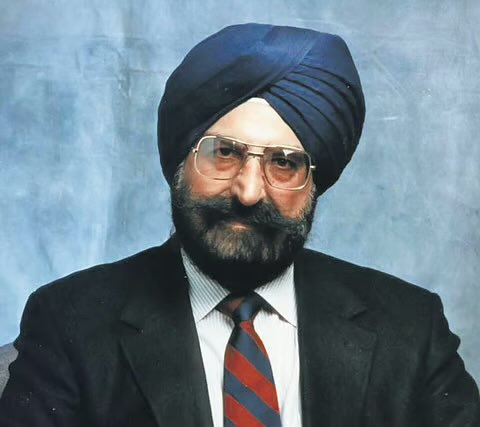
A teacher in Dehradun told his class that light travels only in straight lines.
One boy in that room spent the next forty years bending it, and the internet now runs on what he built.
His name was Narinder Singh Kapany.
Born in Moga, Punjab in 1926. Schooled in Dehradun, graduated from Agra University, worked as an officer in the Indian Ordnance Factories. In 1952 he went to Imperial College London.
There, with a professor named Harold Hopkins, he bundled thin strands of glass together and transmitted a clear image through them. Around corners. Along bends. Nobody had done it before.
That is fibre optics. Undersea internet cables, endoscopy, laser surgery. He gave the field its name in a 1960 article in Scientific American.
Nehru wanted him back in India as scientific adviser to the defence ministry. He went to America instead. Founded Optics Technology, took it public in 1967, held over a hundred patents, and became one of the first Indians to build a company on that scale in Silicon Valley.
In 2009 the Nobel Prize in Physics was awarded for the transmission of light through glass fibre. It went to Charles Kao, who had solved the problem of impurities in the glass swallowing the signal.
Kapany was not named.
Whether he should have shared it is still disputed by people who understand the physics. What is not disputed is that Fortune had already listed him among the seven unsung heroes of the twentieth century, ten years earlier.
He died in California in 2020, aged ninety four. India awarded him the Padma Vibhushan the following year.
Before you rush to criticise @Wangchuk66, first pause to earn the ethos of fasting for 26 days for a cause larger than yourself.
He lies in the ICU today, having lost 11 kg, including muscle mass, because he chose sacrifice over comfort. The least we can offer him is a day of compassion before burdening him with our own expectations and political calculations.
Not everyone is qualified to judge a life of selfless service. One must first earn the moral stature to do so.
Please..Have a heart.