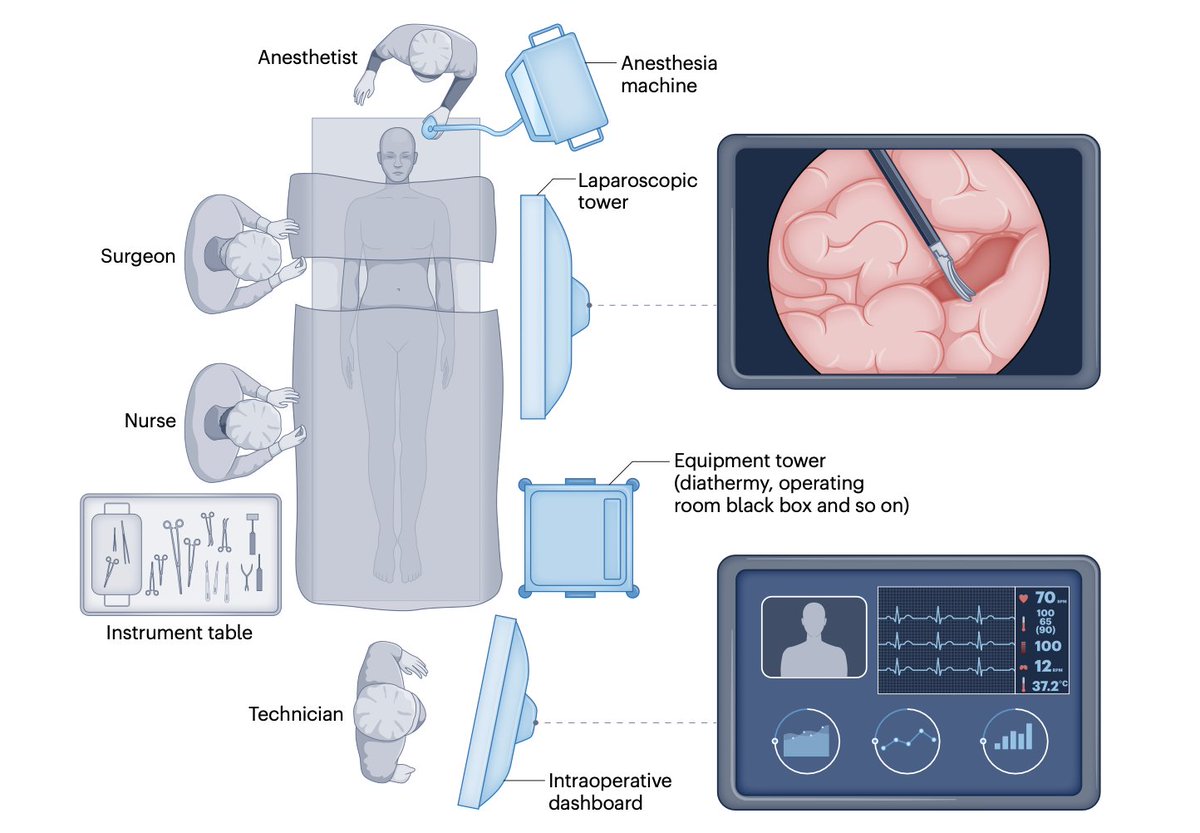
The OR is sensor-rich, yet data remain unsynchronized, unstructured, or discarded.
Our review argues that physical AI in surgery needs a Surgical Data Factory: a closed loop to capture, structure, and use operative data.
Surgeons must help build it.
https://t.co/t69AAUB59v
He taught machines to learn. He won a Turing Award. Now he says we're building AI all wrong.
"We want a path towards intelligence that isn't limited by human abilities."
In 71 minutes at MIT, Richard Sutton reveals what comes after the chatbot.
Self-taught + play + abstraction + superintelligence
Worth more than a year of AI roadmaps on your timeline
Progress in AI is driven by approaches that make weaker assumptions, which allows for better scaling
But representation learning has relied on strong assumptions like augmentations, masking, cropping, etc... until now!
🎬 Introducing Temporal Difference in Vision (TDV), a new paradigm for representation learning built on a single assumption: causality
TL;DR:
- We introduce TDV, the first approach to learn good representations without any augmentations, masking, cropping, or pixel-based reconstruction
- TDV matches SOTA recipes like DINO and iBOT on dense spatial tasks
- We show that as data scales, weaker assumptions work better
🧵Thread:
I'm pleased to share our recent publication in the Journal of Medical Internet Research (JMIR): "Large Language Model–Assisted Surgical Consent Forms in Non-English Language: Content Analysis and Readability Evaluation"
https://t.co/sem0BTKDAl
Introducing OFT—an Optimized Fine-Tuning recipe for VLAs!
Fine-tuning OpenVLA w/ OFT, we see:
-25-50x faster inference ⚡️
-SOTA 97.1% avg SR in LIBERO 💪
-high-freq control w/ 7B model on real bimanual robot
-outperforms π₀, RDT-1B, DiT Policy, MDT, Diffusion Policy, ACT
🧵👇
Our latest paper on "Human AI collaboration for unsupervised categorization of live surgical feedback" has arrived at Nature Digital Medicine @npjDigitalMed
Led by our postdoc @RKocielnik@caltech this paper explores how live surgical feedback in the OR can be evaluated by AI and humans to best predict when meaningful change will occur by the training surgeon.
Open access here:
https://t.co/TLGLp3o7dh
Funded by @theNCI
Collaboration with @AnimaAnandkumar
It was an honor to present at CLINICCAI during my first-ever MICCAI conference. I shared our work on developing an AI-based navigation system for enhancing liver surgery safety.
#MICCAI2024#CLINICCAI#AIinSurgery
This journey has been a proof of the power of dedication and continuous learning. We hope that our research will help advance the field of surgical AI and ultimately improve patient outcomes.
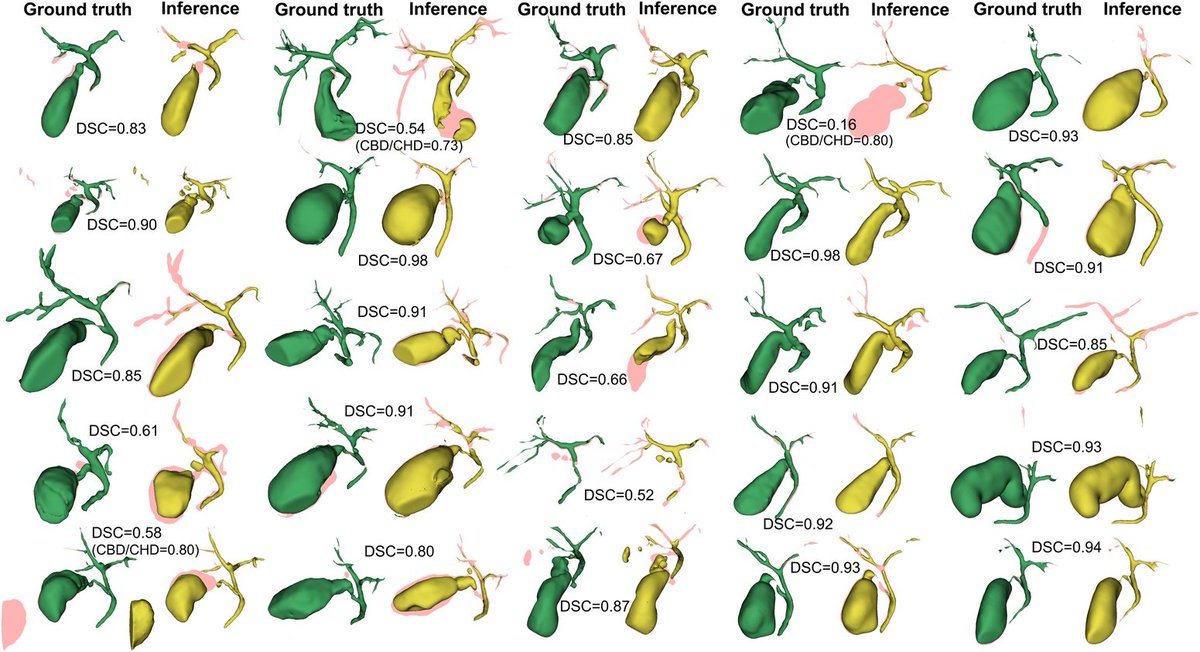
I'm happy to announce our research team's latest paper, 'Real-time segmentation of biliary structure in pure laparoscopic donor hepatectomy', has been published in Scientific Reports (https://t.co/kheKmUIcdQ).
Data preprocessing was not easy, and annotation took countless hours. The subsequent training of the segmentation model also involved many trials and errors.
Super excited to introduce SAM2 Studio! 🚀🤖
I've been getting a lot of questions lately on supporting AI inference tailored for patient data and sensitive workflows.
We optimized SAM2 to run completely on-device in real time for all of your medical segmentation workflows - including surgical video segmentation, radiographs, pathology slides and more!
We announced MedVersa, a generalist AI that excels in multifaceted medical image interpretation! 🚀🩺
👉https://t.co/AnibKW0rdO
MedVersa has two promising features🧐:
1. Learning from vision and language supervision. This maximizes the flexibility of the framework. Imagine combining the SAM and CLIP into a unified model and the mutual benefits it will bring!🤪
2. Leveraging existing modules/tools. MedVersa functions the LLM as a TRAINABLE orchestrator. This design features a notable level of extensibility, allowing integration with advanced modules/tools.🤩
A great journey with @subathraadithan and @jn_acosta
, led by @EricTopol and @pranavrajpurkar
Stay tuned for more updates!👀
#artificiallyinteligence
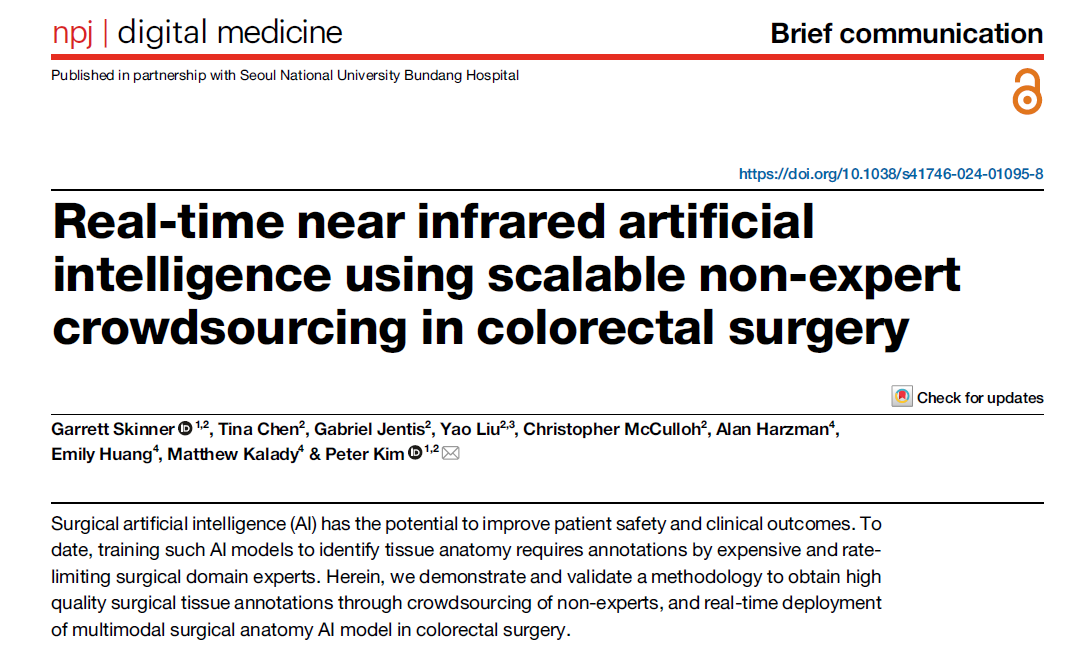
A crowdsourcing approach to obtain high-quality tissue annotations, bypassing the need for costly expert input is presented in this article. With real-time deployment, this multimodal #AI model promises safer and more efficient #colorectal surgery.
https://t.co/WIyibDWIi5
My colleagues and I believe deep learning can improve clinical outcomes for patients. These 3D automated segmentations provide a better understanding of biliary anatomy, and meticulous bile duct division can lead to better outcomes. @IJSurgery