Just heard about incident at a data heavy startup where one of the ML engineers introduced a computation bug that cost them $250K in AWS invoice in a single day! 😮
Satya’s take on the "cognitive loop" is a must-read for the new economy. But instead of just reading about it, we put it to the test.
We ran his piece through Simi, and it one-shotted the entire thesis into a perfect explainer video instantly.
This is exactly what compounding human and token capital looks like in practice. The fastest way to turn dense strategy into scalable media.
Today we're launching the new Activity explorer on OpenRouter.
It's the best way to see how much and your team are spending on every model, along with tokens, cache hit rate, agents, & trends. All updated in real time.
See how our team is using Fable and other models 👇
Here are sone other patterns I’m seeing that are using AI across entire customer journey:
Product Discovery: AI agents are now scanning millions of product reviews, social mentions, and search trends to predict what customers want before they know it themselves. One retailer I spoke with increased conversions by 40% just by using AI to surface the right products at the right time.
Dynamic Pricing: Gone are the days of static price tags. AI is analyzing competitor pricing, inventory levels, demand patterns, and customer behavior in real-time. Some e-commerce sites are updating prices thousands of times per day.
Fraud Detection: Traditional rule-based systems caught maybe 50-60% of fraudulent transactions. Modern AI systems are hitting 85%+ accuracy while reducing false positives that frustrate legitimate customers.
Payment Optimization: AI is figuring out which payment method to suggest to each customer, when to retry failed payments, and how to route transactions for the lowest fees and highest success rates.
Customer Support: Payment issues used to require human agents. Now AI can resolve 80% of payment disputes, refund requests, and billing questions without human intervention.
The companies moving fast on this are seeing dramatic improvements in conversion rates, customer satisfaction, and operational efficiency.
The ones waiting will be falling behind quickly.
I built my first Agentic Commerce startup before LLMs existed at scale.
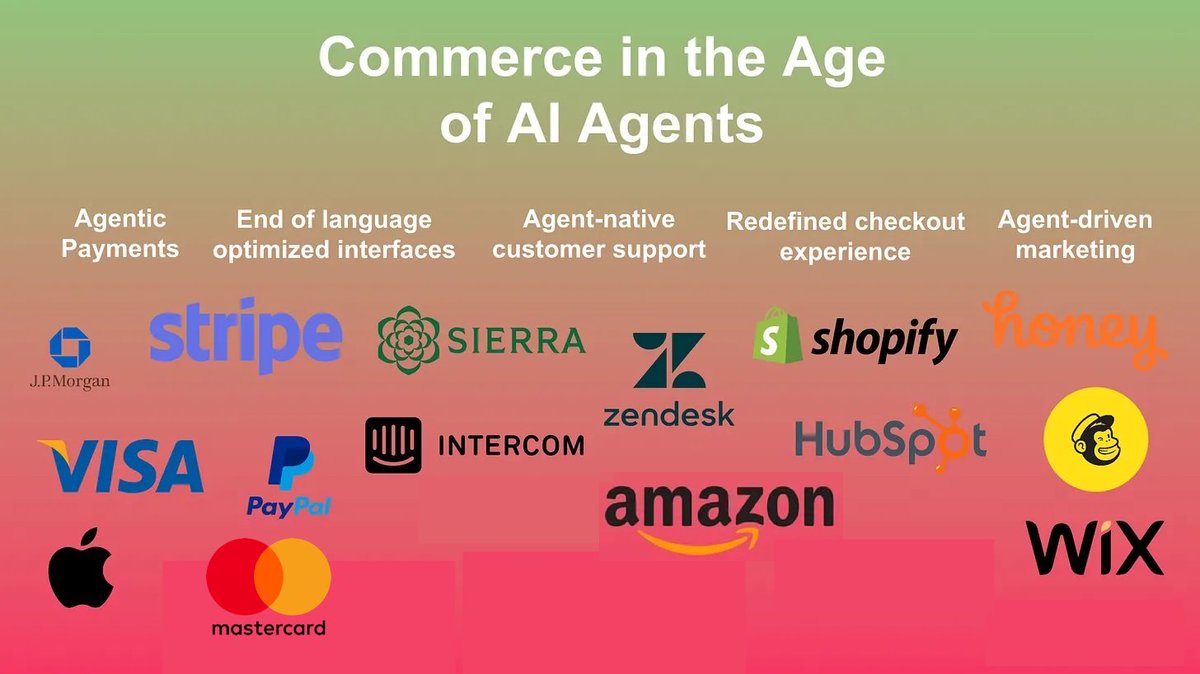
I’ve been tracking the agentic commerce & payments space closely now and there's some interesting stuff happening right now.
The big players are going in different directions. Shopify is doubling down on their Sidekick AI for merchant automation. Amazon is quietly building out their fulfillment agents behind the scenes. And then you have newer companies focusing specifically on customer service automation for e-commerce.
But here's what I'm seeing as the real trend: it's not just about chatbots anymore. The companies that are winning are building agents that can actually take actions - process returns, update inventory, coordinate with suppliers, even make purchasing decisions within set parameters.
I'm seeing three main categories emerging:
1) Customer service agents that can actually resolve issues (not just answer questions)
2) Inventory management agents that predict and auto-reorder stock
3) Marketing agents that can adjust campaigns based on real-time performance data
Congrats @benhylak and @raindrop_ai team for this incredible launch of must-have monitoring platform for every AI product! 🚀
Check out their lightening lesson to learn more! https://t.co/z6pFaEI37d
AI products fail constantly—in ways both hilarious and terrifying.
Regular software throws exceptions. But AI products fail silently.
Meet @raindrop_ai : the first Sentry-like monitoring platform for AI products.
AI products fail constantly—in ways both hilarious and terrifying.
Regular software throws exceptions. But AI products fail silently.
Meet @raindrop_ai : the first Sentry-like monitoring platform for AI products.
Are Stablecoins the key to modern financial systems?
Stablecoins represent a game changing infrastructure for global finance with applications ranging from cross border payments to corporate treasury management.
1/ Unparalleled Efficiency: Stablecoins reduce cross-border transaction fees by up to 99% slashing costs for businesses handling global payments and settlement times in less than 5 minutes on average compared to traditional banking's 2-5 days.
2/ Real-World Applications: Stablecoin transactions now power big real world use cases such as remittances and international trade that are faster and cheaper for consumers and businesses.
3/ Growing Institutional Trust: Traditional financial institutions now hold more than 3x from just a year ago, stablecoin reserves. This trend reflects growing confidence in stablecoins as a secure and stable asset class.
Ofcourse there are still challenges from regulatory hurdles to technical complexity and market concentration risks but the future of stablecoins looks very promising. #FintechThoughts #stablecoin
Some people today are discouraging others from learning programming on the grounds AI will automate it. This advice will be seen as some of the worst career advice ever given. I disagree with the Turing Award and Nobel prize winner who wrote, “It is far more likely that the programming occupation will become extinct [...] than that it will become all-powerful. More and more, computers will program themselves.” Statements discouraging people from learning to code are harmful!
In the 1960s, when programming moved from punchcards (where a programmer had to laboriously make holes in physical cards to write code character by character) to keyboards with terminals, programming became easier. And that made it a better time than before to begin programming. Yet it was in this era that Nobel laureate Herb Simon wrote the words quoted in the first paragraph. Today’s arguments not to learn to code continue to echo his comment.
As coding becomes easier, more people should code, not fewer!
Over the past few decades, as programming has moved from assembly language to higher-level languages like C, from desktop to cloud, from raw text editors to IDEs to AI assisted coding where sometimes one barely even looks at the generated code (which some coders recently started to call vibe coding), it is getting easier with each step.
I wrote previously that I see tech-savvy people coordinating AI tools to move toward being 10x professionals — individuals who have 10 times the impact of the average person in their field. I am increasingly convinced that the best way for many people to accomplish this is not to be just consumers of AI applications, but to learn enough coding to use AI-assisted coding tools effectively.
One question I’m asked most often is what someone should do who is worried about job displacement by AI. My answer is: Learn about AI and take control of it, because one of the most important skills in the future will be the ability to tell a computer exactly what you want, so it can do that for you. Coding (or getting AI to code for you) is a great way to do that.
When I was working on the course Generative AI for Everyone and needed to generate AI artwork for the background images, I worked with a collaborator who had studied art history and knew the language of art. He prompted Midjourney with terminology based on the historical style, palette, artist inspiration and so on — using the language of art — to get the result he wanted. I didn’t know this language, and my paltry attempts at prompting could not deliver as effective a result.
Similarly, scientists, analysts, marketers, recruiters, and people of a wide range of professions who understand the language of software through their knowledge of coding can tell an LLM or an AI-enabled IDE what they want much more precisely, and get much better results. As these tools are continuing to make coding easier, this is the best time yet to learn to code, to learn the language of software, and learn to make computers do exactly what you want them to do.
[Original text: https://t.co/HdI3Jb9HmF ]
Generative AI agents are the future.
@Google 's recent white paper on AI Agents dives deep into this. Here are some takeaways:
1️⃣ Agents vs. Models
These agents extend the capabilities of foundational language models (LLMs). They interact with the real world through tools and APIs, making them more versatile.
2️⃣ Cognitive Architectures
Agents use cognitive architectures to enable reasoning, planning, and decision-making. The orchestration layer is crucial here, managing these processes.
3️⃣ Tools
Various tools that empower agents:
- Extensions: These bridge the gap between agents and APIs, allowing seamless execution of API calls.
- Functions: These give developers fine-grained control over data flow and execution.
- Data Stores: These enable agents to access real-time information and leverage external data sources.
4️⃣ Targeted Learning
To enhance model performance in specific tasks, here are the key strategies:
- In-context learning
- Retrieval-based in-context learning
- Fine-tuning based learning
Key Insights:
🤖 Foundational models, despite their impressive text and image generation, remain constrained by their inability to interact with the outside world. Tools bridge this gap, empowering agents to interact with external data and services while unlocking a wider range of actions beyond that of the underlying model alone.
🤖 By combining LLMs with cognitive architectures, tools, and targeted learning techniques, agents can interact with the real world, solve complex problems, and drive significant value across various industries.
#AI #GenerativeAI #LLMs
We're underutilizing AI in banking.
Banks can process transactions efficiently but struggles to offer personalized services.
These 18 strategies (2025 roadmap) should be implemented in all banks:
AI-Powered Customer Service
↪ Enhances customer interactions with quick responses.
Fraud Detection
↪ AI can identify suspicious activities in real-time.
Automated Loan Processing
↪ Speeds up loan approval and reduces errors.
Personalized Financial Advice
↪ AI tailors advice based on customer data.
Predictive Analytics
↪ Helps in forecasting market trends and customer needs.
Chatbots
↪ Provides 24/7 customer support and service.
Risk Management
↪ AI assesses and mitigates potential risks effectively.
Customer Segmentation
↪ Automation helps in categorizing customers for targeted services.
Automated Compliance
↪ Ensures adherence to regulations with minimal human intervention.
Data Analysis
↪ AI processes large data sets for better decision-making.
Virtual Financial Assistants
↪ Offers personalized assistance to customers.
Credit Scoring
↪ AI provides accurate and unbiased credit assessments.
Transaction Monitoring
↪ Keeps track of all transactions to prevent fraud.
Customer Feedback Analysis
↪ AI analyzes feedback to improve services.
Investment Management
↪ Automated tools help in managing investment portfolios.
Loan Underwriting
↪ AI streamlines the underwriting process for efficiency.
Customer Retention
↪ Predictive models help in retaining valuable customers.
Operational Efficiency
↪ Automation reduces costs and improves overall efficiency.
This is future-proofing banks for a world that's constantly evolving.
#Banking #AI #Fintech
Building effective agents is crucial for AI development.
It's beyond coding algorithms.
It's about creating adaptable and intelligent systems.
Done right, it improves performance, reliability & user satisfaction.
☑ What are Agents?
Agents are fully autonomous systems that operate independently over extended periods, using various tools to accomplish complex tasks. At a high level, there are 2 types of Agentic systems for architectural differences.
1. Workflows are systems where LLMs and tools are orchestrated through predefined code paths.
2. Agents are systems where LLMs dynamically direct their own processes and tool usage, maintaining control over how they accomplish tasks.
☑ Key Principles of Effective Agents
1. Clear Objectives
Ex: Define specific tasks for the agent to accomplish.
2. Robust Learning Mechanisms
Implement methods for continuous learning and adaptation.
3. User-Centric Design
Design agents that prioritize user needs and feedback.
4. Ethical Considerations
Ensure agents operate within ethical boundaries and guidelines.
5. Scalability
Create systems that can grow and adapt with increased demands.
☑ Strategies for Implementation
→ Define Objectives
Tasks must be clear and aligned with the agent's purpose.
Ex: Automating customer support queries.
→ Incorporate Learning
Agents should learn from interactions and improve over time.
Ex: Using machine learning to enhance responses.
→ Focus on User Experience
Agents must be intuitive and user-friendly.
Ex: Simple and effective user interfaces.
→ Adhere to Ethics
Ensure transparency and fairness in agent interactions.
Ex: Avoiding biased decision-making processes.
→ Plan for Growth
Agents should be designed to handle future challenges.
Ex: Scalable architecture for increasing data loads.
Here is great article to deep dive on building effective agents by @AnthropicAI : https://t.co/IS455Sbnxq
#Agents #AI