If you’re working with Claude Code, you’ll probably run into similar problems. Claudespace is open source—feel free to fork it, tweak it, or drop a PR.
Read more: https://t.co/ECyYbZGTxi
Repo: https://t.co/1JIuwPSVj3
We’ve been using Claude Code at @operatordotxyz as our primary coding agent. We found its CLI-first design, and no-fluff communication to be the best.
But as our usage grew, we ran into issues trying to run it alongside our local dev flow: conflicting checkouts, shared state, single-instance limits. So we vibe coded Claudespace, a CLI tool for spinning up isolated Claude Code instances locally using git worktrees, remapped ports, and scoped envs.
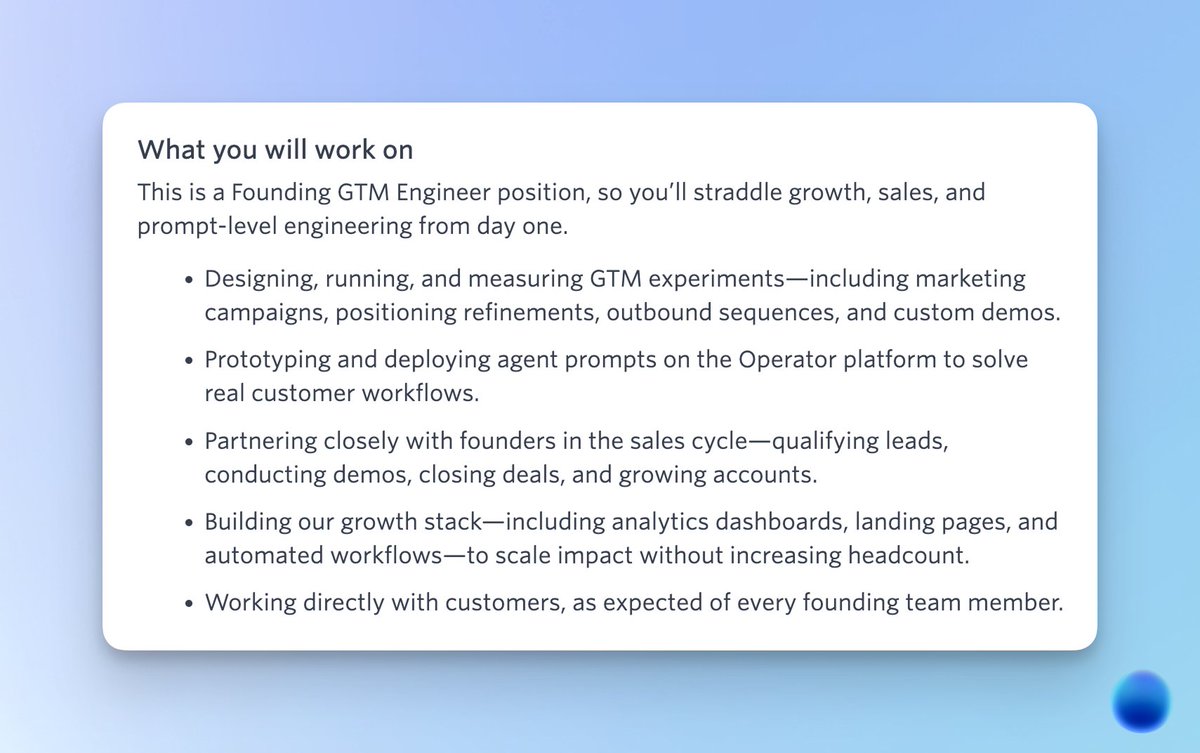
We’re growing @operatordotxyz and hiring for a GTM role. If you love talking to customers, shipping fast, and believe AI will reshape how businesses operate—we’d love to chat!
We are hiring our first non-eng teammate to work with me on GTM at @operatordotxyz.
- team is all staff-level engineers from @stripe, @figma, @coinbase , @pipe
- great product and a growing base of initial customers
- opportunity to build out the GTM function almost from scratch
Looking for an ambitious generalist who's excited to join a small team and get their hands dirty.
plz share with relevant folks or reach out:
[email protected], dm's open
We just shipped Warm Transfers.
No repetition. No confusion. No wasted time.
Everyone hates being transferred between different customer support agents and having to repeat themselves. It’s one of the fastest ways to erode trust, and one of the biggest sources of wasted time in customer service.
Most AI agent systems treat escalation as a failure path—dropping the customer on a human with no context and hoping for the best.
With Warm Transfers, we do it differently. Our AI agent briefs the human agent before the handoff, so they know exactly what’s going on and can pick up without missing a beat.
It’s a small product detail that unlocks a much better customer experience—and makes it easier for companies to trust AI agents with more of the front line.
No one likes IVRs. Most callers instantly press 0—because robotic menus are frustrating, not useful.
Good news: We can help you ditch your IVR and replace it with an AI frontline agent that actually helps customers.
"How do we get started with AI?" is the question we keep hearing from heads of support and operations. The space is so full of noise and flashy demos, that it makes it hard to figure out what will actually work in production.
We believe that a good pragmatic approach allows teams to take advantage of today's capabilities now and sets them up with the right foundations to keep compounding on top of as AI models get better.
We wrote up a guide describing an approach that we have found to be particularly effective when it comes to phone based operations and support.
Link in comments ⤵︎
Excited to announce our first product: Operator.
Operator helps fast-growing companies scale their phone support with AI agents.
Our goal is simple: build the world's top support agent and put it within reach of every company.
As companies scale, phone support becomes impossible to do well. You either compromise on quality or watch costs spiral out of control—usually both.
The numbers tell the story:
• 900m minutes wasted on hold each year
• $50b+ spent on subpar, complex call center operations
• 3-4 month lead time required for demand planning
• 3+ teams needed for global coverage
We spent a year working closely with design partners to get this right. Operator is not another voice bot—it's an AI agent purpose-built for support, handling thousands of real customer calls today.
Operator picks up instantly. Understands context deeply. Maintains quality at any scale. And gets better every day.