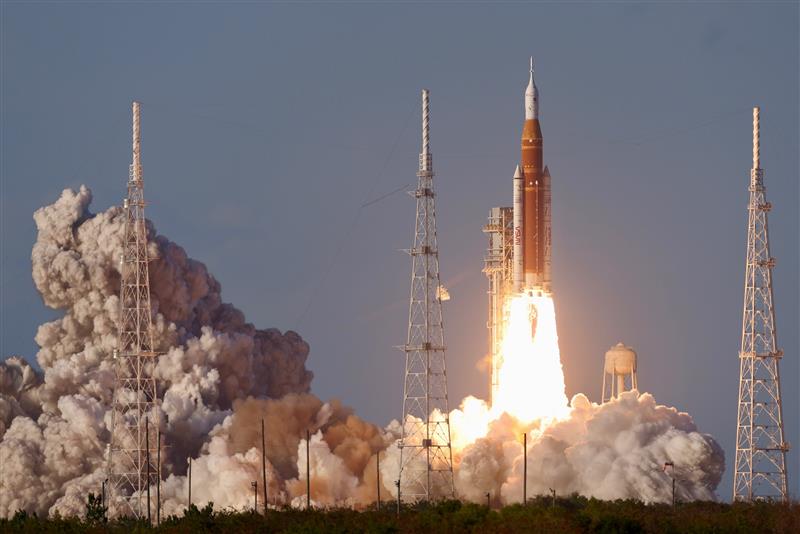
For the first time in over 50 years, humans are Moonbound.
At 6:35 p.m. EDT (2235 UTC) NASA’s Space Launch System rocket and the Orion spacecraft lifted off from the agency’s Kennedy Space Center in Florida, sending four astronauts on a planned test flight around the Moon and back. https://t.co/0Q9ZB4IWVI
Liftoff.
The Artemis II mission launched from @NASAKennedy at 6:35pm ET (2235 UTC), propelling four astronauts on a journey around the Moon.
Artemis II will pave the way for future Moon landings, as well as the next giant leap — astronauts on Mars.
Christian Potiszil (Okayama University) talked about organic matter in Ryugu and how different ratios of unsaturated and saturated carbons point to different types of processing.
#AGU22#SciConSketch
I'm only at #AGU22 for the day, so I spent the morning hearing about carbon in the solar system. First, Eri Tatsumi (U of Tokyo) talked about the carbonaceous asteroid Ryugu and what it can tell us about solar system history via samples collected by @haya2e_jaxa#SciConSketch
Tuesday, May 6, 2025. In case you are wondering what the weather is like in the mountains around Tucson, Arizona today. 30° and light rain and snow on Mt. Lemmon.
Then and now. Before leaving Flagstaff, I paid my first visit to the Cinder Lakes Crater Fields - an artificial field of craters produced for #Apollo astronaut training. Pictured are Jack Schmitt & Gene Cernan in 1972 and us yesterday! #Artemis#geology#ToTheMoon
Did you know ASU students have access to museums, parks and more through @act1az and @ASULibraries’ Culture Pass program? 📚 🌳 🗺
📸: @ASULibraries
Learn more: https://t.co/rfyts7QdiM
ASU students set up a huge gems and fossils booth every month in front of my office building 😳 I just can't help myself—I end up buying several pieces each time! 🤪
Today we hiked Sabino Canyon Creek on Mt Lemmon where it begins (right behind Ski Valley at 9,000 feet). We came down this afternoon and hiked Sabino Canyon hiking trail (around 2,500 feet) where all the snow melt ends up. Absolutely amazing Tucson, Arizona.
A huge thank you to Assoc. Prof. Steve Kortenkamp (@UArizonaLPL) for sharing these planetary surface models! 🌍🔬 can’t wait to incorporate them into the Planetary Science (undergrad) and Planetary Surface Processes (graduate) courses at Kasetsart University, Thailand.
Single thick dusty layers may be differentiated from multiple thin dusty layers based on power returned from the lower reflector. #MaterialAnalogs#LPSC2025 WTB5 Abst. 2061
With Lucy Thompson, Senior Research Scientist at the University of New Brunswick, Canada, who is my advisor’s colleague, after meeting Prof. John Spray—my advisor’s advisor—in 2023.
Presented my work on Mars simulant last night at #LPSC2025.
@EliDjomekou Thanks,@EliDjomekou! I really appreciate your hard work in keeping the session updates coming. Because of you, I was able to keep track of other sessions in different rooms! #LPSC2025
Eruptive conditions led to large variation in crystallinity of chemically similar watershed rocks and generated sediment. #Mars#LPSC2025 WTB6 Abst. 2123