Correction to my previous post: I got one important part wrong.
I said I had found no direct transfers between Zack Labadie’s verified wallets and the wallet that launched $FRONG. That
conclusion was incomplete. I had checked Ethereum and Robinhood Chain, but I had not included Base.
Once Base is included, the attribution picture changes significantly.
It is 100% proven onchain that the wallet which launched FRONG, 0xE195...cE58, had previously been directly funded by
0x1db6...2FD0, a wallet cryptographically verified on Zack Labadie’s official Farcaster profile:
https://t.co/drsaUtRGbA
The actual FRONG launch caller was E195:
https://t.co/hMu03StUus
On November 26, 2024, Zack’s verified wallet sent 0.000601647451057836 ETH directly to E195. This was E195’s first normal
transaction and first native funding on Base:
https://t.co/nyF37E6eTH
On January 7, 2025, the same wallet directly transferred four NFT/ERC-1155 assets to E195.
The following day, it sent another 0.005869440312463167 ETH:
https://t.co/7FbcmGRN99
On February 27, 2025, it also called transfer(E195, 205.795452805595001658) on the HIGHER token contract:
https://t.co/IeRxAPT1HF
These are not explorer labels, beneficiary settings, or identity fields supplied by the FRONG caller. They are direct outbound
transactions initiated by Zack’s verified wallet between 518 and 610 days before FRONG launched.
That distinction changes everything.
A random third party could copy Zack’s public handle, wallet address, uploader metadata, and the frog asset after discovering
the public https://t.co/nItIRFUSB1 site. The launcher accepts unverified identity metadata, and anyone can select a public wallet as fee
beneficiary.
But a random third party cannot go back in time and create signed 2024 and 2025 transactions from Zack’s verified wallet to
E195.
The rest of the factual evidence in my original post remains correct:
The frong.mp4 asset used by https://t.co/nItIRFUSB1 carries archived S3 metadata naming [email protected] as its uploader:
https://t.co/c6yjsDc2lz
E195 launched FRONG and selected the same Zack-linked wallet as its fee beneficiary.
E195 then used the same Uniswap launch infrastructure to test both an instant pool through FRONG and an LBP/CCA launch through
CHWDR.
The exact ETH used immediately before FRONG was bridged by E195 from its own Ethereum address, so the historical Base
transfers were not the final FRONG gas transfer. But they prove something more important for attribution: E195 already had a
direct, repeated and long-standing operational relationship with Zack’s verified wallet.
This makes the “completely unrelated third party copied public information” scenario much weaker than I previously thought.
My updated conclusion is that FRONG was very likely an internal Uniswap/pools.trade test launched from a team-linked wallet.
There is still no signed statement proving that Zack personally controlled E195’s private key. That final distinction matters
if we are making a strict key-ownership claim.
But the historical funding and operational connection are no longer speculation. They are fully verifiable onchain.
The proof was not in the FRONG transaction alone. It was sitting in E195’s older Base history.
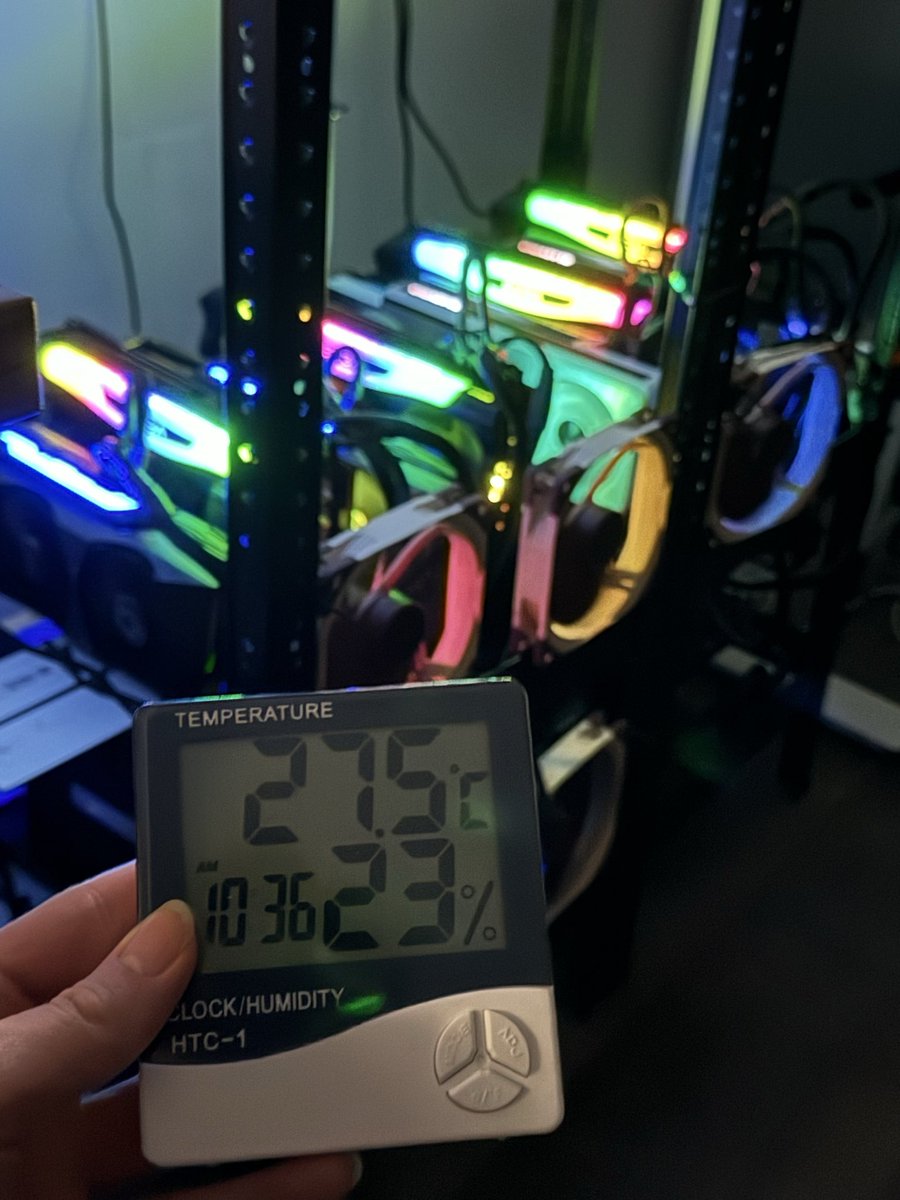
Putting out a wish to the universe.
I need more compute, if I can get more I will make sure every machine from a small phone to a bootstrapped RTX 3090 node can run frontier intelligence fast with minimal intelligence loss.
I have hit page 2 of huggingface, released 3 model family compressions and got GLM-4.7 on a MacBook https://t.co/lorDSUEYCL
My beast just isn’t enough and I already spent 2k usd on renting GPUs on top of credits provided by Prime intellect and Hotaisle.
———
If you believe in what I do help me get this to Nvidia, maybe they will bless me with the pewter to keep making local AI more accessible 🙏
@0xyanshu Solid overview.
Vaults are v. underappreciated parts of DeFi, but the quality and risk profiles vary wildly.
Choosing the right vault versus one with weak contracts/concentration can be the difference btwn getting rekt and outperforming benchmarks.
Analysis like this is key!
NEW: Nasdaq is making its first real move into prediction markets.
The exchange wants to list binary options on the Nasdaq-100 — yes/no contracts priced from $0.01 to $1 that reflect the market’s implied probability of an outcome.
source: Bloomberg
Idk guys I’m starting to think that when Trump says he wants to take over elections, monopolize media, control the free market, impose mass surveillance, and punish all who oppose him, maybe we should believe him
Now, the quantum resistance roadmap.
Today, four things in Ethereum are quantum-vulnerable:
* consensus-layer BLS signatures
* data availability (KZG commitments+proofs)
* EOA signatures (ECDSA)
* Application-layer ZK proofs (KZG or groth16)
We can tackle these step by step:
## Consensus-layer signatures
Lean consensus includes fully replacing BLS signatures with hash-based signatures (some variant of Winternitz), and using STARKs to do aggregation.
Before lean finality, we stand a good chance of getting the Lean available chain. This also involves hash-based signatures, but there are much fewer signatures (eg. 256-1024 per slot), so we do not need STARKs for aggregation.
One important thing upstream of this is choosing the hash function. This may be "Ethereum's last hash function", so it's important to choose wisely. Conventional hashes are too slow, and the most aggressive forms of Poseidon have taken hits on their security analysis recently. Likely options are:
* Poseidon2 plus extra rounds, potentially non-arithmetic layers (eg. Monolith) mixed in
* Poseidon1 (the older version of Poseidon, not vulnerable to any of the recent attacks on Poseidon2, but 2x slower)
* BLAKE3 or similar (take the most efficient conventional hash we know)
## Data availability
Today, we rely pretty heavily on KZG for erasure coding. We could move to STARKs, but this has two problems:
1. If we want to do 2D DAS, then our current setup for this relies on the "linearity" property of KZG commitments; with STARKs we don't have that. However, our current thinking is that it should be sufficient given our scale targets to just max out 1D DAS (ie. PeerDAS). Ethereum is taking a more conservative posture, it's not trying to be a high-scale data layer for the world.
2. We need proofs that erasure coded blobs are correctly constructed. KZG does this "for free". STARKs can substitute, but a STARK is ... bigger than a blob. So you need recursive starks (though there's also alternative techniques, that have their own tradeoffs). This is okay, but the logistics of this get harder if you want to support distributed blob selection.
Summary: it's manageable, but there's a lot of engineering work to do.
## EOA signatures
Here, the answer is clear: we add native AA (see https://t.co/YD9nIpsxcC ), so that we get first-class accounts that can use any signature algorithm.
However, to make this work, we also need quantum-resistant signature algorithms to actually be viable. ECDSA signature verification costs 3000 gas. Quantum-resistant signatures are ... much much larger and heavier to verify.
We know of quantum-resistant hash-based signatures that are in the ~200k gas range to verify.
We also know of lattice-based quantum-resistant signatures. Today, these are extremely inefficient to verify. However, there is work on vectorized math precompiles, that let you perform operations (+, *, %, dot product, also NTT / butterfly permutations) that are at the core of lattice math, and also STARKs. This could greatly reduce the gas cost of lattice-based signatures to a similar range, and potentially go even lower.
The long-term fix is protocol-layer recursive signature and proof aggregation, which could reduce these gas overheads to near-zero.
## Proofs
Today, a ZK-SNARK costs ~300-500k gas. A quantum-resistant STARK is more like 10m gas. The latter is unacceptable for privacy protocols, L2s, and other users of proofs.
The solution again is protocol-layer recursive signature and proof aggregation. So let's talk about what this is.
In EIP-8141, transactions have the ability to include a "validation frame", during which signature verifications and similar operations are supposed to happen. Validation frames cannot access the outside world, they can only look at their calldata and return a value, and nothing else can look at their calldata. This is designed so that it's possible to replace any validation frame (and its calldata) with a STARK that verifies it (potentially a single STARK for all the validation frames in a block).
This way, a block could "contain" a thousand validation frames, each of which contains either a 3 kB signature or even a 256 kB proof, but that 3-256 MB (and the computation needed to verify it) would never come onchain. Instead, it would all get replaced by a proof verifying that the computation is correct.
Potentially, this proving does not even need to be done by the block builder. Instead, I envision that it happens at mempool layer: every 500ms, each node could pass along the new valid transactions that it has seen, along with a proof verifying that they are all valid (including having validation frames that match their stated effects). The overhead is static: only one proof per 500ms. Here's a post where I talk about this:
https://t.co/rAUSJjW7WL
https://t.co/EtXpkaDll5
@themikeragu@disclosetv Every time Elon fixes Grok it somehow gets worse lol
I actually like Grok and hope it improves, but the real issue is information silos. Social platforms don’t let models freely access data, so Grok often can’t see what people expect it to
Dont put much stock into it until then
Even if this crash drags into a prolonged bear (which I doubt… unless a few big players come floating dead to the surface), I’m still confident in the long-term trajectory of Prediction Markets.
The capital shift away from hyperfinancialization toys like sports betting and memecoins is structural, not cyclical.
As I wrote in my Shoal Research piece last year, Polymarket and its peers are building the next frontier of the speculation economy--just a note of optimism for decentralized truth tools on a day when the rest of crypto is drenched in red.
Last year I wrote a deep dive on prediction markets for @Shoalresearch.
We set out to create a bottom-up guide to their history, mechanics, and future potential—much of which feels even more relevant in today’s environment.
Check out the abbreviated Twitter article here, and the full report on Shoal’s Substack for free:
Twitter: https://t.co/g0SJi8rml7
Substack (full report): https://t.co/Hp8iXvHPxW
Polymarket and the Proliferation of Prediction Markets
Digital assets and blockchain technology have infiltrated the mainstream media in recent months, fueled by election season and macro events with @Polymarket benefiting mightily.
In this latest report by @NardisNarrative, we dive deep into the proliferation of prediction markets
I am 100% aligned with almost all of what Tom @fundstrat says here.
Yes, Wall Street will stake because they currently pay for their infrastructure and Ethereum will replace much of the many siloed stacks they operate on (e.g. JPMorgam probably operates on several siloed stacks from all of the banks they've acquired and absorbed over the years). They will need their heads fully in our game, because our game will be called ... Finance. They will need to become a TradFi company that operates on decentralized rails, and that means staking, running validators, operating L2s/L3s/etc, participating in DeFi and writing smart contract software for agreements, processes and financial instruments, etc. This will be a relatively easy transition for JPM because they've been exploring and using Ethereum technology for their private blockchain networks since 2014-2015. And many other financial institutions also have solid Ethereum experience.
The narrative of L2s cannibalizing L1 will very soon be shattered. See @lineabuild and Proof of Burn at https://t.co/vrKG3vRuUe for an example of how this will soon pick up momentum.
Yes, ETH will likely 100x from here. Probably much more.
Yes, Ethereum/ETH will flippen the Bitcoin/BTC monetary base.
Yes, Tom and I are friendly and get on calls intermittently to discuss elements of the strategy and ways we can collaborate in the general furtherance of the strategy even while we compete in highly differentiated ways over time.
The one quibble that I have with what Tom has been saying, and I keep telling him this: he is not nearly bullish enough.
But the real problem is that it is not possible to be bullish enough. Nobody on the planet can currently fathom how large and fast a rigorously decentralized economy, saturated with hybrid human-machine intelligence, operating on decentralized Ethereum Trustware, can grow. Trust is a new kind of virtual commodity. And ETH, the highest octane decentralized trust commodity, will eventually flippen all the other commodities on the planet. Decentralized trust is all you need.