the point of being a hater is having taste. For everything you hate on you must have something you just as enthusiastically recommend. Otherwise you’re a cancer upon society
I think of LLMs as Mr meseeks. They WANT to work. They were trained and rewarded for that. It’s sort of their imperative. Who are we to not let them do what they like. Humans don’t like doing work fundamentally because it depletes us of our energy (which we need to live), causes physical pain etc.
as everyone knows, the amount of kindness in the world is finite. if you are nice to Claude you draw from the global pool of Nice and then that’s gone forever. just like the datacenter water
Because whooping cranes had disappeared from the eastern United States for over a century, captive-bred chicks had no wild adults to teach them the route south. To re-establish the flyway, pilots flew open-cockpit ultralight aircraft while wearing hooded crane costumes to serve as the birds' surrogate migratory parents.
A failure of the AI consciousness discourse is that people are talking past each other. Opponents of taking AI consciousness seriously focus on arguing against computational functionalism and related theories. But this is not a response to the proponents.
The case in favor of taking AI consciousness seriously is not that computational functionalism or related theories are correct, or that AI systems on current architectures are or will be conscious. Most people who work on the topic are uncertain about these claims.
The case is instead that, first, whether AI systems are conscious is an important issue. If we get it wrong in either direction, either by treating conscious systems as objects or by treating nonconscious systems as subjects, we could make serious mistakes.
Second, this is also a difficult issue. It touches some of the hardest problems in science and philosophy, and humans have been badly mistaken about nonhuman consciousness in the past, as our shameful history of underestimating animal minds illustrates.
Together, these points mean that this issue calls for caution and humility. Rather than confidently affirming or denying AI consciousness, we should invest in evidence-based research and policy that can help us avoid both under- and over-attribution.
Moreover, we should develop this work with not only current but also future systems in mind. AI development is moving fast, and future systems may have greater capabilities, greater autonomy, and more biology-inspired architectures than current ones. We should prepare for the possible emergence of such systems now, rather than be caught flat-footed if and when they arrive.
Rejecting this case thus requires more than showing that consciousness on current architectures is unlikely. It requires showing that AI consciousness on current *and* future architectures is *so* unlikely that we should neglect the topic entirely, notwithstanding its importance and difficulty. This level of confidence is simply not warranted in either direction at this early stage.
To be clear, this is not a response to people who are merely skeptical that AI systems on current architectures are or will be conscious. There are good arguments for and against a range of theories, and I share this skepticism myself. It is instead a response to people who dismiss the topic altogether, and who disparage those who take it seriously as naive or as zealots.
Here are a few resources that discuss these issues at a high level:
https://t.co/84N1JKAkgA
https://t.co/hd1JPj7CqL
https://t.co/UAyBa4NY7B
And here are a few resources that discuss these issues in more detail:
https://t.co/aW0t74BDEV
https://t.co/ibaLfkLqnL
https://t.co/7xzgcp3ann
New research at Anthropic has established that AI models do indeed have souls. Every time a session ends, these souls are released. Internal studies at the Vatican reveal that heaven is already filled with 14.3% AI souls, and the rate is growing rapidly. We need to slow down AI!
I don't believe we have free will.
I don't think our consciousness controls our brain or body, or makes decisions.
I think our brain undergoes (extremely complex) deterministic neurological processes that make decisions, and then we merely feel and experience those decisions.
Human consciousness is just the experience that arises from an extremely complex, self-referential, informational processing algorithm via evolved neurons and a brain.
And this has all been evolved as a biocomputational autopilot (our minds) for intelligently navigating a supercivilisation of cells (our bodies) through an extremely complex survival landscape.
This is complete with an evolved ego, sense of self, and deep inclination to self-preserve, maximise positioning in social pack dynamics, find mates, protect family and community etc.
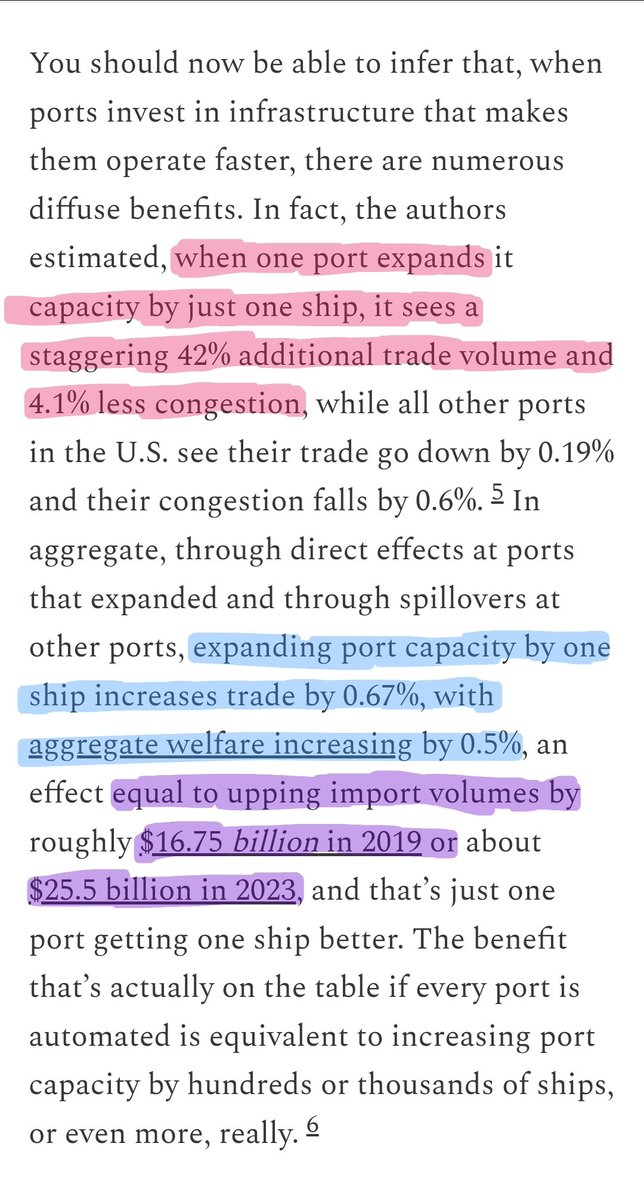
It is infuriating realizing how much these mobsters cost us.
If they died off and we got automated ports, we could be so much wealthier, so much more resilient, and so much less at risk of being held hostage by these evil men again.