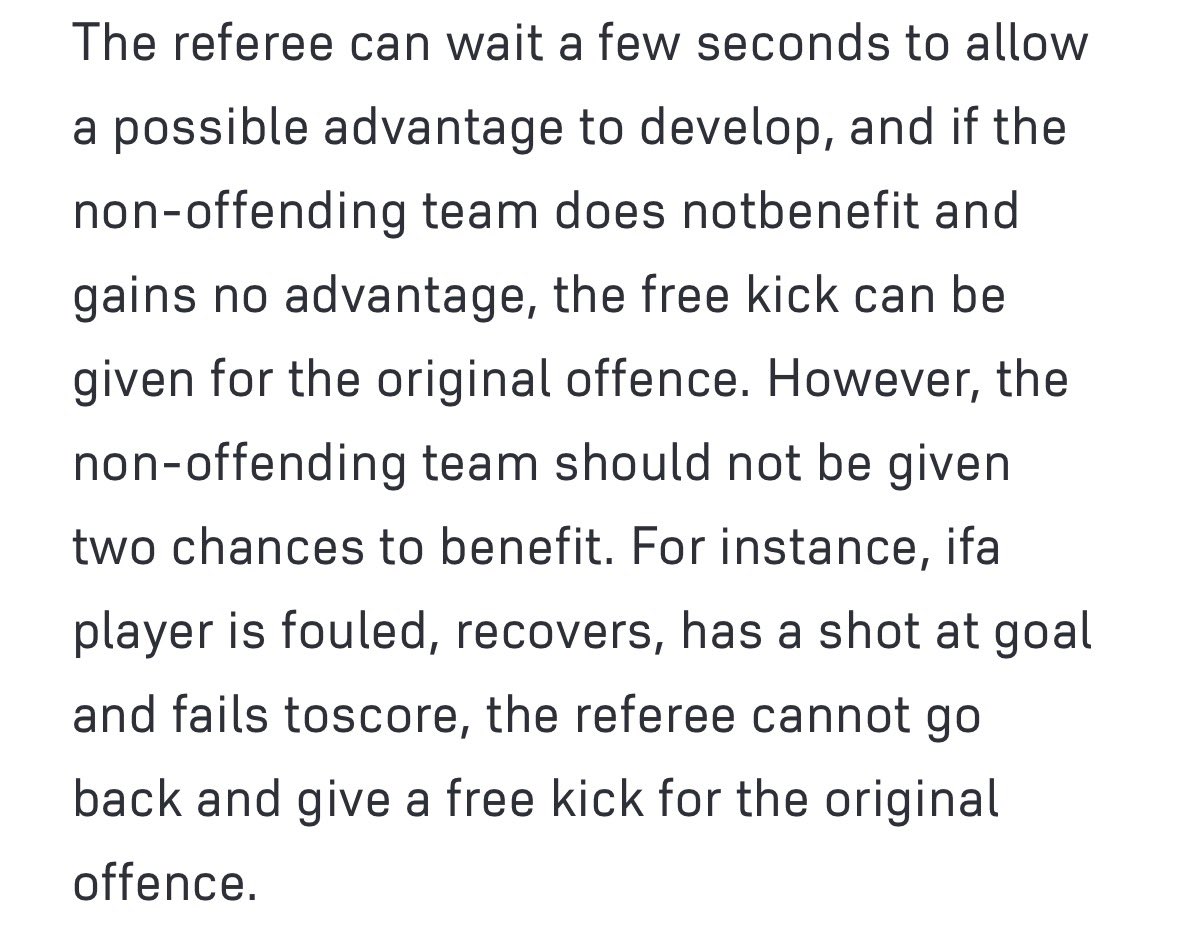
@mmMOUF@GregBenage@wwalsh It doesn’t matter if he doesn’t give the hand signal to confirm the advantage. If a shot occurs during the anticipated advantage, the opportunity to give advantage is over.
From IFAB directly: https://t.co/4iFoNls7bc
@mmMOUF@GregBenage@wwalsh The idea is to prevent double jeopardy/punishment for the defenders. If the attackers get fouled in the box, now they get a freeroll to score AND get a penalty if they miss. It’s too big of an advantage, so this rule is place. Same idea as DOGSO red in box -> yellow downgrade.
@mmMOUF@GregBenage@wwalsh Basically, if the foul was seen live, ref would’ve played advantage, allowed the shot, and been unable to call it back for a penalty once the chance was missed. This was explicitly the procedure when I was a certified ref.
But now, with VAR, it seems they just … ignore that?
@tombos21 Idk boss don’t ask us; why do you think we follow you?
Joke aside, isn’t there extreme ICM(-style?) pressure near landmark? E.g. you have 90k w/ 100k target, and a 50k stack jams. Odds to call = risk 50k to win 60k (50k call + only 10k additional if you win bc 100k max stack)
@tombos21@WSOP But isn’t there a temporal aspect to it? Meaning even if the skill edge is equal between an early reg and MLR, as long as it’s > 0% edge, the early reg gets to “compound” the edge over more hands. Then you’d expect their expected chip share to be > than a player that always MLR?
@tombos21@WSOP I would think bc the big $ is in podium places, we want to maximize odds of getting there, and the benefit of playing cEV for longer vs weaker players makes it much easier to get there than short-stacked MLR with heavy ICM. Obv I believe the data, but it’s not intuitive to me.
@tombos21@WSOP Can you help grok this wrt late reg: MTTs are top-heavy but min cash only results in a <= ~2x payout, on avg ~15% of the time. Edges are also smaller short, but say an elite pro who always MLR cashes ~25%. How is that > value of early reg and chipEV given the big $ is up top?
@tombos21 To me, the argument against it is actually less about “protecting recs” and more along the lines of we should be treating poker like a true mind-sport, incentivizing everyone to play to the best of their abilities at all times.