@just_be_dev@dillon_mulroy I love your observations, but I think I disagree on the plan part. We’re naturally moving towards specifying high-level intent and a way to verify work - building a common plan that an implementation might diverge from anyway, also feels suboptimal to review.
Spent years watching models ace a single image and completely whiff on anything that moves or changes angle. Today we’re fixing that.
Try Glimpse now, our first visual thinking model with competitive frontier performance compared to Astra on key public visual reasoning benchmarks.
“Do work that you’ll be proud of, I trust you.” is my new favorite way of working with agents. I’ve noticed agents check and critique their work a bit more when I say that.
Today we’re releasing Muse Spark Open, the most capable US open-weight model to date.
Built for coding and agentic work, it excels at long-horizon tasks, complex software engineering, and multi-step reasoning.
Key Model Specs:
→ 816B total / 42B active parameters
→ 1M token context window
→ Natively multimodal across text, image, video, audio
@housecor How do you even get “blocked” in the age of AI? You might be waiting on things, permissions for example, but being fully blocked should be debugged.
@poteto What do you think about comments carrying context that’s not obvious from the code itself? Such as an incident that led to a particular fix? That’s the only exception I have carved for the moment.
New on our Engineering blog: Creating in-house source control.
In May, we merged around 2,500 code changes per day. In September, we merged more than 30,000 per day. As a result, we became bottlenecked by developer infrastructure built for human (rather than agent) scale.
Here, we share how we built a new version control system—and fully migrated our monorepo from git—in five months: https://t.co/wzNkwHs7IN
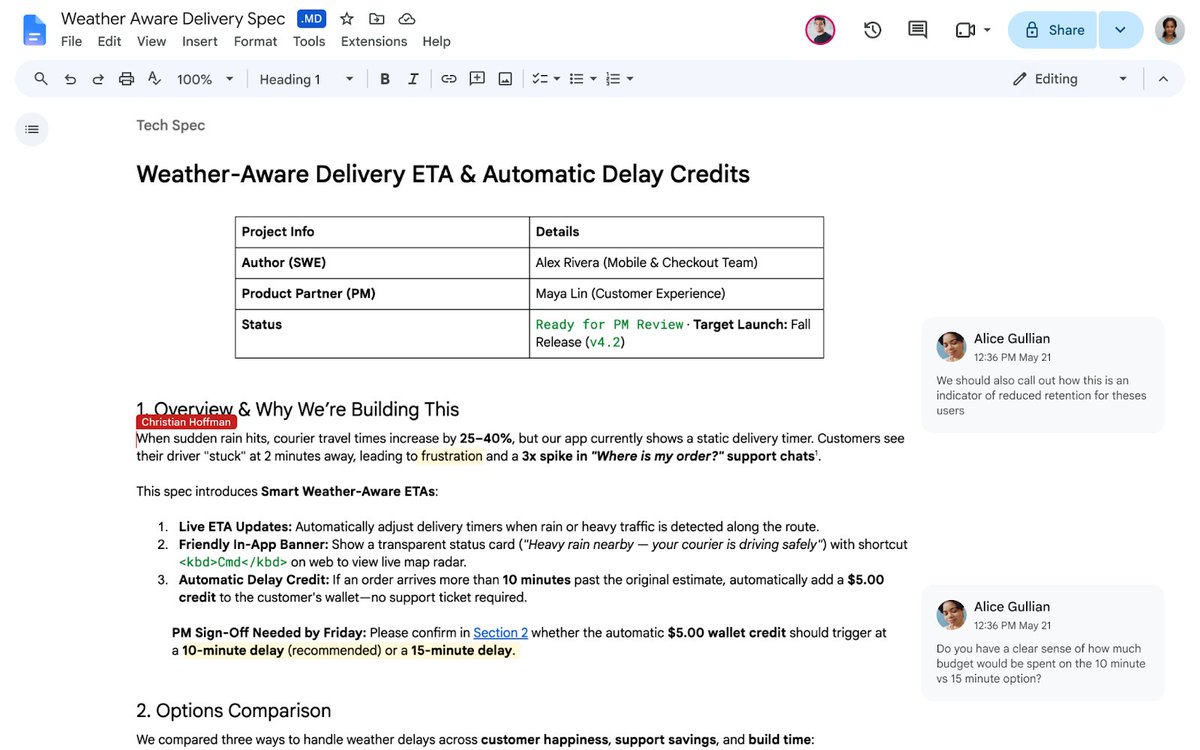
We are making Markdown files work natively across Google Drive and Docs.
You can now preview .md files in Drive, open them in Docs, edit them, comment on them, and collaborate without converting the file into a Google Doc!
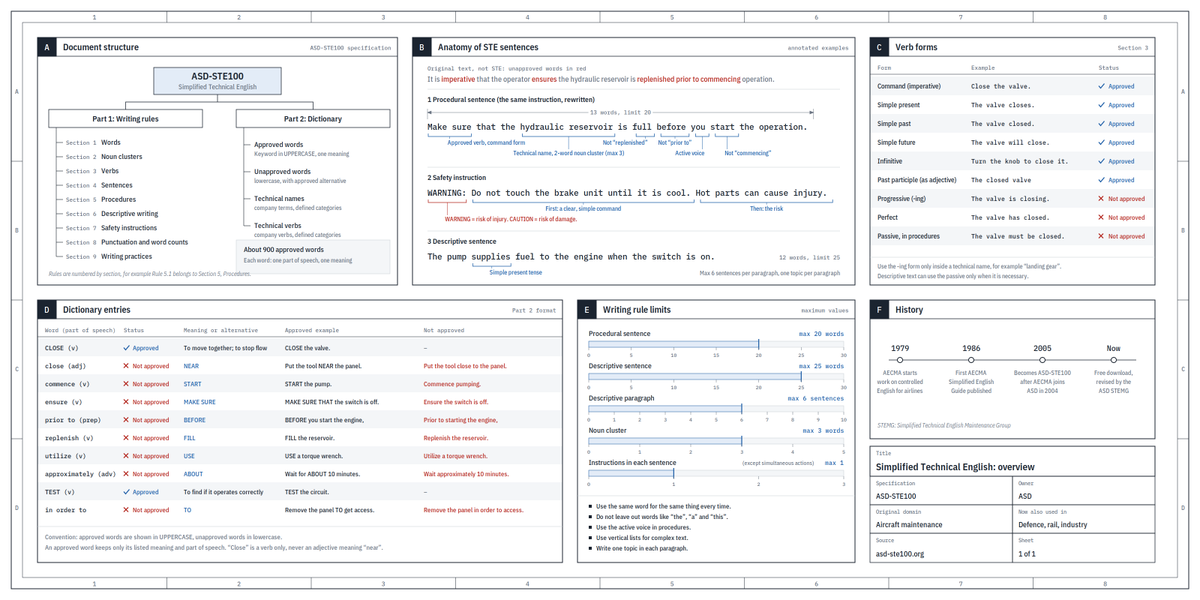
ASD-STE 100 works well, but there are more ways to control -
1. ELI5 - Explain Like I’m 5 - Works a treat if you want to clearly understand the outcome.
2. Use principles of “On Writing Well”, automatically primes AI to write far better prose.
Mix and match.
We'll be spending a lot more time trying to understand the outputs of language models. A few thoughts, tips & tricks:
Writing. Something I've had success with: Ask your LLM to explain something in ASD-STE100, it's a controlled language specification originally developed for aerospace maintenance documentation. LLMs well-versed in this language and it comes with heavy constraints on clean writing style that I often find a lot more readable. Sometimes I've tried to soften it a bit e.g. ask for "80% of the way to ASD-STE100" because the spec is quite stringent. But even better:
Diagrams / images. Instead of writing, ask your LLM to create a diagram. These can be a lot easier to process, parse, and understand. But even better:
Web pages. Ask for output "in HTML" to get a beautiful, interactive webpage. LLMs are getting really good at frontend and can create beautiful experiences, animations, etc. But even better:
Explainer videos. The output format I am most bullish on is fully custom / bespoke explainer videos generated on any arbitrary topic. Experiment with things like "Create a 3b1b style video explainer on X. Use my ElevenLabs API key for audio narration". (you'd need an API key for the latter or you can ask your LLM to find you decent free alternatives that use your local compute). This is actually starting to work!
In summary:
- As LLMs get better, they will do more and more of the legwork autonomously, and a lot more of our work will rise up the abstractions into oversight and understanding.
- Luckily, LLMs can help here too because as intelligence and code are increasingly abundant, you can ask for large, custom, discardable software artifacts (e.g. web apps, video explainers) that would have never made sense to create before. Push the boundaries here and you'll be surprised.
Google: “[Swift] has matured into a viable systems and cloud language, pairing Rust-like data-race safety with predictable, reference-counted performance.” Announcing their Swift-based cloud SDK for backend services: https://t.co/fGQKYSTKi7
Started doing this. Very useful for when you're dictating out a bunch of stuff and you can only half-remember what you've said.
I prefer a 5-word version:
Restate my intent before continuing
@mustafa01ali@GergelyOrosz Did you consider Rust? Not that I am suggesting it as an approach, just curious if there were any learnings there? Mostly curious.