The AI infrastructure bottleneck isn't easing anytime soon. Most announced 2027-28 data center capacity hasn't even broken ground, while power, transformer, and grid constraints keep worsening.Existing powered data centers remain scarce assets.
AI demand will keep accelerating, but infrastructure remains the bottleneck. Models, agents, and applications are only as valuable as the compute, power, and data centers available to run them. Longing Infra!
Similar to how the banks helped finance and build the railroads in the past, the same fundamentals apply today. The difference is that AI has the potential to create an even greater impact on the economy and society.
Google is reportedly planning to sell up to $80B in new shares to fund growth, with Berkshire Hathaway said to be considering a $10B investment in $GOOGL.
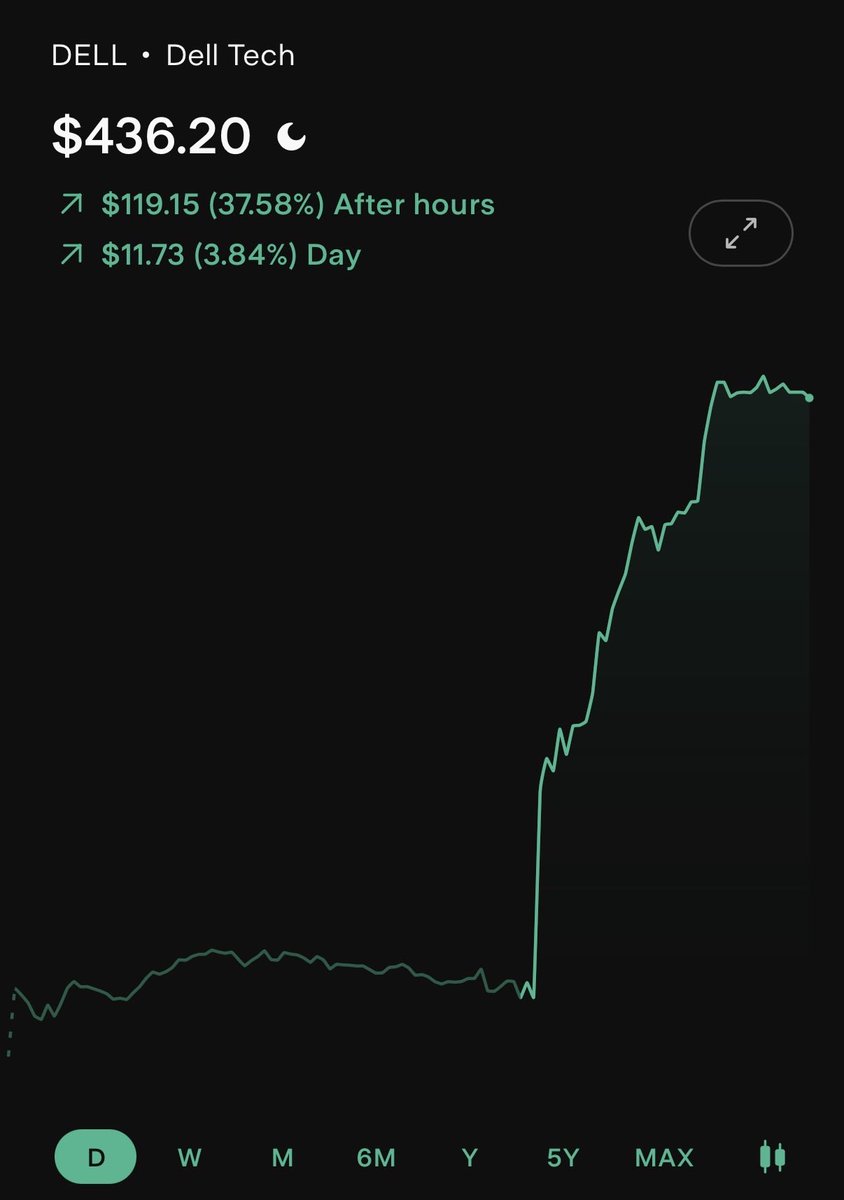
$DELL CRUSHED THEIR Q1 EARNINGS
• Revenue $43.8B vs Est. $34.8B
• EPS $4.86 vs Est. $2.88
• AI Server Sales: $16.1B (+757% YoY)
FY27 Guidance
• Revenue $167B vs Est. $144B
• EPS $17.90 vs Est. $13.16
$NVDA still looks set for the next leg higher. Natural selloff after strong earnings while the rest of the Mag 7 catches a bid, then likely continuation higher.
$IREN signed a $1.6B purchase agreement with Dell for air-cooled Blackwell systems at its Childress, Texas data centers.
The systems support IREN’s previously announced 5-year, $3.4B managed services AI cloud contract, with commissioning targeted for early 2027.
IREN expects the deal to lift annualized run-rate revenue from $3.7B to $4.4B, though that target is not fully contracted.
As AI adoption scales, many companies may realize the biggest ROI comes from workflow automation rather than endlessly increasing model usage. Platforms like $NOW become more valuable if token and inference costs remain high. Claude currently experiencing this.
This is my sixth conversation with @GavinSBaker.
As always with Gavin, the conversation covers a lot of ground, but we spend the most time on watts and wafers.
We discuss:
- Why the wafer shortage may prevent an AI bubble
- Data centers in space (reframed)
- Elon's Terafab and the new chip companies challenging Nvidia
- Usage-based pricing
- The disaggregation of GPUs
- DRAM, frontier tokens, and open source
Enjoy!
Timestamps:
0:00 Intro
7:55 Anthropic and OpenAI Valuations
12:58 Watts, Wafers, and Infrastructure
14:39 Orbital Compute and Data Centers in Space
22:49 Avoiding the AI Bubble
28:26 Terafab and the Future of US Manufacturing
32:16 Returns to the Frontier
37:23 Continual Learning
42:03 New Chip Companies
48:52 Extending GPU Lifespans and Private Credit
51:22 The Application Layer
57:32 The Token Path and Open-Source Dynamics
1:01:37 Cybersecurity
1:05:46 Diversity Breakdown
1:11:59 Assessing the Big Tech Players in AI
1:19:02 Geopolitics, Personal Safety, and the AI Horizon
NVIDIA Q1 RESULTS: NVIDIA REPORTED Q1 REVENUE OF $81,615 MILLION (VS. IBES ESTIMATE OF $78,855 MILLION) AND NET INCOME OF $58,321 MILLION. ADJUSTED EPS CAME IN AT $1.87 (VS. ESTIMATE OF $1.76), WITH EPS OF $2.39, A GROSS MARGIN OF 74.9%, AND EBIT OF $53,536 MILLION. FOR Q2, NVIDIA EXPECTS REVENUE OF $91,000 MILLION (VS. ESTIMATE OF $86,788 MILLION).
$GOOG or one of the Mag 7 should acquire $UBER.
Overnight you control robotaxis, food delivery, logistics, and one of the world’s largest real-world mobility networks.
For a company of that scale, the acquisition price is surprisingly achievable. My guess would be Goog or Amzn