Pleased to have passed my dissertation proposal! Thankful to have a community of scholars supporting me (esp. my advisor, Nels) and excited for the next steps of the PhD journey.
Excited to FINALLY release toughest+most rewarding paper I've worked on...
….we attack a 150 year old Walras question that's gone unanswered, not for lack of trying (Hicks, Samuelson, Arrow; our chances?😱)...
Q: Is the market equilibrium stable or unstable?¯\_(ツ)_/¯
🧵
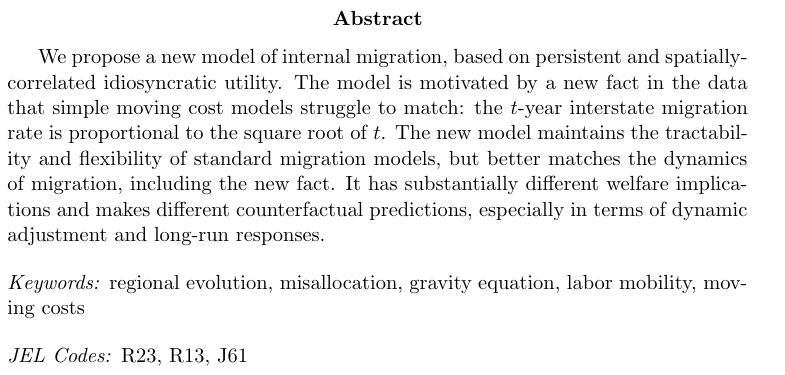
Thrilled to have this paper with Hansen Shao, "The Dynamics of Internal Migration: A New Fact and its Implications" accepted. We hope it changes the way you think about internal migration and that it provides a useful tool for economists to model location choices.
I feel like the "quick" fix here is to flip the classroom. Record your lectures and put them on Canvas, and then in class use hand-written assessments with no technology available. AI can be used as a study aid, but all measurable elements of assessment are sans tech.
🚨 University professors have been saying AI is completely destroying learning and that we'll soon have an AI-powered, semi-illiterate workforce. Here's a glimpse into the educational apocalypse:
"Sarah, a freshman at Wilfrid Laurier University in Ontario, said she first used ChatGPT to cheat during the spring semester of her final year of high school. (...) After getting acquainted with the chatbot, Sarah used it for all her classes: Indigenous studies, law, English, and a “hippie farming class” called Green Industries. “My grades were amazing,” she said. “It changed my life.” Sarah continued to use AI when she started college this past fall. Why wouldn’t she? Rarely did she sit in class and not see other students’ laptops open to ChatGPT. Toward the end of the semester, she began to think she might be dependent on the website. She already considered herself addicted to TikTok, Instagram, Snapchat, and Reddit, where she writes under the username maybeimnotsmart. “I spend so much time on TikTok,” she said. “Hours and hours, until my eyes start hurting, which makes it hard to plan and do my schoolwork. With ChatGPT, I can write an essay in two hours that normally takes 12.”
-
"By November, Williams estimated that at least half of his students were using AI to write their papers. Attempts at accountability were pointless. Williams had no faith in AI detectors, and the professor teaching the class instructed him not to fail individual papers, even the clearly AI-smoothed ones. “Every time I brought it up with the professor, I got the sense he was underestimating the power of ChatGPT, and the departmental stance was, ‘Well, it’s a slippery slope, and we can’t really prove they’re using AI,’” Williams said. “I was told to grade based on what the essay would’ve gotten if it were a ‘true attempt at a paper.’ So I was grading people on their ability to use ChatGPT.”
-
AI in education is a serious topic, and many schools and universities are blindly jumping into the "AI-first" wave without considering short and long-term consequences.
It would be great to hear more from teachers and educators to understand potential solutions.
This might be a great opportunity for rethinking the education system and how students are assessed.
-
👉 Link to the full article below.
👉 To learn more about AI's legal and ethical challenges, join my newsletter's 94,700+ subscribers (link below).
IV-PPML-HDFE. We are happy to introduce an instrumental-variable Poisson pseudo-maximum likelihood estimator with high-dimensional fixed effects. We also provide a robust and user-friendly ‘ivppmlhdfe’ package for Stata and Julia.
More details here 👇
https://t.co/3rXLVQMxbJ
Examining how multimodal transport networks shape the economic and environmental impacts of infrastructure investments and disruptions, from @simonfuchs4 and @WoanFoongWong https://t.co/Sz6L0GpOAn
@FelixTintelnot Thank you for writing it! It’s been really helpful for some overfitting issues in my work on tract-level diffusion and growth. Looking forward to citing it when I go on the market next year.
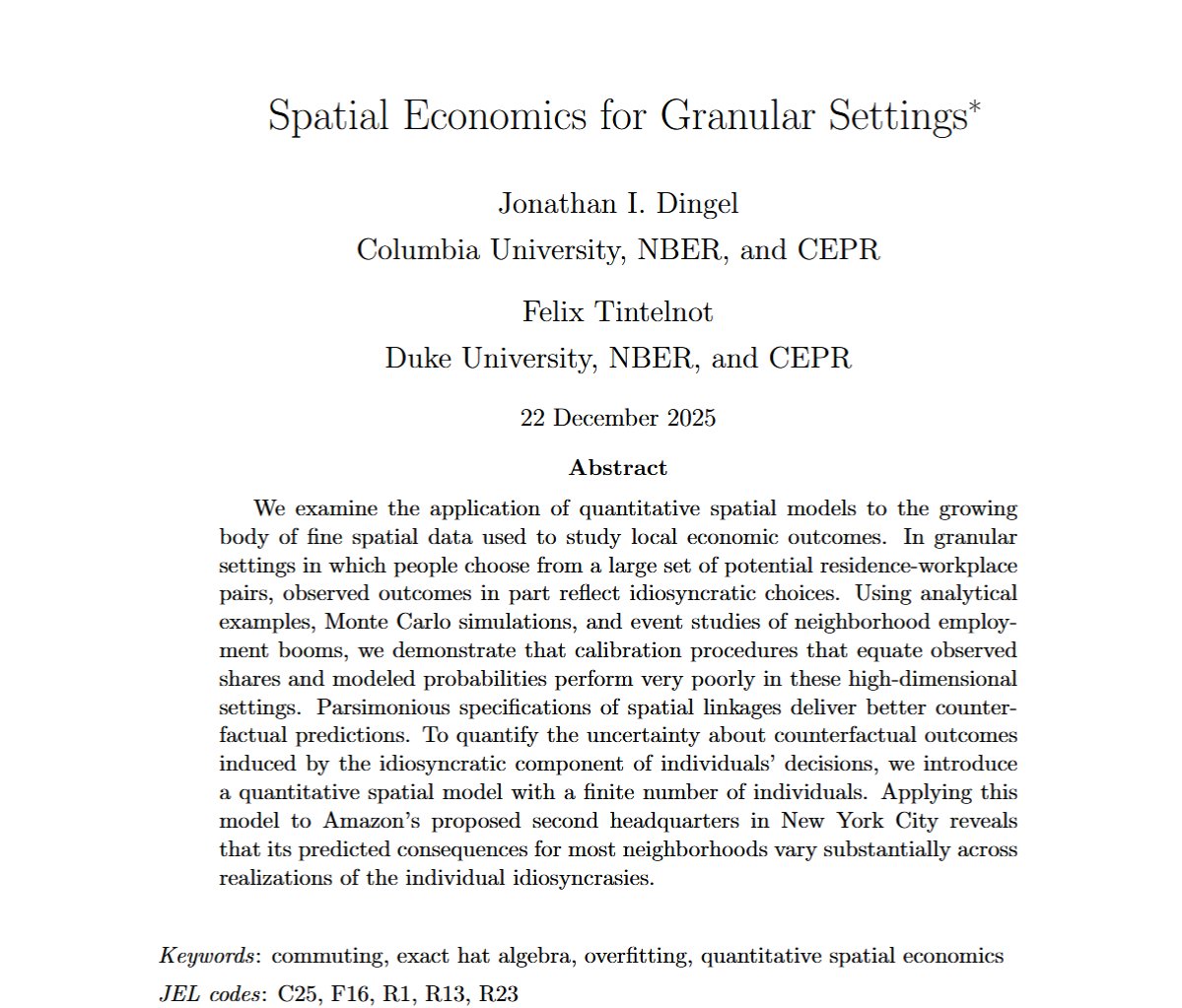
Spatial models calibrated to observed flows suffer overfitting problems in granular settings. @TradeDiversion & @FelixTintelnot diagnose the problem, show data smoothing performs better, and introduce a finite model to quantify counterfactual uncertainty. https://t.co/aBEUa6urEs
@JohnRuf6 I bet it must have been really cool (and a great training exercise) to work on this paper. My tentative title for my JMP is “Granular Spatial Growth”, so you can tell how much I enjoy this paper
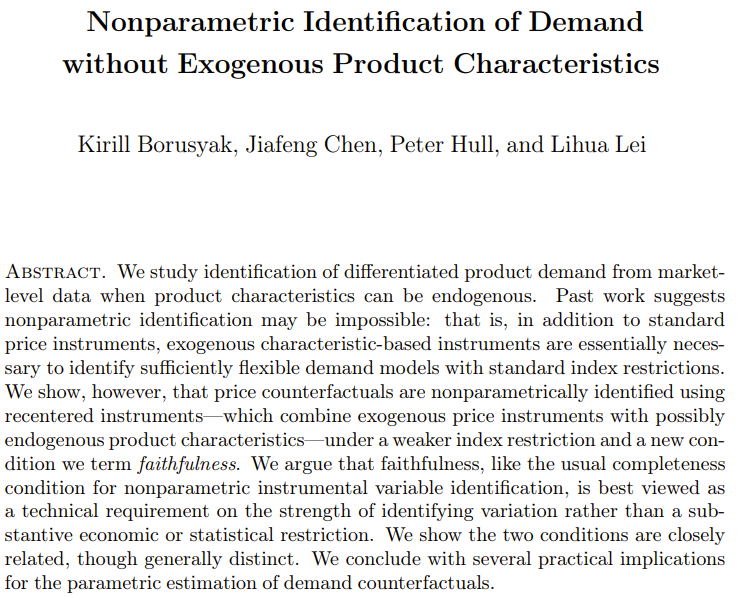
I have a new IO/metrics paper out, with @borusyak, Kevin Chen, and @lihua_lei_stat. We have some new results on the nonparametric identification of demand counterfactuals with recentered IV
We still doing tweet threads here? Ok, here goes...
New @cepr_org Discussion Paper out with @CarolineFohlin! We study market behavior throughout the infamous Teapot Dome Scandal in the 1920s, when insider trading was still legal in the United States.
A short🧵 (1/4)
Hi all, please spread the word and we hope everyone can make good use of this new data drop: https://t.co/1DSR2NZ38p
The full surviving establishment-level Census of Manufactures manuscripts from 1850, 1860, 1870, and 1880!