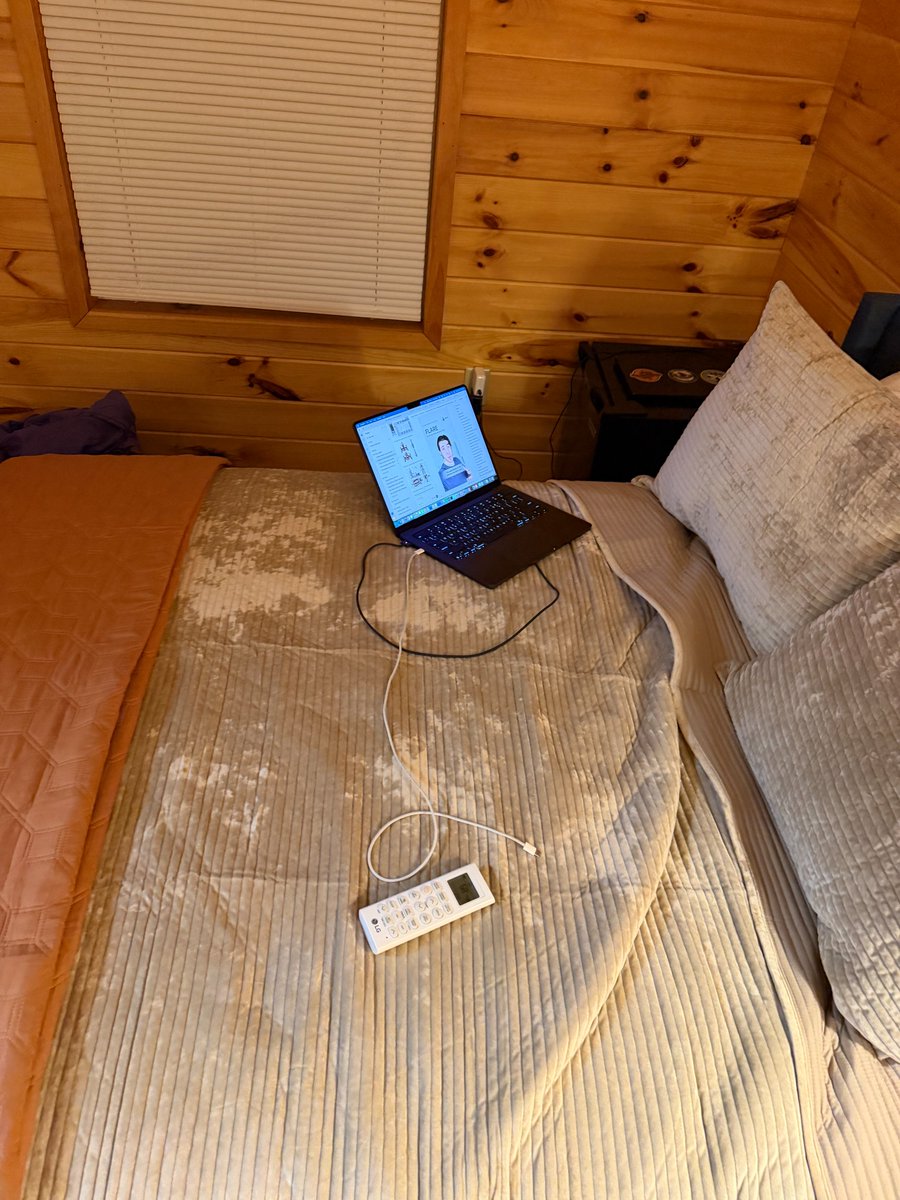
Lake view. Tree-stump desk. Still thinking about pilot plants.
Building RARE Labs at Launchpad: helping engineers turn lab results into a plant they can actually build.
@stanleybystan#StanLaunchp
You have six lab runs. Make them answer a decision.
Our software and AI plans matched experiments to compare two rare-earth recovery routes, imports results and keeps the unanswered questions visible.
Illustrative data in this demo.
RARE Labs: design → test → learn.
Your lab chemistry works. What should the pilot plant look like?
Reflux turns a rare-earth recovery brief into three process concepts, compares the trade-offs and proposes a starting route.
Concept-stage demo. Assumptions visible.
Building at RARE Labs.
A test for my startup pitch: can I explain the problem without naming a single tool?
If I need five acronyms before someone cares, I haven’t found the story yet.
That’s my constraint for explaining RARE Labs.
@stanleybystan#StanLaunchpad
The best pilot plant isn’t the one with the most sensors.
It’s the one that answers the question blocking the next decision.
I’d rather get one measurement that changes the design than 10,000 that decorate a dashboard.
@stanleybystan#StanLaunchpad
The most useful thing an engineering AI can say is “I don’t know.”
A confident answer is cheap. Knowing which measurement would settle the question is valuable.
That’s the bar I want for RARE Labs.
@stanleybystan#StanLaunchpad
If you were building your first pilot plant, which decision would you want checked before buying anything: reactor size, materials, mixing or heat removal?
Building RARE Labs (@tryreflux ) at @stanleybystan Launchpad. Where is the biggest uncertainty?
#StanLaunchpad
A chemistry undergrad in Chile messaged me this weekend and opened with "I know I am a nobody."
He had watched a one-minute video I posted on Thursday about why a reaction that works in a flask dies in a factory. For his undergrad thesis he tried to design a prototype electrolyser, and he wrote that he was surprised by how little his chemistry professors knew about reactor processes, and how little his engineering professors knew about the chemistry of the processes they handle. Then a biotechnology student in Egypt wrote that the same video had sent him off to read up on bioreactors, and that he could not believe the account had under 800 followers.
That video is now the 2nd-most watched thing I have ever made, almost entirely by people who had never seen me before, and 75 of them left the same comment asking for the one-pager.
Here is what I think happened. I stopped talking about myself. The video named who it was for in the first four words, taught one mechanism with one diagram, and tied the company to it only at the very end. Twenty weeks of posting about my week, and the thing that travelled was the thing I already knew from four years of chemical engineering at Waterloo.
The gap those two students described is the reason @tryreflux exists. The person who makes the molecule is almost never the person who can model the plant, and the software in between takes most of a year to learn.
To the guy in Chile: you are not a nobody. You are exactly who this is for.
Chemists and chemical engineers: what did the other side's professors not know about your work?
300 sales calls into heavy industry taught me three things nobody tells software founders.
I build AI for the simulators that design oil refineries and chemical plants. Since May I have had 300 conversations with process engineers, plant managers and the executives above them, and the pattern was obvious by call fifty. I still watch founders learn it the expensive way.
Data privacy is the whole conversation. Every company in this sector guards its data like a pack of bloodhounds. Until they feel safe with you, nothing else you say gets heard, so the first ten minutes of every call are about making them feel safe, and the product comes after.
"If it ain't broke, don't fix it" is liability, not laziness. When a model is wrong at a gas plant the cost is a shutdown and a lawsuit, so urgency is nearly impossible to create from the outside, and even when you manage it, a decision takes months to climb the ladder. Plan your runway around their calendar, not your demo.
Warm intros are the only door that opens fast. Cold outreach works, barely. People bend the rules a little for someone a colleague vouched for. The hour you would spend cold calling is better spent earning one introduction.
You cannot force this industry. You can only be the calmest, safest, best-introduced person in it.
I wasted most of the summer talking to the wrong people and I was enjoying it too much to notice.
I built a product for process engineers, so I went and talked to process engineers. Hundreds of them. Those conversations were fantastic. They understood immediately, they told me about the exact pain, several of them said some version of I would use this tomorrow.
None of them could buy anything.
I thought enthusiasm from the person who would use the product was the signal. It is not a signal at all in an industry where software gets bought by someone two or three levels up who has never opened the tool and whose entire incentive is to not be the person who approved the thing that broke.
The tell was that every great conversation ended with me feeling good and nothing on the calendar.
I still talk to users. I just stopped counting it as progress, which is a harder change than it sounds, because the buyer conversations are worse. They are shorter, colder, more sceptical, and you leave most of them feeling like you failed. That feeling turns out to be roughly uncorrelated with whether anything happens.
There are two bets being made on AI in heavy industry right now and I think most people are conflating them.
Bet one is the plant model. Build an AI system that understands the whole facility, ingests the historian, and reasons about the operation end to end. Applied Computing raised $20M for a version of this. It is a big, legitimate, capital-intensive swing.
Bet two is the interface layer. Leave the simulator alone. Leave the physics alone. Put natural language in front of the tools engineers already use and already trust, so that the four days of rebuilding a model becomes twenty minutes and the engineering judgement stays with the engineer.
These are not the same product and they do not fail the same way. The plant model has to earn trust it does not have yet against consequences that are physical. The interface layer inherits trust it did not build, because the engine underneath is the one the industry already validated, and the ceiling is lower for exactly the same reason.
I am building the second one. Partly conviction, partly because I have spoken to enough engineers to know that "the AI decided" is a sentence nobody in a safety-critical plant wants to say out loud in an incident review.
If you think the first one wins, I would like to hear why. I am not certain about this.
A software vendor is mailing me a dongle.
Not a license key. A physical USB hardware key, in an envelope, from Australia, so that I can build an integration against his simulation software.
This is normal in process engineering. A large share of the simulators that refineries, chemical plants and mines depend on are still licensed on physical dongles or on floating network licences that require a machine sitting inside the corporate LAN. Some vendors will not issue a developer seat at all without a phone call first.
Every software person I tell this to assumes I am exaggerating. Every process engineer I tell this to says yes, obviously, mine is in a drawer.
The physics inside these tools is genuinely world class. Forty years of validated thermodynamics that plants worth hundreds of millions of dollars are designed against. And it ships like it is 1998.
That distance is most of why I think there is a company here.
@dark_coderz Well, starting the content and distribution and growing the balls to commit full-time to running a business is still definitely hard, and a lot of people are not built for the shamelessness and discomfort that is required for it.
In Thunder Bay we have a thing called a nose beer. You crack the can and you snort the foam, to stay awake. My accelerator cohort found out, and one of the goodbye notes I got last week just says "hope you survive all the nose beers."
I'm at camp tonight (that's what we call cottages up here) explaining to city friends why this is normal. It is normal. I will not be taking questions.
Someone asked me recently what my biggest fear is, and I answered without hesitating, which surprised me more than the question did.
Not living up to my potential.
That's theanswer. It's the reason I'm this relentless and this wacky, the reason I put meetings on strangers' calendars and cold call executives on Friday evenings and freestyle in cars and try things that have no business working. I always want to be sure I become the greatest version of myself possible, and every unhinged thing I do makes a lot more sense once you know that.
What's yours?