@Majora__Z@Cozticapetztli I know kushkatan had a post back in 2020 where he illustrated Aztec male hairstyles, he showed it there and called it “ixquazontli.” I don’t remember his source rn, I’d assume Florentine but I’m not 100%
@Majora__Z@Cozticapetztli Tēskatl Ihpōka has the same hairstyle in Borgia. It might not be clear on Piltsin but on TI it’s evident this is a hairstyle, not headwear. He’s in the panel immediately to the right of Piltsin on this plate, 14. Also clear on P 21
@MiCorazonMexica Out of curiosity, why diverge so strongly with her body paint? The Relación doesn’t have many, but it does have images showing their body paint, as shown in this graphic by Daniel Parada
@MiCorazonMexica Dude, it’s been a month and you know this is stolen from a Nahua artist. Why is this still up? Please show some respect for Axolito and take it down.
> be microplastics researcher 2015
> develop better detection method
> can see particles 10x smaller than before
> run samples
> counts 100x higher than previous estimates
> publish
> conclusion: "more research needed"
> funding expires
> be different researcher 2020
> even better detection
> same samples
> counts higher still
> publish
> grant rejected: "not novel"
> be researcher 2024
> can now detect nanoplastics
> counts astronomical
> particles in brain tissue, testes, placentas
> concentrations increasing decade over decade
> publish
> industry response: "correlation not causation"
> plastic production: up 4%
every improvement in measurement finds worse news. thats not uncertainty. thats the answer
@Lee_H_Ovale@jah_cook@NahuatlGPT Having reread, you’re addressing op. They readily apologized and have indicated it was a misunderstanding of the source material, and likely they’ve seen other pop posts like this one. No mental health confinement needed!
@jah_cook@Lee_H_Ovale@NahuatlGPT It’s not that you shouldn’t rely on Spanish sources, in fact for the best results researching you must include Spanish results. However, you need to do better research before posting online if quality of information matters to you. Especially surrounding Nāwatl.
El Lienzo de Cuauhquechollan: Una Visión Náhuatl de la Conquista
De las sombras del siglo XVI emerge el Lienzo de Cuauhquechollan como un testimonio vivo de resistencia y alianza. Este códice del siglo XVI, pintado sobre una tela de algodón de 2.35 por 3.25 metros, no es solo un mapa, sino un relato pictográfico que captura la perspectiva indígena de la conquista española de Guatemala. Fue creado por los nahuas locales de la población de Quauhquechollan —hoy San Martín Huaquechula, Puebla—, para reclamar privilegios ante la Corona, evidenciando cómo los pueblos originarios se insertaron en la narrativa europea sin perder su voz.
La obra inicia con una escena emblemática: un abrazo simbólico entre el gobernante nahua de la población y Hernán Cortés, flanqueado por La Malinche y un español portando una oriflama con cruz. Este gesto, datado en 1520, representa la alianza estratégica de los cuauhquecholtecas contra el yugo mexica. Bajo el mando de Jorge de Alvarado —hermano de Pedro de Alvarado—, miles de guerreros nahuas marcharon hacia el sur, co-conquistando Guatemala entre 1527 y 1529.
El lienzo original se halla en el Museo Regional de Cholula, en Puebla.
There were some (but a minority of) city-states which allied with Cortes to topple the Aztec, but this wasn't in South America, nor was it from the Aztec being "that evil"
It was ironically because the Aztec, while conquerors, ruled loosely, enabling opportunistic side switching as a method to gain or hold onto political status
See below for more info (Also Apocalypto is horribly inaccurate, see: https://t.co/eO0d3JEXZj)
-----------
For a somewhat longer explanation
While the Mexica of the Aztec capital of Tenochtitlan were conquerors, they and other major Mesoamerican powers didn't often directly govern the places they conquered (no draft animals + the terrain made it logistically iffy):
Subjects usually kept their kings, laws etc, with basic obligations like to not block roads, to pay taxes (not usually of sacrificial victims: those were mostly collected in wars, not from already conquered subjects, keep in mind too EVERYBODY did sacrifices, groups allied with Cortes), and so on
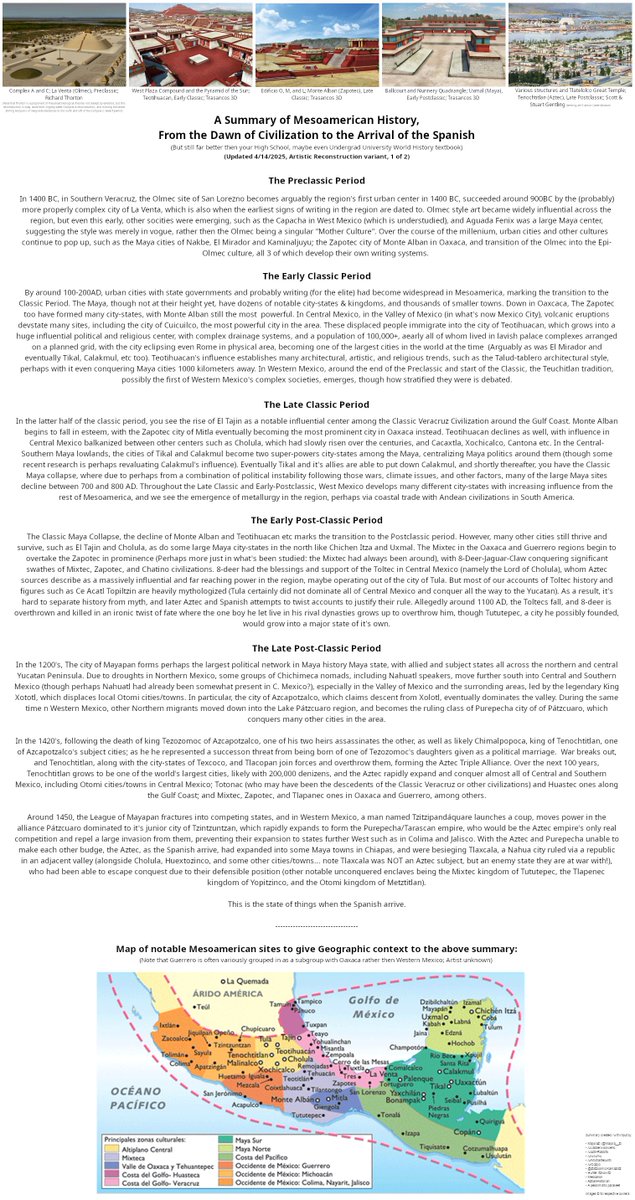
That meant subjects (which were STATES, not "tribes", the region had cities writing etc for millennia already, see pic) kept their own political ambitions and agency. Defecting was common, as was pledging yourself as a subject (as they got mostly left alone) or an ally to another state to take out your collective rivals or capitals, to then have higher status within that new kingdom you helped prop up
THAT is what happened with Cortes and how he got allies
The Mexica/Tenochtitlan got help overthrowing their old capital and rose to power this same way a century before Cortes. And decades after Cortes, various states like the Zapotec kingdom of Tehuantepec, the Iximche Maya etc allied with other Conquistadors to take out their rivals too, with the Mexica being uninvolved... actually, they may have fought ALONGSIDE the Mexica, who were in Spanish subject armies by then!
So this was just a common thing, not a unique reaction to Mexica rule in particular, and not even most Spanish authors thought it was particular bad or unfair: To the contrary Cortes, Diaz, the Anonymous Conqueror, Sahagun, Duran, Acosta, and Las Casas all praised Mexica rule as dignified, just and proper (I'd argue they were TOO excusing, here)
Now, Tlaxcala specifically may have resented the Mexica, yes... because they were at war, Tenochtitlan was trying to conquer Tlaxcala: It wasn't a subject already inside the empire. Texcoco, Chalco, Xochimilco etc WERE inside it, and (to varying degrees) BENEFITTED from Mexica rule, due their political marriages with Mexica royalty and the taxes Mexica conquests brought into the valley
Which is why they, unlike Tlaxcala, only allied with the Conquistadors and Tlaxcala AFTER Tenochtitlan was ravaged by smallpox, multiple Mexica kings/nobles died etc. By then states had less to lose & more to gain by switching sides
Even then, most Aztec subjects didn't defect; (there were ~500 Aztec subjects, arguably only a dozen or so defected) and of those that did, some only did so conditionally, unwillingly, or only specific officials/factions switched sides (EX: Ixtlilxochitl II of Texcoco and his followers defected, not his brother/the king Coanacochtzin; while Xochimilco only switched sides after being beaten and forced to etc)
Even Tlaxcala, the closest thing to a innocent victim here, in contrast to the Mexica as frequent aggressors, used Cortes to attack other cities to further their own political reach, not just to strike back at the Mexica:
Everybody was using and manipulating each other, it wasn't as simple as states rallying against Mexica tyranny (which as I said, wasn't much of a thing), nor Cortes dastardly playing (or graciously liberating) local states against each other
There were no clear "good guys" or "bad guys", just different groups with different interests willing to go to slightly different lengths
--------------------
For even more info, see:
https://t.co/AyAkboKZOA on how Cortes was used and manipulated by local kings & officials like Xicomecoatl, Ixtlixochtlli II, Xicotencatl II, and even Moctezuma II, as much as Cortes used them
https://t.co/Mbp39uKrv9 Touches on the motives behind Moctezuma II's actions a bit and his attempt to use Cortes (I should do a more in depth version of this)
https://t.co/kEPXGtlRXw and https://t.co/k25yfDAhEp and https://t.co/7ASRld53Iu are more in depth versions of the above explanation, while https://t.co/dgtahqaXHN is an even MORE-more in depth version (and this also in turn links to stuff about Flower Wars, in the meantime since I need to make a tweet about to add here too)
https://t.co/TRwC0LksyC and https://t.co/25Ciplm2i9 are me addressing people who were skeptical of the above info, in case you want to see me further clarify on things
https://t.co/yM9vKIjwRz Gives more info info on Aztec vs Mexica vs Tenochca vs Nahua etc as terms
https://t.co/2cQRtGDkRa touches on Aztec warfare/militarism and how it was more pragmatic then ritualistic, see also https://t.co/YbWbUvWrOn for more on Aztec warfare, and https://t.co/GP5NSxbNg9 for other common conquest myths
https://t.co/DMmnKHm1XZ Has quotes of Spanish, Italian, and German sources of the time praising Aztec art, cities, systems of law and order, even ethics and virtues
https://t.co/Kfa3mihhR8 is a directory general Mesoamerican infodumps I've done, including some of the above links, but also stuff on cities, architecture, engineering, warfare, etc
@Itzcacalotl Just saw your other replies that it’s in Oaxaca. Wild, in GTO there’s at least one site with sunken patios and a not dissimilar layout to this site