If an AI can control 1,000 robots to perform 1 million skills in 1 billion different simulations, then it may "just work" in our real world, which is simply another point in the vast space of possible realities. This is the fundamental principle behind why simulation works so effectively for robotics.
Real-world teleoperation data scales linearly with human time (< 24 hrs/robot/day). Sim data scales exponentially with compute.
There are 3 big trends for simulators in the near future:
1. Massive parallelization on large clusters. Physics equations are "just" matrix math at their core. I hear GPUs are good at matrix math 🔥. One can run 100K copies of simulation on a single GPU. To put this number in perspective: 1 hour of wallclock compute time gives a robot 10 years (!!) of training experience. That's how Neo was able to learn martial arts in a blink of an eye in the Matrix Dojo.
2. Generative graphics pipeline. Traditionally, simulators require a huge amount of manual effort from artists: 3D assets, textures, scene layouts, etc. But every component in the workflow can be automated: text-to-image, text-to-3D mesh, and LLMs that write Universal Scene Description (USD) files as a coding exercise. RoboCasa is one example of a prior work.
3. End2end neural net that acts as simulator itself. This is still bluesky research and quite far from replacing a graphics pipeline, but we are seeing some exciting signs-of-life based on video gen models: Sora, Veo2, CogVideoX, Hunyuan (text-to-video); and action-driven world models: GameNGen, Oasis, Genie-2, etc.
Genesis does great on (1) for certain tasks, shows good promises on (2), and could become a data generation tool for reaching (3). Its sim2real capabilities for locomotion are good, but there's still a long way to go for contact-rich, dexterous manipulation. It shows a bold vision and is on the right path to providing a virtual cradle for embodied AI. It is open-source and puts a streamlined user journey at the front and center.
I had the privilege to know @zhou_xian_ and play a small part in his project since a year ago. Xian has been crunching code non-stop on Genesis with a very small group of core devs. He often replied to my messages at 3 am. @Zhenjia_Xu from our GEAR team helped with sim2real experiments in his spare time. Genesis is truly a grassroot effort with an intense focus on quality engineering.
Nothing gives me more joy than seeing the simulation ecosystem bloom. Robotics should be a moonshot initiative owned by all of humanity.
Congratulations.
Everything you love about generative models — now powered by real physics!
Announcing the Genesis project — after a 24-month large-scale research collaboration involving over 20 research labs — a generative physics engine able to generate 4D dynamical worlds powered by a physics simulation platform designed for general-purpose robotics and physical AI applications.
Genesis's physics engine is developed in pure Python, while being 10-80x faster than existing GPU-accelerated stacks like Isaac Gym and MJX. It delivers a simulation speed ~430,000 faster than in real-time, and takes only 26 seconds to train a robotic locomotion policy transferrable to the real world on a single RTX4090 (see tutorial: https://t.co/bEkIlCKqdf).
The Genesis physics engine and simulation platform is fully open source at https://t.co/DhBv7NdyqH. We'll gradually roll out access to our generative framework in the near future.
Genesis implements a unified simulation framework all from scratch, integrating a wide spectrum of state-of-the-art physics solvers, allowing simulation of the whole physical world in a virtual realm with the highest realism.
We aim to build a universal data engine that leverages an upper-level generative framework to autonomously create physical worlds, together with various modes of data, including environments, camera motions, robotic task proposals, reward functions, robot policies, character motions, fully interactive 3D scenes, open-world articulated assets, and more, aiming towards fully automated data generation for robotics, physical AI and other applications.
Open Source Code: https://t.co/DhBv7NdyqH
Project webpage: https://t.co/SBNyhFB0yn
Documentation: https://t.co/3yuBoaealV
1/n
Meet Willow, our newest quantum chip. In under 5 minutes, it's able to perform a benchmark computation that would take one of today’s fastest supercomputers 10 septillion years. (That's greater than the age of the universe!) Learn more ↓ https://t.co/6UnDvVt7v2
Over a decade ago, Google embarked on a journey to build a useful quantum computer. Today, with our latest quantum chip, Willow, we're closer to harnessing the power of quantum mechanics for real-world impact. Learn more about Willow below ⬇️
https://t.co/4QTh61HW2g
2/ It’s interesting to see that the ‘ultimate form of the government/central authority’ in civil law system and common law system tend toward convergence at some point.
This quotation echoes the idea of ‘When the people are weak, the state is strong. Hence the state that possesses the Way devotes itself to weakening the people ’ in The Book of Lord Shang.
"Society will develop a new kind of servitude which covers the surface of society with a network of complicated rules, through which the most original minds and the most energetic characters cannot penetrate. It does not tyrannise but it compresses, enervates, extinguishes, and stupefies a people, till each nation is reduced to nothing better than a flock of timid and industrious animals, of which the government is the shepherd." ― Alexis de Tocqueville
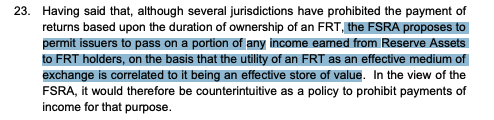
ADGM stablecoin consultation paper saying the quiet part out loud.
Stablecoins cannot scale if they don't become an effective store of value, and sharing income from reserves in the form of rewards is a great way to do so.
This marks the second leading crypto jurisdiction to provide a framework for yield-bearing stablecoins (Bermuda's BMA and Abu Dhabi's ADGM)
Compound Finance got DAO REKT because they just don't seem to care.
Here’s how absurd the process was:
An initial proposal to grant 92k $COMP was submitted without prior discussion. Thankfully, Compound's security advisor @LewellenMichael spotted it.
Despite glaring red flags, Michael's warnings only received 6 comments on the DAO forum. Notable few who cared: @MonetSupply and Wintermute.
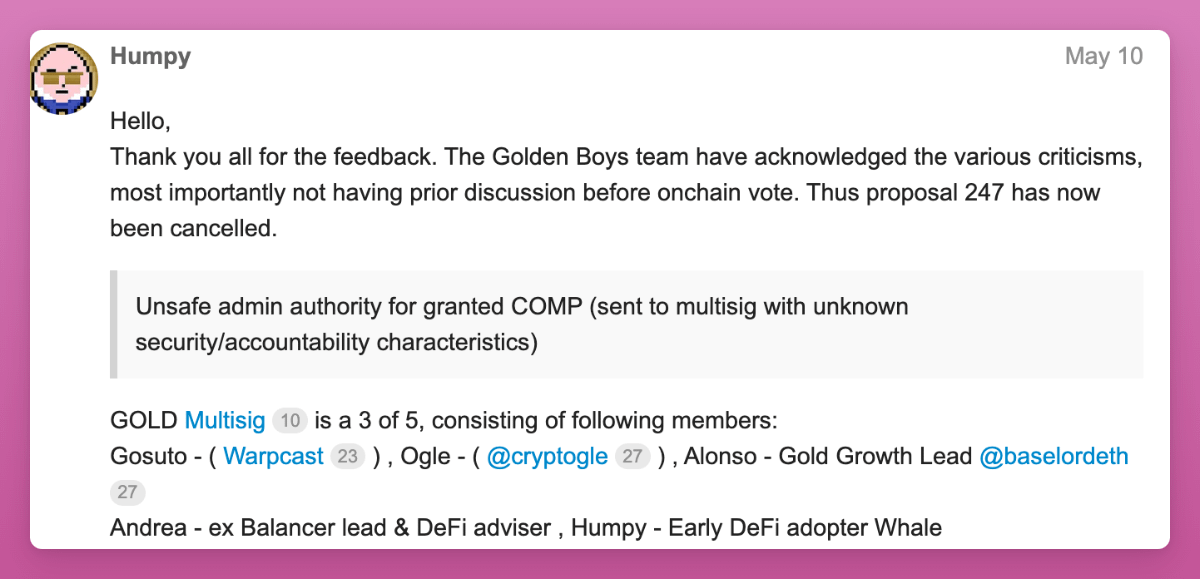
Humpy (the proposer) acknowledged the criticism and canceled the first proposal.
Then, he submitted a second vote, attracting just 4 comments from @StableLab, Wintermute, @bryancolligan, and Michael.
Despite the lack of public concern, the second proposal thankfully FAILED.
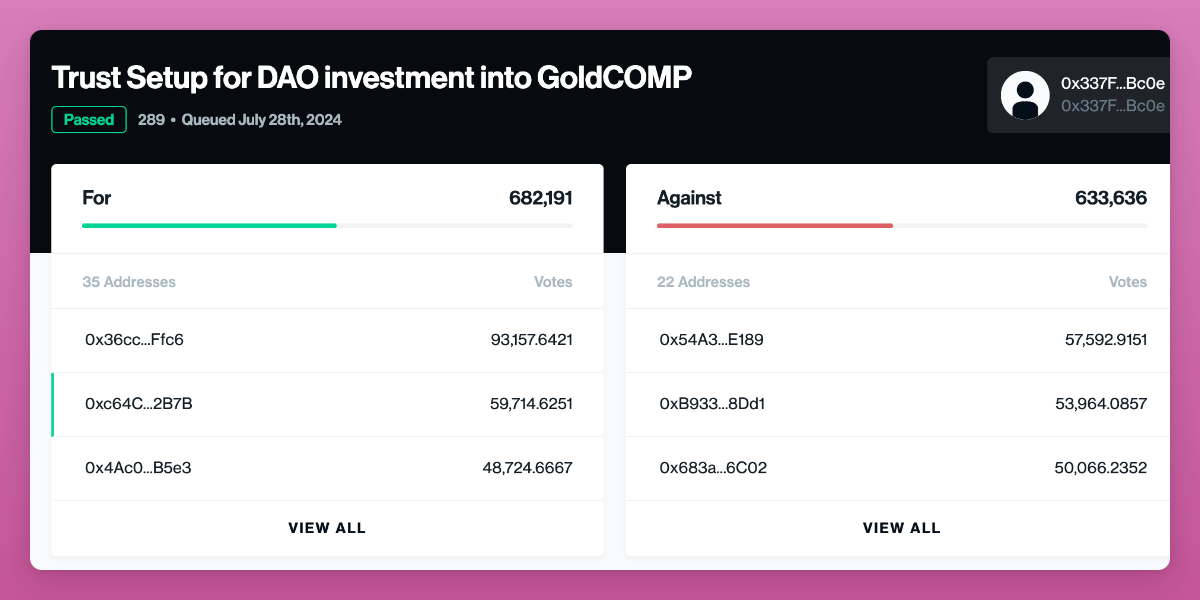
But then it got wilder: the third proposal not only sailed through but saw Humpy increase the requested $COMP amount by a crazy 5.4x, jumping from 92k to 499k.
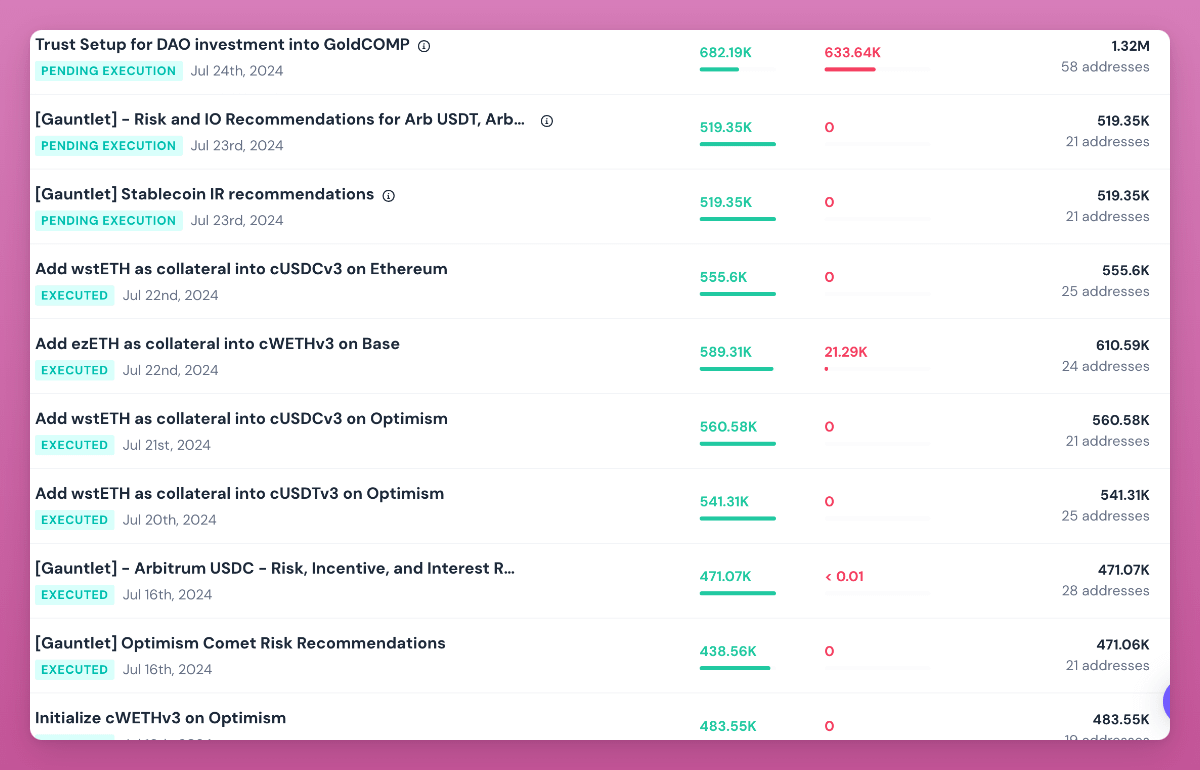
Only 57 addresses cast their votes for the goldCOMP proposal. Where was everyone else?
It seems nobody cares.
Barely ~20 addresses typically participate in DAO votes.
Proposal discussions in the forum attract minimal engagement.
For instance, a previously contentious plan to launch a USDT market on Compound III quietly passed in July.
Almost all proposals in Compound DAO originate from Gauntlet.
In practice, Gauntlet runs the DAO, and they get paid to do it.
Gauntlet's effectively running the DAO because they're getting paid.
And the rest? Silence. No pay, no interest.
Even the Compound team seems indifferent. @compoundfinance doesn't even tweet anymore.
This is alarming. If Humpy can pass this vote, what's stopping another vote from jeopardizing your lent assets next?
Just use @aave, @0xfluid or any other lending protocol with the community that cares.
Building a platform for generative AI applications
https://t.co/G9CFC6HLxt
After studying how companies deploy generative AI applications, I noticed many similarities in their platforms. This post outlines these common components, what they do, and implementation considerations.
This post starts from the simplest architecture and progressively adds more components.
1. Enhance context input into a model by giving the model access to external data sources and tools for information gathering.
2. Put in guardrails to protect your system and your users.
3. Add model router and gateway to support complex pipelines and add more security.
4. Optimize for latency and costs with cache.
5. Add complex logic and write actions to maximize your system’s capabilities.
I try my best to keep the architecture general, but certain applications might deviate. As always, feedback is appreciated!
Building a platform for generative AI applications
https://t.co/G9CFC6HLxt
After studying how companies deploy generative AI applications, I noticed many similarities in their platforms. This post outlines these common components, what they do, and implementation considerations.
This post starts from the simplest architecture and progressively adds more components.
1. Enhance context input into a model by giving the model access to external data sources and tools for information gathering.
2. Put in guardrails to protect your system and your users.
3. Add model router and gateway to support complex pipelines and add more security.
4. Optimize for latency and costs with cache.
5. Add complex logic and write actions to maximize your system’s capabilities.
I try my best to keep the architecture general, but certain applications might deviate. As always, feedback is appreciated!
Introducing NuminaMath, the dataset behind the 1st AIMO progress prize winning solution!
It is the largest competition math dataset ever released, with 860K problem solution pairs.
Check here for all details of the datasets and the full training process:
https://t.co/k5iYI8QxgV
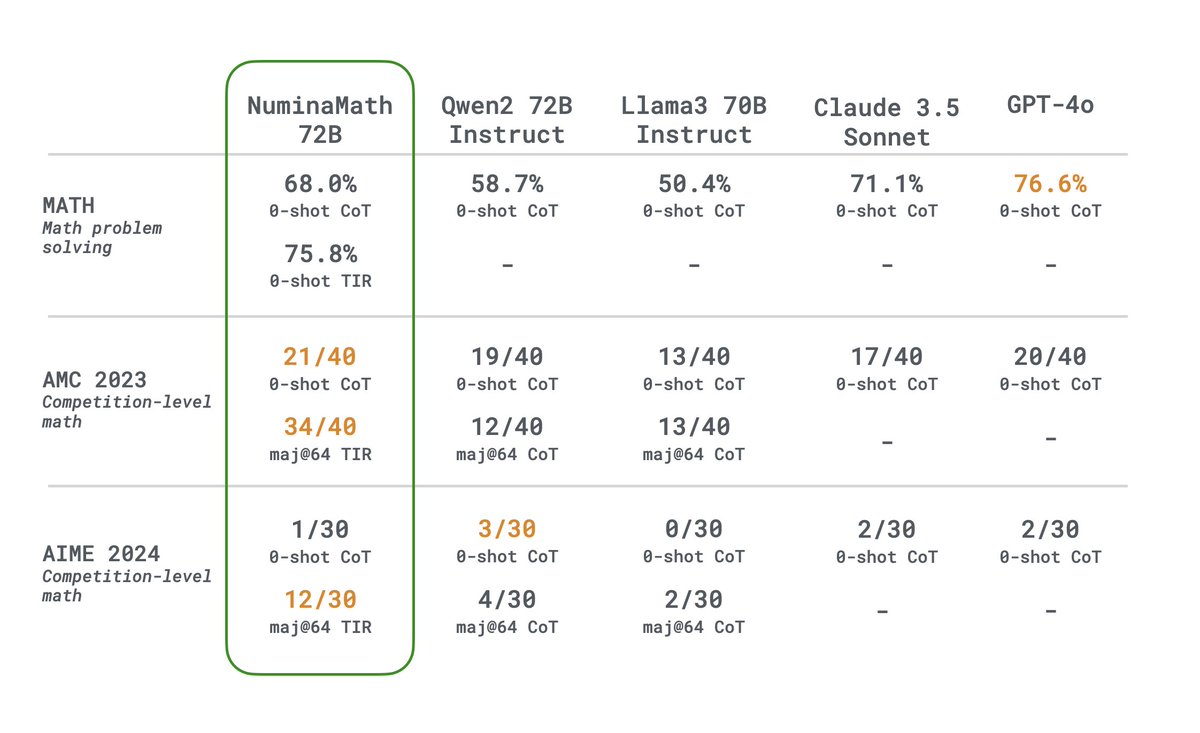
Synthetic data can beat its teacher! The AI-MO team released their winning dataset with an additional fine-tuned @Alibaba_Qwen 2 model that approaches or surpasses @OpenAI GPT-4o and @AnthropicAI Claude 3.5 in match competitions. 👀
There was a sentiment that fine-tuned models from synthetic datasets could not beat their teachers. Well, they can! NuminaMath 72B TIR matches GPT-4o and Anthropic Claude 3.5 on AMC 2023 and AIME 2024 with TIR.
Open LLMs + Syntehtic Data = 🚀