Journaling is one of the most helpful things I do for my mental clarity and emotional health.
I also almost never did it consistently — because the friction was just too high.
So I built an app to fix that. Here's the story 🧵
50 out of 10,080 minutes.
That's how much a therapist typically sees of a client's week. The other 10,030 minutes are invisible — they rely on filtered, reconstructed memory. Clients forget. They minimize. They can't always put words to what their week felt like.
I'm building a therapist dashboard for Voice2Journal to help close that gap. Voice journaling between sessions. Patterns surfaced for the clinician. Weekly assignments pushed to clients.
Looking for therapists willing to poke at it and tell me what I'm getting wrong. DM me or reply if you're interested or know someone who would be.
I used to joke about how my first real job out of college (web designer in 2000) didn't exist when I first went into college in 1996. Then in 2025 I finished my computer science degree and again, this job didn't exist when I was studying computer science just last year.
As advanced agents move from coding to the rest of knowledge work, it takes a real amount of work and know-how to get right.
You need to ensure agents have the right context and data to work with, wire up systems to agents in a safe and secure way, ensure that the agents are producing quality output, design the end-state workflow where and how humans will be in the loop, maintain the agents when there are model and system upgrades, and more.
This isn’t a side project or something you can just do on nights and weekends. You need to design and develop robust agents that will be used in mission critical workflows. It’s a highly technical job, very much akin to a forward deployed engineer for internal functions.
This is why, at Box, we’re starting to hire for AI automation engineering roles. This a technical role that will partner with the business directly and help augment how they work to drive even more output, and deliver better experiences for employees and ultimately customers.
This is just one example of the kind of role that AI will start to open up in the future. I expect most companies will have many flavors of this going forward.
HTML is the new markdown.
I've stopped writing markdown files for almost everything and switched to using Claude Code to generate HTML for me. This is why.
HTML is the new markdown.
I've stopped writing markdown files for almost everything and switched to using Claude Code to generate HTML for me. This is why.
@ok6ixx It's great that Japan has this ethic, but it's not exclusive to them. I live in the U.S. and had my lost wallet returned to me in much the same way. I also know plenty of others who have had similar experiences in the U.S. My cousin turned in $1200 that he found on the road.
@PropositoyVida Love this! Are you going to share it with the world? I started answering calls then putting them on mute and going about my business. It's surprising how long they will stay on trying to get a response. But if they are going to waste our time, I don't feel bad wasting theirs.
A lot of people look at me funny when I tell them I created a voice journaling app. There's an implied "I didn't know the world needed that" vibe. But that's usually coming from people who don't journal.
If you journal, you already know how hard it is to make the habit stick. I get antsy when I sit down and stare at a blank page. There's pressure to write something profound, or at least meaningful. Knowing there's limited room in the fancy journal I bought only adds to the pressure to make it count.
But if I can just start talking and not worry about saying it perfectly, because the app will clean it up for me, suddenly I'm free to just let everything out. And it never fails to bring clarity to my thinking and make me feel lighter. That's why I built Voice2Journal.
#voicejournaling #journaling
Voice2Journal is live on the App Store.
If you've ever wanted to journal but struggle with the blank page or finding the right time — this is why I built it. You talk, it cleans up your thoughts into something readable. Journal in the car, on a walk, sitting in a park, anywhere!
Download: https://t.co/iKcEEVLNYk
It's the first journaling habit I've actually kept.
Even after screwing over OpenClaw users to save on token usage, #Anthropic still can't keep their servers working. #fail
Even when I'm paying for API use, they can't seem to hold up their end of the ToS.
@krispuckett@openclaw@claudeai Codex is way better at actual coding. I send all my coding tasks to Codex 5.4. Today I canceled my Claude Max subscription because they don't want use using OpenClaw with it... so I won't. I'm trying Gemini 3.1 as my main orchestration agent.
@AnthropicAI@claudeai@AnthropicAI, Max plan canceled. If you stop jerking us around I might consider coming back and recommending to clients again, but as of now, you change the rules and break things constantly, you can't be trusted as a business partner.
Goodbye to @AnthropicAI and @claudeai, it was a great run w/ OpenClaw. Perfectly understandable to enforce usage limits, but if I can't use my Max plan w/ my tool of choice-I'll move to AI providers that have more respect for their users. I'll be cancelling my Max plan today.
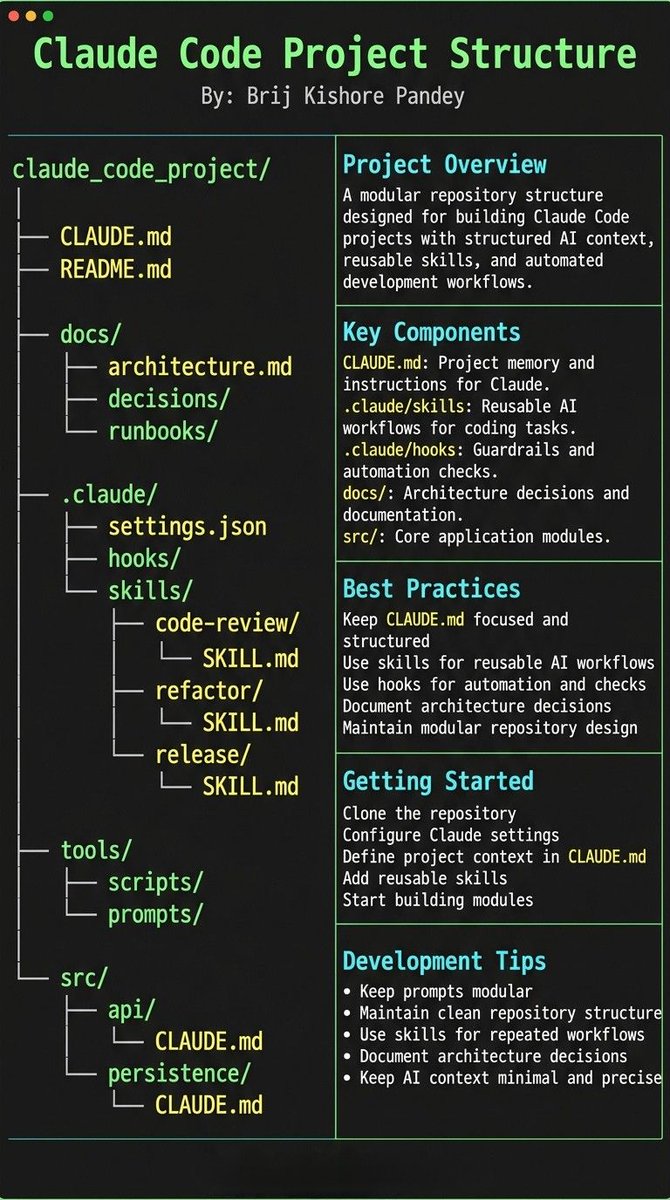
Most people treat CLAUDE.md like a prompt file.
That’s the mistake.
If you want Claude Code to feel like a senior engineer living inside your repo, your project needs structure.
Claude needs 4 things at all times:
• the why → what the system does
• the map → where things live
• the rules → what’s allowed / not allowed
• the workflows → how work gets done
I call this:
The Anatomy of a Claude Code Project 👇
━━━━━━━━━━━━━━━
1️⃣ CLAUDE.md = Repo Memory (keep it short)
This is the north star file.
Not a knowledge dump. Just:
• Purpose (WHY)
• Repo map (WHAT)
• Rules + commands (HOW)
If it gets too long, the model starts missing important context.
━━━━━━━━━━━━━━━
2️⃣ .claude/skills/ = Reusable Expert Modes
Stop rewriting instructions.
Turn common workflows into skills:
• code review checklist
• refactor playbook
• release procedure
• debugging flow
Result:
Consistency across sessions and teammates.
━━━━━━━━━━━━━━━
3️⃣ .claude/hooks/ = Guardrails
Models forget.
Hooks don’t.
Use them for things that must be deterministic:
• run formatter after edits
• run tests on core changes
• block unsafe directories (auth, billing, migrations)
━━━━━━━━━━━━━━━
4️⃣ docs/ = Progressive Context
Don’t bloat prompts.
Claude just needs to know where truth lives:
• architecture overview
• ADRs (engineering decisions)
• operational runbooks
━━━━━━━━━━━━━━━
5️⃣ Local CLAUDE.md for risky modules
Put small files near sharp edges:
src/auth/CLAUDE.md
src/persistence/CLAUDE.md
infra/CLAUDE.md
Now Claude sees the gotchas exactly when it works there.
━━━━━━━━━━━━━━━
Prompting is temporary.
Structure is permanent.
When your repo is organized this way, Claude stops behaving like a chatbot…
…and starts acting like a project-native engineer.
Voice2Journal started with a plain record button. Press to start, press to stop. Functional, but completely forgettable.
A friend recommended I make the record button a dinosaur to make it memorable.
🧵
That's what Voice2Journal does. A mirror for your own thinking. You talk through whatever's on your mind, & clarity shows up on its own.
Wait, aren't ducks descended from dinosaurs? The 2 ideas clicked together and it became obvious that I needed a duck.
I couldn't figure out what a dinosaur had to do with journaling. So I sat with it.
Developers use something called rubber duck debugging--explain a problem out loud to a rubber duck on your desk. Just articulating the issue tends to surface the answer. The duck just listens.