A 14 year old child killing a 22-23 year old man in a downtown parking garage usually means one thing in Indy. This was a gang initiation premeditated murder. Gangs have been running Indianapolis, IN in the evening for at least 15 years. Senator Taylor, myself, Secretary of the Senate Jen Mertz all experienced the violence from a gang meetup on the Senate parking lot many years ago during fireworks on the 4th of July. It’s the real reason why streets are crap, Circle City Mall died and the economics of Indy are on the decline. I doubt it was either a drug deal gone wrong or a murder theft thing not in a parking garage. When will IMPD tell the public the truth? @angelaganote@indystartony
A 24-year-old Polish tennis player arrived in Paris last week ranked 114th in the world, with no sponsors, no guaranteed income, and no certainty she could even pay for her hotel room.
She had to win three qualifying matches just to enter the French Open main draw. Prize money is only paid at the end of the tournament, so a Polish sports drink brand quietly stepped in and covered her hotel bill.
Her name is Maja Chwalinska. And today, she plays in the French Open final.
Before this tournament, she had won exactly one Grand Slam main draw match in her entire career. She had battled depression so severe that in 2021 she couldn't get out of bed. She underwent knee surgery in 2022. She spent years grinding through small tournaments across Europe just to stay afloat.
Then she arrived in Paris, won three qualifiers, and kept winning. Zheng Qinwen. Elise Mertens. Maria Sakkari. Diana Shnaider. Nine straight matches. One set dropped.
She is now the first qualifier in French Open history to reach the final. The last time a qualifier reached a Grand Slam final, it was Emma Raducanu at the 2021 US Open. Raducanu won.
By simply making the final, Chwalinska has earned more prize money than her entire career combined. The runner-up cheque alone is $1.6 million. If she wins today, she takes home $3.25 million.
One week ago she couldn't pay for her hotel room.
Kids will get you locked up.
A lil girl in my son’s class told her teacher that she takes baths with her uncle.
So of course, they did their investigation.
Tell me why the uncle is 2 years old.
I do not want to hear another person bring up the “but Caitlin Clark did not win a championship” excuse like it is serious basketball analysis.
It does not hold water.
Not in basketball.
Not in team sports.
Not when you apply the same standard to anyone else.
And certainly not when you look at the facts.
Basketball is not singles tennis.
There is no individual national champion in basketball because basketball is not an individual sport. There are five players on the floor, rotations, coaching decisions, roster construction, injuries, illnesses, foul trouble, matchups, officials, shooting variance, bench depth, and a hundred other variables that decide who cuts down the nets.
One player can be the best player in the country and still lose.
One player can be the best player on the floor and still run into a deeper roster.
One player can carry a program farther than it had any reasonable business going and still not win the last game.
That is not failure.
That is team sports.
So when people say Caitlin Clark cannot be historically great because Iowa did not win the national championship, what they are really doing is using a team result to erase individual dominance.
That is lazy.
And if we applied that standard consistently, sports history would sound ridiculous.
Dan Marino never won a Super Bowl.
Nobody serious says he was not great.
Charles Barkley never won an NBA title.
Nobody serious says he was not great.
Allen Iverson never won an NBA title.
Nobody serious says he was not great.
Patrick Ewing never won an NBA title.
Nobody serious says he was not great.
Karl Malone never won an NBA title.
Nobody serious says he was not great.
Barry Bonds never won a World Series.
Ted Williams never won a World Series.
Nobody serious says they were not historically great baseball players.
Why?
Because serious sports people understand context.
They understand individual greatness and team championships are related, but they are not the same thing.
Now let’s apply that same adult standard to Caitlin Clark.
Caitlin Clark finished her college career as the NCAA Division I all-time leading scorer across men’s and women’s basketball. She ended with 3,951 points and passed Pete Maravich’s 54-year-old scoring record.
She was the first Division I player to record more than 3,600 points, 1,000 assists, and 850 rebounds in a career.
She was a two-time John R. Wooden Award winner, and in her final college season she averaged 31.6 points, 8.9 assists, and 7.4 rebounds while leading Division I in both scoring and assists.
She also holds the record for the most 30-point games by any men’s or women’s Division I player over the last 25 seasons.
Those are not participation trophies.
Those are historic basketball facts.
And while people keep trying to turn Iowa’s championship losses into proof that Caitlin was somehow overrated, they conveniently ignore who Iowa was facing.
In 2023, Iowa lost the national championship game to LSU, a roster loaded with high-end talent, size, athleticism, and future professional players.
In 2024, Iowa lost the national championship game to South Carolina, a team that finished undefeated and had overwhelming depth, length, defense, and elite recruiting power.
That matters.
Iowa was not built like those teams.
Iowa did not have South Carolina’s depth.
Iowa did not have LSU’s athletic profile.
Iowa did not have a bench full of five-star replacements waiting to check in.
Iowa had Caitlin Clark, a strong system, good teammates, and a superstar who turned a very good program into the center of the basketball universe.
That is the part her critics keep skipping.
Caitlin did not “lose the national championship” like she underachieved with the best roster in America.
She took Iowa to back-to-back national championship games.
That is the accomplishment.
That is the evidence.
That is the context.
And if there were an individual national championship in college basketball, the closest thing would be National Player of the Year.
Caitlin won that twice.
So no, the championship argument does not prove she was overrated.
It proves the people making it do not understand how team sports work.
The same logic is already being dragged into the WNBA.
If Caitlin has a rough shooting night, she is a fraud.
If she turns the ball over, she was manufactured.
If the Fever lose, she was overhyped.
If she gets frustrated, she is entitled.
If she carries the viewership, attendance, merchandise, and national conversation, somehow that still is not enough.
But again, facts matter.
In 2024, the WNBA had its most-watched regular season in 24 years, its highest attendance in 22 years, and record merchandise sales.
Caitlin Clark entered the league and immediately became one of the central reasons casual fans started watching, arenas started filling, and national media started paying attention.
Then, in 2026, she became the fastest player in WNBA history to reach 500 career assists, doing it in 59 games and beating Sue Bird’s previous mark of 82 games.
That is not hype.
That is production.
That is not a myth.
That is basketball impact.
A player can lose the final game and still be the most dominant player in the country.
A player can be popular and still be excellent.
Those ideas are not contradictory.
They are sports.
What bothers me is not that people criticize Caitlin Clark.
Criticism is part of greatness.
What bothers me is how often people reach for the weakest possible argument because they do not want to acknowledge the obvious.
She changed the sport.
She changed the audience.
She changed the market.
She changed Iowa basketball.
She changed the WNBA conversation.
And she did it with a style of play people wanted to watch.
The range.
The passing.
The pace.
The vision.
The gravity.
The audacity.
The way she made ordinary possessions feel dangerous.
The way she made people who had never watched women’s basketball suddenly care.
That is not manufactured.
That is rare.
So stop treating basketball like an individual sport only when it is time to diminish Caitlin Clark.
Stop pretending championships are the only measurement of greatness when you would never apply that standard consistently to Marino, Barkley, Iverson, Ewing, Bonds, Williams, or any number of all-time greats who did not finish with the trophy their critics demand.
And stop using “no championship” as a shortcut to avoid discussing what actually happened.
Caitlin Clark was one of the most dominant college basketball players to ever step on the floor.
She did not need a national championship ring to prove that.
The record book already did.
@NodeBaron@Uber I was robbed in rio a few years ago. Phone also. Left me such a bad taste in my mouth because I love Brazil. But also - I was safe. Most important
I have been told countless times over the last 48 hours that I am a conspiracy theorist.
That I do not know basketball.
That I do not understand the WNBA.
And that my articles are too long.
So I wrote this...
I do not believe there is some organized, calculated operation to take down Caitlin Clark.
That would be too simple.
The truth is deeper... and far more damaging.
Caitlin Clark walked into a league that spent nearly three decades convincing itself that its weaknesses were culture.
For years, the WNBA was not a mainstream sports product.
It was a cause.
A talking point.
A subsidized idea.
A league people were told they should support, even when the product on the floor often failed to earn that support from casual fans.
The empty seats were excused.
The financial struggles were excused.
The rough offensive flow was excused.
The poor spacing was excused.
The inconsistent officiating was excused.
The excessive physicality was excused.
The lack of mainstream interest was excused.
And anytime fans questioned the product, the answer was usually the same:
You just do not understand women’s basketball and you're racist.
That was the lie the league told itself for too long.
Because a lot of fans understood basketball perfectly fine.
They just did not like what they were watching.
Too often, the WNBA confused physicality with quality.
It confused survival with success.
It confused being protected with being excellent.
It confused an insulated culture with a strong one.
And then Caitlin Clark arrived.
She did not come in asking people to support the league out of obligation.
She made people want to watch.
That is the difference.
Caitlin brought range, pace, vision, passing angles, court gravity, creativity, and real basketball electricity.
She made regular-season games feel like events.
She made casual fans stop scrolling.
She made people who had ignored the WNBA for years suddenly care about matchups, rotations, officiating, coaching decisions, and league standards.
And that is where the collision happened.
Caitlin Clark exposed the gap between what the WNBA had convinced itself was good enough and what mainstream sports fans actually expect.
Fans want skill.
They want spacing.
They want pace.
They want shooting.
They want smart coaching.
They want fair officiating.
They want stars protected.
They want basketball that looks modern, intelligent, and entertaining.
They did not show up to watch Caitlin get grabbed, held, shoved, bumped, and treated like every possession needs to become a wrestling match in the name of “physicality.”
They also did not show up to watch the basketball constantly pushed into the background while social messaging, league-approved narratives, and cultural lectures compete for center stage.
That is not evolution.
That is a league clinging to old habits because it does not know how to handle the future standing right in front of it.
And Caitlin Clark is the future.
That does not mean she is perfect.
She is not.
That does not mean veterans have no value.
They do.
That does not mean physicality has no place in basketball.
It does.
But there is a difference between physical basketball and ugly basketball.
There is a difference between toughness and fouling.
There is a difference between defensive pressure and mugging someone off the ball.
There is a difference between culture and bad habits that went unchallenged because not enough people were watching.
Caitlin did not create the league’s problems.
She exposed them.
She exposed the officiating.
She exposed the coaching gap.
She exposed the outdated style.
She exposed the resentment toward new fans.
She exposed the discomfort some people have with a player becoming bigger than the system that was supposed to contain her.
And more than anything, she exposed a league that is still trying to force a generational player into an old version of basketball that she has already outgrown.
That is why this does not feel like a conspiracy.
It feels like resistance to change.
The WNBA finally got the player who could push the league into a new era, and too many people inside the ecosystem seem determined to make her prove she belongs in the old one.
That is backwards.
You do not take the most skilled, market-changing player your league has ever seen and ask her to shrink into the culture that failed to attract mainstream fans in the first place.
You build around her.
You modernize around her.
You protect what she represents.
Because she is not just another player.
She is the mirror.
She is showing the league what it has been, what it is, and what it could become if it would stop defending its flaws as tradition.
And the frustrating part is that the next generation is already here.
You can see it with Caitlin.
You can see it with Paige Bueckers.
You can see it with Sonia Citron.
You can see it with Aliyah Boston.
You can see it with JuJu Watkins.
The skill is changing.
The training is better.
The footwork is better.
The shooting is better.
The spacing is better.
The basketball IQ is better.
But too much of the league around them is still operating like nothing has changed.
Same coaching habits.
Same officiating problems.
Same marketing instincts.
Same defensive excuses.
Same resentment toward criticism.
Same belief that the old WNBA culture must be protected, even if it means slowing down the very players who could make the league bigger than it has ever been.
That is the real story.
Caitlin Clark is not being taken down by some secret plan.
She is being resisted by a league that still does not fully understand what she represents.
She represents a better product.
A bigger audience.
A more skilled game.
A more modern game.
A version of women’s basketball that does not need to be sold as charity, activism, obligation, or guilt.
It can be sold as basketball.
Great basketball.
But that requires the league to stop pretending its weaknesses are sacred.
It requires officials to clean up the game.
It requires coaches to modernize.
It requires veterans to adapt.
It requires media voices to stop protecting the old product from honest criticism.
And it requires the WNBA to stop resenting the very fans it spent decades trying to attract.
So no, I do not think there is a coordinated takedown of Caitlin Clark.
I think it is bigger than that.
I think Caitlin walked into a league that spent years convincing itself its flaws were culture.
And now that a generational player has arrived to expose the difference, too many people are trying to humble her instead of learning from her.
That is not Caitlin Clark’s failure.
That is the league refusing to recognize the future.
Looks like Verizon has scammers in their company.
My wife just called Verizon (the number listed on their website) to get a new phone line, and the guy who answered that's supposed to transfer you to the correct department actually transferred her to some random lady who, when answered, just said "hi".
My wife say's "hi" back.
Random lady: "who is this?" (on a sales call, btw).
My wife: "who is this?" (since it sounded suspicious).
Random lady in broken English: "Uhh... oh, this is Tasha with your phone company... what do you need?" (she didn't specify which phone company).
My wife: "I'm calling to get a new line."
Random lady: "Have you been on any trips recently?"
My wife: ??? *hangs up*
Then my wife calls the same Verizon number again from their website, gets on the phone with a different person who saw the record of my wife calling but it doesn't show that she was transferred at all.
So it appears some scammer got a job at Verizon and instead of transferring customers to a different department, he transfers them to his scammer friend.
This is super sketchy. I bet a lot of folks have fallen for this scam, unfortunately. Verizon needs to vet their people better.
Jensen Huang says that investing in the IPOs of SpaceX, Anthropic, and OpenAI will be like buying $AMZN, $GOOGL, or $META in their early stages.
Don't become a victim of FOMO.
IPO day is not where the best opportunities are made.
In many cases, there's a massive spike followed by a sharp decline that takes the stock below its IPO price.
Just look at $META.
After its 2012 IPO, the stock lost more than 50% of its value within three months.
The best opportunities come when the hype is gone, sentiment turns negative, and nobody wants to touch the stock.
That's when I'll be buying heavy.
It’s a *Toy* Story 🤠
You knew it! My new original song “I Knew It, I Knew You” for Disney and @Pixar’s @toystory 5 will be yours on June 5th. I’ve always dreamed of getting to write for these characters who I’ve adored since I was a 5 year old kid watching the first Toy Story movie. I fell instantly in love with Toy Story 5 when I was lucky enough to see it in its early stages, and I wrote this song as soon as I got home from the screening. Sometimes you just know, right?
You can pre-order now exclusively at https://t.co/NoneI6kxdH and catch Toy Story 5 in theaters June 19th ☁️☁️☁️☁️☁️
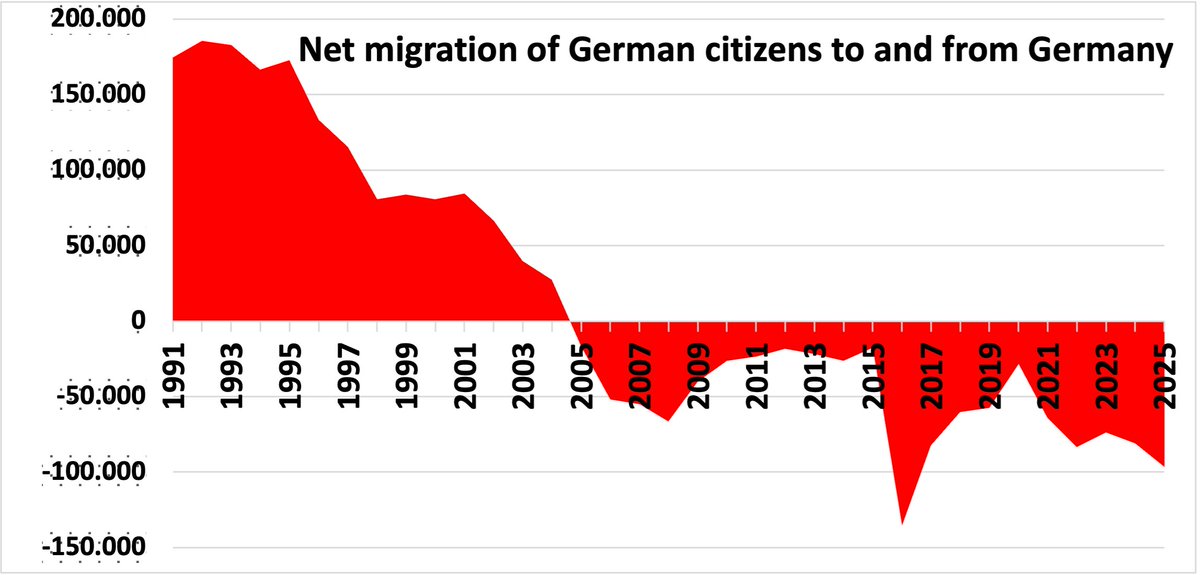
Good Morning from Germany, where more and more German citizens are leaving the country.
Last year, 288,579 Germans moved abroad, up from 270,000 the year before – a fresh record. The number of Germans moving back to Germany rose slightly, from 189,000 to 192,000. But the net balance still worsened to almost -97,000. That is the 2nd-highest net outflow of German citizens in the country’s history. Only 2016 was worse, at -135,000.
@elonmusk I live in Germany so no fsd. Was in Texas this weekend and my bro has a Tesla and made him use fsd. Was SOOOOO COOOOOOOL. What is the eu waiting for?!??