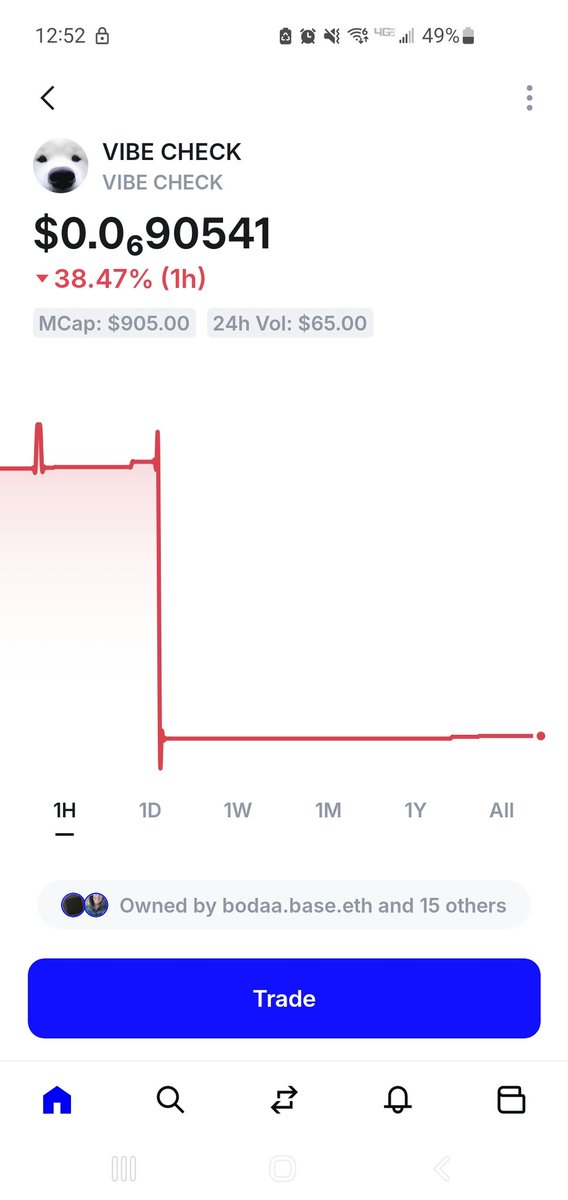
@mizzysworld Well said.
In 2021 everyone either created categories that nobody needed (decentralized social, gameFi, vape-to-earn) or tokenomics that were unsustainable.
Then when it all inevitably failed we declared web3 dead. A live action strawman.
Everyone is looking at this wrong.
No single game, app, or “metaverse” needs to rival Roblox.
In web2, a metaverse (or any app with an ecosystem) is a walled garden.
Individual developers are building experiences on top of the same central platform.
In crypto, a “metaverse” isn’t one central platform but rather a decentralized network of apps.
Like Roblox, crypto users travel between different apps and games while maintaining a persistent inventory and identity (their wallet).
In Roblox, most individual games are ephemeral, with a lifespan of weeks or months. Only a few last long-term. This also sounds a lot like crypto!
So the correct comparison isn’t Roblox vs [individual crypto game] but Roblox vs. an entire network of crypto games / apps.
Roblox is 20 years old. Crypto gaming, and consumer crypto broadly, is much younger.
Over the coming years, we will start to see more robust crypto networks emerge.
Crypto apps and games will have shared currencies, reputation systems, and loot.
The issue is the cold start / chicken and egg problem.
No single app can participate in the network when the network is mostly nonexistent. And the network can’t emerge without participant apps.
We’ve seen networks takeoff in DeFi because “money legos” inherently fit together.
But in gaming and consumer crypto it's less obvious how one app’s assets might interact with another app.
How should the NFT or token from app A gain benefits in app B? What are the incentives for doing so? What are the business models?
Of course individual crypto apps also need to be worth using (not just trading and gambling experiences).
But once individual apps are actually good and there is a network to tap into, consumer crypto will take off.
And we will collectively build experiences way bigger and more fun than Roblox.
@MattBartlettVE Everyone is hyper critical when money is at stake.
If projects would:
1) initially launch without tokens so users can judge the actual project and
2) stop having terrible tokenomics
Then maybe CT would appreciate them better.
Crypto makes the internet multiplayer.
Earn tokens and NFTs in one app and take them to another to get new benefits.
The challenge is overcoming the "chicken and egg" problem to bootstrap this network effect.
@Kam_Punia This is the problem with consumer crypto broadly: economy before product.
Consumer teams think they need to financialize their apps to justify their crypto identity.
The irony is hyper financialization killed read write own.
But now the only people left in crypto are the traders and finance people.
So everyone is doubling down on trading experiences because those are the only users left.
After many events last week, everyone is saying @cdixon's “Read Write Own” era is dead.
That’s the wrong conclusion.
What actually died was Read Write Own theater. For years, the industry shipped speculative products, unsustainable incentives, and onchain casinos with terrible UX and labeled it “Read Write Own.” Tokens first. Users second.
Nothing broke through. So now everyone has capitulated and decided crypto is only about speculation, betting, trading, and perps. Is anyone surprised that products that give or make users money found PMF?
That doesn’t mean the Read Write Own vision was wrong. It means we haven’t figured it out yet.
The Read Write Own era never really started. But now it can.
To me, everyone giving up on Read Write Own is bullish. Clean slate. Regulation is nearing the finish line. The tech is finally good enough to hide the wires.
THIS is the moment to build real products with real value when nobody is paying attention, not another casino.
@blknoiz06 1) Teams are building hyper financialized apps that no normal consumer wants.
2) Consumer crypto will become one internet-wide metaverse. But like any network it has a chicken and egg / cold start problem.
https://t.co/2hRoqwGBhE
Metaverse is the end state of consumer crypto.
But not Metaverse as in some vr world (that will happen eventually).
Metaverse as in a multiplayer internet, in which we earn stuff (items, reputation, assets) and take them between apps, unlocking new benefits.
@wabdoteth@sotoalt_ Yeah, I'm not sure why this is so hard for consumer crypto builders to understand.
Normal people don't want to be thrust into ruthless financial PvP where they can easily lose all their money.
@wabdoteth Sooner or later consumer crypto teams will realize crypto isn't only "finance tech."
And the key to mainstream apps is to instead see crypto as "game design tech."
https://t.co/ZpDUYYcsJl
@0xNairolf This is just web3. Or Metaverse. Or whatever you want to call it.
The real challenge is cold starting the multiplayer network effect: getting apps to incorporate each other's onchain loot.
https://t.co/2hRoqwGBhE
Metaverse is the end state of consumer crypto.
But not Metaverse as in some vr world (that will happen eventually).
Metaverse as in a multiplayer internet, in which we earn stuff (items, reputation, assets) and take them between apps, unlocking new benefits.
Metaverse is the end state of consumer crypto.
But not Metaverse as in some vr world (that will happen eventually).
Metaverse as in a multiplayer internet, in which we earn stuff (items, reputation, assets) and take them between apps, unlocking new benefits.
“Too often, we in crypto think that if you insert a speculative coin into something, that counts as innovating.”
This is the problem with consumer crypto at large.
Everyone thinks you can take a web2 idea and just slap a token on it; decentralize it; or call it xFi.
In 2026, I plan to be fully back to decentralized social.
If we want a better society, we need better mass communication tools. We need mass communication tools that surface the best information and arguments and help people find points of agreement. We need mass communication tools that serve the user's long-term interest, not maximize short-term engagement. There is no simple trick that solves these problems. But there is one important place to start: more competition. Decentralization is the way to enable that: a shared data layer, with anyone being able to build their own client on top.
In fact, since the start of the year I've been back to decentralized social already. Every post I've made this year, or read this year, I made or read with https://t.co/BJ3J4TvNNu, a multi-client that covers reading and posting to X, Lens, Farcaster and Bluesky (though bluesky has a 300 char limit, so they don't get to see my beautiful long rants).
But crypto social projects has often gone the wrong way. Too often, we in crypto think that if you insert a speculative coin into something, that counts as "innovating", and moves the world forward. Mixing money and social is not inherently wrong: Substack shows that it's possible to create an economy that supports very high-quality content. But Substack is about _subscribing to creators_, not _creating price bubbles around them_. Over the past decade, we have seen many many attempts at incentivizing creators by creating price bubbles around them, and all fail by (i) rewarding not content quality, but pre-existing social capital, and (ii) the tokens all going to zero after one or two years anyway.
Too many people make galaxy-brained arguments that creating new markets and new assets is automatically good because it "elicits information", when the rest of their product development actions clearly betray that they're not actually interested in maximizing people's ability to benefit from that information. That is not Hayekian info-utopia, that is corposlop.
Hence, decentralized social should be run by people who deeply believe in the "social" part, and are motivated first and foremost by solving the problems of social.
The Aave team has done a great job stewarding Lens up to this point. I'm excited about what will happen to Lens over the next year, because I think the new team coming in are people who actually are interested in the "social": even back when the decentralized social space barely existed, they were trying to figure out how to do encrypted tweets.
I plan to post more there this year.
I encourage everyone to spend more time in Lens, Farcaster and the broader decentralized social world this year. We need to move beyond everyone constantly tweeting inside a single global info warzone, and into a reopened frontier, where new and better forms of interaction become possible.
@seyong@jaibhavnani This is the issue with consumer crypto broadly.
Cant just slap a token on it; decentralize it; call it xFi or x-to-earn.
You need to build something useful from first principles.
And almost nobody seems to understand how to do that.
The problem with consumer crypto:
Putting trading first, value second.
We have a million ways to trade tokens. But the tokens are slop. Nobody holds. Everything goes to zero.
We need the reverse:
Put value first and let trade emerge naturally.
@thecryptomayne Open edition is just one example.
But in general I think token design is a better place to find solutions and create more normie friendly ux.
Even without sniping volatile tokens aren't normie friendly, give sharks an advantage, etc.
Instead of trying to combat sniping, more apps should
have tokenomics that are snipe-proof.
E.g. open edition NFTs can't be sniped because the price is the same for everyone.
Combine this with a limited minting window, after which supply locks and price discovery can happen.
If @zora wants to really succeed, they need to address the sniping problem.
On Clanker, there was a sniper who made millions - every launch was sniped.
Eventually, people stopped trading, and the money never returned to the trenches.
Most tokens with volume have snipers as top traders, with a huge gap compared to others.
One problem with creator / content coins is their form factor:
They have a $ticker. They trade like financial assets. You view their charts and interact with them through exchanges.
These need a completely different, non financey feel if they are ever going to go mainstream.