@RodriSabato@tavogomez75 Cuando existía la vuelta a México @DavidFaitelson_ reportaba desde la moto tras el pelotón, por ahí debe haber videos… tampoco veo tan errados sus comentarios y que bueno que los grandes medios hablen de ciclismo, como sea ayuda al deporte en México 🇲🇽
@sofiageyer@cesifoti La pobreza no genera ser prepotente y mucho menos es una característica de la gente que está en esa situación.
Los jugadores y la afición argentina tienen un comportamiento injustificable que deberían de empezar por reconocer.
Argentina’s behavioral crisis in the World Cup final has brought to light traits many of us in Latin America have internalized and that we need to come to terms with.
In many countries, emotional self-control and the ability to admit mistakes are seen as virtues. A behavioral problem in parts of Latin America is that there are social circles where the opposite is often celebrated.
This is the idea that someone who remains in control of their emotions is a coward or, depending on the situation, a traitor.
If someone offends you, your family, your team, the reaction that is celebrated in these circles is not restraint but flipping the table. The more berserk you go, the more you show that you care. That is a harmful value to hold, and also, one that many of us once shared. I certainly had it internalized when I left Chile 20+ years ago. In fact, I’ve spent much of my adult life trying to unlearn what I grew up believing was the socially acceptable behavior.
The second trait is an unwillingness to admit mistakes. You can always find an excuse, move the goalposts, or, once again, start a fight instead of publicly accepting that you’ve made a mistake. Admitting fault is a sign of weakness. Defending a losing position is a symbol of courage or, in sports, a test of loyalty.
Together, these two traits are behavioral dynamite. People explode because they cannot admit fault, and double down. Instead of learning from their mistakes, they become prisoners of them.
I grew up watching football with my father. When I was 10 or so, I was learning what was right and wrong from the way he interpreted the game. This included behavior both on and off the field. Only later in life did I realize that every penalty he called for, or contested, had little to do with the play itself. Whether a call was fair depended entirely on which team benefited. He was happy if his team received a nonexistent penalty or an opposing player got an undeserved red card.
These traits are among the things that pushed me away from the continent. They are certainly not exclusive to Latin America or the Southern Cone. I’ve encountered them in people all over the world. In an important sense, these are behaviors that all of us exhibit as children. What strikes me as unusual from the place I am from is having been part of social circles where these behaviors were not seen as flaws of character but as virtues to be admired, celebrated, and enforced.
These excessive forms of pride are not conducive to learning. They make it psychologically difficult to update one’s beliefs, accept responsibility, or improve. Although they become particularly visible in sports, they are by no means confined to them.
Something I am proud to have learned is to apologize quickly and often. Not because it is too difficult, but because it was like learning a new language at old age. That doesn’t mean becoming a pushover. But I’ve learned that a man who never apologizes cannot be a man of integrity, because we all make mistakes.
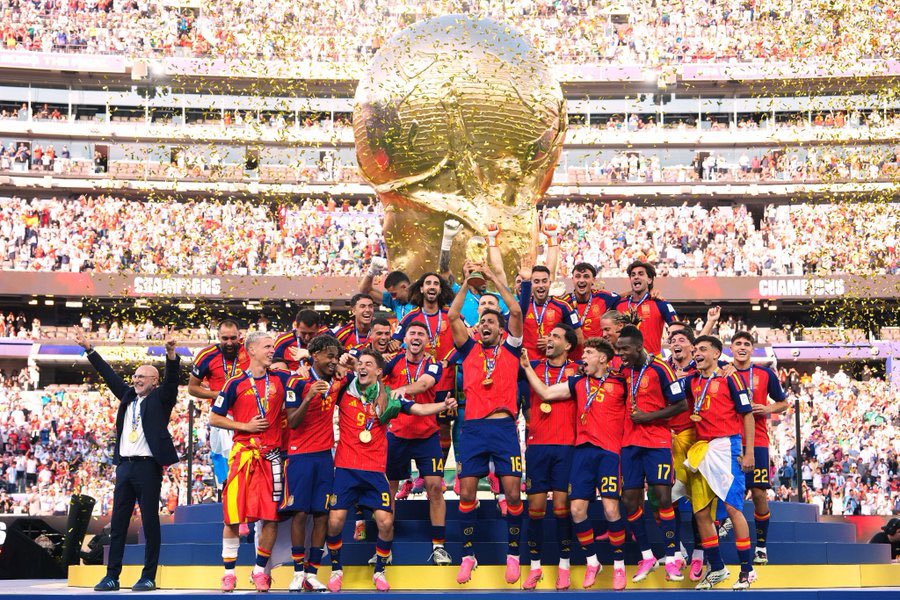
Argentina’s behavior on and off the field during the World Cup final was, to me, a particularly blatant expression of values that many people continue to defend. In some circles, these attitudes have become intertwined with ideas of national identity and loyalty. Yet they are shackles that ultimately limit our development, not because they make us lose a football match, but because they make it harder for us to learn from our mistakes.
The right thing to do now is the least likely: offer an honest apology. If my interpretation is even partially correct, we are more likely to see the opposite. Never back down. Never apologize. Never control your emotions. There is such a thing as having the wrong values. I hope that one day we can do better.
Look at this loser, Leandro Paredes should face a lengthy ban. He couldn’t handle Argentina producing one of the worst World Cup final performances ever. A pathetic sore loser, and then people wonder why this Argentina team is so disliked
No amount of skill makes up for a bad character.
Messi tried to get his opponent sent off for doing nothing wrong.
A shameful way to end a glittering career. We can be glad he lost.
🚨👊🏼 IMÁGENES COMPLETAS
Aquí empezó todo. Puñetazo de Molina a Rodri. Los españoles iban sólo a celebrar (se ve mejor en siguiente tuit). Eric lo ve y va a por Molina. 👇🏼 (sigue)
Lo de la @Argentina (@AFA) es la definición de antifútbol y mal perder. No supieron ganar en el campo y han demostrado una falta de dignidad absoluta fuera de él. Dar la espalda y negar el aplauso a la @SEFutbol es una actitud marrullera, tosca e inaceptable para profesionales.
@herqles_es Los jugadores argentinos son marrulleros, tramposos, ofensivos con su celebraciones y malos perdedores y eso lo transmiten a la afición que actúa parecido… por eso resultan antipáticos
Entre dormir o ver otro atraco de Argentina, no había discusión cual era la mejor opción
¿ Alguien sabe por qué aquí el VAR no revisa el teatro de Messi y lo amonesta ?
La FIFA ha dejado a Negreira en una broma
https://t.co/ZFYIQmVMeB
💥EL FBI PONE LA MIRA EN LA AFA.
Medios reportan que el FBI investiga operaciones financieras de la AFA en EE.UU. por presunto lavado de dinero.
A su vez, el Parlamento Europeo pide investigar a Infantino por su gestión y presuntas decisiones arbitrales que beneficiaron a algunas selecciones.
🚨Thierry Henry on Argentina eliminating Egypt from the FIFA World Cup:
🗣️ “For me, this feels like football robbery in broad daylight.
I’m not taking anything away from Argentina’s quality because they have world-class players, but I don’t think they deserved to win this match. Egypt worked incredibly hard to build a two-goal lead. They defended with courage, attacked with confidence and earned every bit of that advantage.
The turning point, in my opinion, was the refereeing. I didn’t agree with the penalty that was awarded to Argentina earlier in the game, and after that it felt as though every important decision was going against Egypt. Whether people agree or disagree, those moments changed the rhythm of the match and gave Argentina the momentum they desperately needed.
Egypt will leave this tournament feeling heartbroken because they were so close to one of the greatest victories in their history. Sometimes football is decided by brilliant moments, and sometimes it’s decided by controversial decisions. Tonight, I believe the officiating will be discussed just as much as the football itself.”
🚨 José Mourinho on Argentina vs. Egypt:
“This is daylight robbery. It’s a shame what football is becoming. How do you let the play continue, allow the goal to be scored, and only then decide to go back and cancel it? If there was a foul, stop the game immediately. Don’t wait until after the goal.
Then I ask another question—why wasn’t Argentina’s first goal reviewed with the same attention when it looked very close to offside? Why was every incident involving Argentina checked, while Egypt didn’t seem to get the same treatment?
VAR is supposed to bring fairness, not confusion. Today, it looked like every important decision went in Argentina’s favour. Football deserves better.”
¡Histórico, Isaac del Toro! 🇲🇽🔥
El mexicano conquistó la Etapa 2 del Tour de France 2026 y volvió a poner el nombre de México en lo más alto. 🙌
Hoy más que nunca, #SomosMéxico. 💚🤍❤️
¡MÉXICO HACE HISTORIA EN EL TOUR DE FRANCIA!
Isaac del Toro ganó la segunda etapa del Tour de Francia. El mexicano sigue confirmando que es una de las grandes figuras del ciclismo mundial.