I'm building Lumi Support.
It's customer support for small teams, all in one place: an AI agent that answers from your help text, calls you in when a person is needed, and contact forms with their own inbox.
$12 a month per AI agent + tax.
https://t.co/GBuXxund1i
My Video editor is ready 😎
It creates motion graphics and edit like @AdobeAE for me.
It has a multi-camera tracker for podcasts also and a bunch of cool features.
MCP ready, so my Claude talks to it directly 🕺💃🏼
I’ll publish it soon 🥳
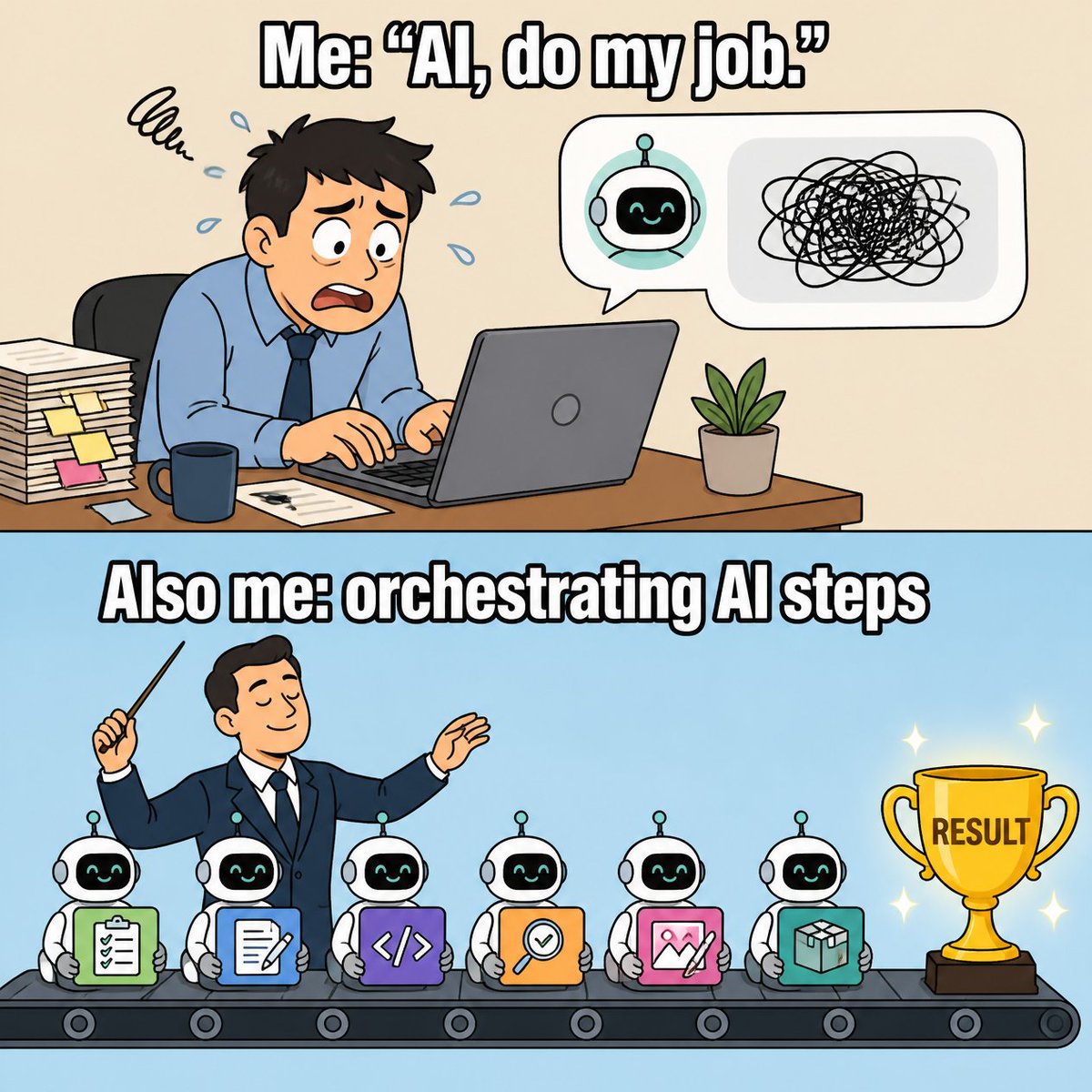
AI is not replacing people. It is replacing job titles.
Big companies are cutting thousands of jobs. Many teams are half the size they were.
But here's what I see: AI doesn't remove humans. It removes fixed roles. "I'm a designer." "I'm a copywriter." "I'm a junior dev." Those boxes are breaking.
Anyone can get an OK answer from AI in one or two prompts. That's not a skill anymore.
The real skill is directing AI:
→ breaking a big problem into steps
→ connecting many AI steps into one pipeline
→ checking, fixing, and pushing it to a result that's actually valuable
That's something AI can't do for itself.
I've been a developer for 10 years. For the last 4, I've used AI in my work every day. Today I can build things with AI that most people can't, not because I have better tools, but because I know how to orchestrate them.
So the question is not "Will AI take my job?"
It's "Can I lead AI?"
The people who can will have the jobs and make the money.
@jack Does Dessa truly understand the melodic aesthetics of human speech: the natural resonance, vocal timbre, and musical cadence our vocal cords produce?
Well I come from the same route, I would say you need at least 50k cash before leave your 9-5 job:
1. Building is cheap and easy but selling your product is much harder than ever and AI cant do anything about it.
2. Anxiety and depression seating on the route as much as you go further from your 9-5 job.
The best route is to keep your 9-5 job, and try to build your products with claude 20x, automate your process then building is running while you are sleep or on the 9-5 job.
Then try to sell your services, only if you find 10-100 customers then you can think to leave your main job.
@dee_hw Claude Code at work and Codex at home is my exact week too. One command center for all of them makes sense. I built the other end: AI Council decides what to build, then hands the work to Claude Code or Codex sessions. Good luck today Dee.
@dschewchenko Same launch day as us, and nearly the same idea: AI answers, the team takes over the same chat. Order checks and booking flows are a smart wedge. I built Lumi for that exact handover, so happy to swap notes on what users ask for first. Happy 7th to the account too.
@ifbuilder Thanks Emir, "a product team inside git" is exactly how I think of it. The repo is open source if you want a look, and the launch page has the details: https://t.co/EHyo48lScj
Launched 2 products on Product Hunt today, solo:
Lumi: AI support chat + contact forms for small teams
AI Council: an open-source AI product team that lives in your git repo
Day 1 lesson: building is the easy part. Getting seen is the actual job.
What got your first launch noticed?
10 AI agents were pinging me all day. Now I talk to one, and my mind is calm.
What changed?
The middle doesn't need me anymore.
A few weeks ago, Claude Opus 5.5 let agents run subtasks across many sessions. At first, I used it the wrong way: more agents, more tabs, more reviews. I lost the deep work feeling.
So I built my own "AI console":
→ I talk to one agent, by voice or text.
→ My expectations + the AI's plan become the execution plan.
→ Sub-agents do the work in the background.
→ Only what matters comes back to me.
Behind it, AI manages a document repository. I defined the structure once. I never read it.
I only care about the query. I carry the big picture in my mind, and each question gives me a clear view of one piece.
Multiply this by 10 or 100. With proper testing, I ship 10–20 heavy features in a few days.
The pattern:
- Build a pipeline.
- Sit at the front.
- Get the results at the end.
My honest view: maintenance is no longer my job. AI does it better. My job is to set expectations and test results.
This works for any complex process. Software, video, research.
Are you at the front of your pipeline, or stuck in the middle?