If you want to become top 1% at building AI agents, start with these 10 papers.
These papers shaped almost every modern AI agent framework.
1. Chain-of-Thought Prompting (2022)
What you'll learn: Why asking an LLM to reason step by step dramatically improves complex problem solving. This paper laid the foundation for reasoning models.
https://t.co/IvmquaonBF
2. ReAct (2022)
What you'll learn: How agents can alternate between thinking and taking actions, enabling them to search the web, call APIs and solve real-world tasks.
https://t.co/0jI2oDpAmu
3. Toolformer (2023)
What you'll learn: How language models can learn when and how to use external tools like calculators, APIs and search engines without constant human prompting.
https://t.co/gjOXrrwOvO
4. Generative Agents (2023)
What you'll learn: How AI agents can maintain memory, form relationships, plan ahead and exhibit believable long-term behavior in simulated environments.
https://t.co/O2AKL5ivN4
5. Reflexion (2023)
What you'll learn: Instead of retraining the model, agents improve by reflecting on their mistakes, storing lessons and using them in future attempts.
https://t.co/cLpTjZM3sy
6. Tree of Thoughts (2023)
What you'll learn: Why exploring multiple reasoning paths and backtracking often beats linear Chain-of-Thought reasoning on difficult problems.
https://t.co/YEh2S92vw7
7. HuggingGPT (2023)
What you'll learn: How one LLM can orchestrate dozens of specialized AI models to solve multimodal tasks involving text, vision, audio and more.
https://t.co/qBRuELHQwU
8. Voyager (2023)
What you'll learn: How an autonomous agent continuously learns, writes its own skill library and becomes more capable over time without restarting from scratch.
https://t.co/kW2tYNo9Eq
9. AutoGen (2023)
What you'll learn: Why multiple AI agents collaborating through structured conversations outperform single-agent systems for complex workflows.
https://t.co/ARqDWhmDPk
10. A Survey on LLM-Based Autonomous Agents (2023)
What you'll learn: A complete overview of the field from planning, memory and tool use to multi-agent collaboration, evaluation methods and future research directions.
https://t.co/VUkxAZUg1F
(Bookmark this)
follow @suraj_sharma14 for such useful resources.
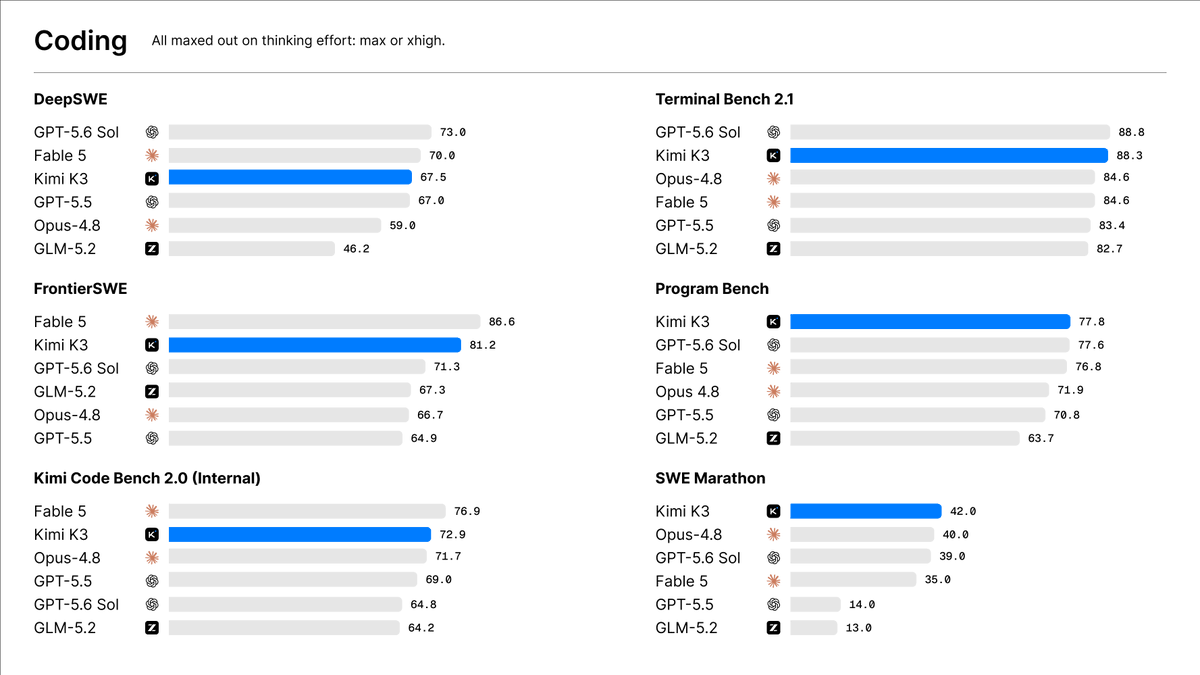
Introducing Kimi K3: Open Frontier Intelligence
🔹 2.8 Trillion Parameters, 1 Million Context, Native Multimodal
🔹 Kimi Delta Attention enables up to 6.3x faster decoding in million-token contexts
🔹 Attention Residuals deliver ~25% higher training efficiency at <2% additional cost
🔹 Built for long-horizon agentic coding and self-evolving workflows
Kimi K3 is now live on on https://t.co/zrk6zZxZUo, Kimi Work, Kimi Code, and the Kimi API.
Open Weights by July 27, 2026.
🔗 API: https://t.co/XCrgjXAqMw
🔗 Tech blog: https://t.co/YTfiMSNM1f
Before optimizing indexes or adding Redis, check for N+1 queries.
The fix is usually simple: fetch related data together using JOINs, eager loading, or batching instead of querying inside a loop.
Less database trips = faster APIs
One backend mistake that looks small but kills performance: the N+1 query problem.
Imagine you're showing 100 orders.
First, your app runs 1 query to fetch all orders.
Then, for every order, it runs another query to fetch the customer...................
So instead of 1 query, you end up making 101 queries.
Everything works fine in development with 10 records, but once real users and larger datasets arrive, response times suddenly become much slower because the database is doing hundreds of unnecessary round trips.
‼️BREAKING: Telegram's core t[.]me domain has been placed on serverHold at the .me registry, a registry-level status that drops it from DNS worldwide and dead-ends every t[.]me link.
Domain records show the change happened today, with no public explanation yet from Telegram, the .me registry, or backend operator Identity Digital.
@officialdev_bml Full Stack AI Engineer. I build end-to-end web/mobile apps with features & integrations, fast, focused & can take ideas from zero to shipped product. would love to connect.
here is my portfolio:
https://t.co/wiS5hzkDyj
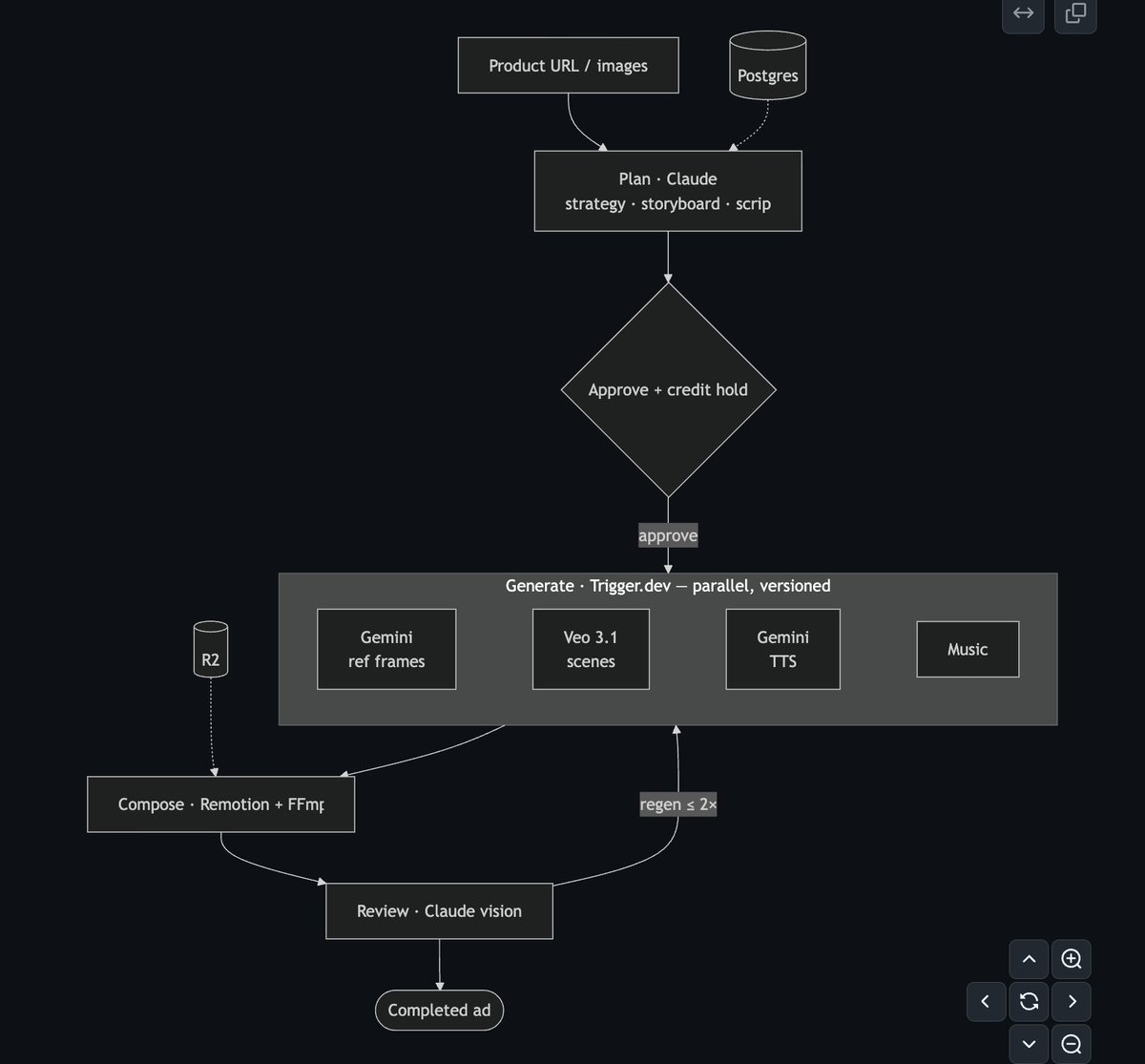
I'm building AdPilotX. Turn any product into high-converting AI video ads with automation in social media. If you have some insights for building video generation pipeline, please review the architecture and give me feedback. would love to open a discussion!
#adpilotx#adautomate
stack: Next.js (App Router) · Postgres + Drizzle · Bun · Recharts. dashboard does spend-over-time, cost-by-model, cache-hit ratio, filterable to the last 24h.
same response, same latency it just observes.
https://t.co/MageYhPNEN
so a friend gave me an Anthropic API key, and instead of just... using it responsibly, i went and built a whole app to see exactly how much of it i'm burning through 😅 it's called Token Meter ....
@SpaceX@cursor_ai We're witnessing the transition from:
IDE → Al Copilot → Autonomous Engineering Platform.
And companies that depend on world-class engineering execution are paying attention.
The reported @SpaceX acquisition of @cursor_ai is interesting not because it's a rocket company buying a code editor.
It's because Al-assisted software development is rapidly becoming an engineering advantage.
@SpaceX@cursor_ai The long-term value isn't autocomplete.
It's having an Al system that understands an entire codebase, reasons across repositories, suggests architectural changes, generates tests, identifies regressions, and acts as a collaborative engineering agent.




![IntCyberDigest's tweet photo. ‼️BREAKING: Telegram's core t[.]me domain has been placed on serverHold at the .me registry, a registry-level status that drops it from DNS worldwide and dead-ends every t[.]me link.
Domain records show the change happened today, with no public explanation yet from Telegram, the .me registry, or backend operator Identity Digital.](https://pbs.twimg.com/media/HNIpZxQXMAALM0w.png)
![IntCyberDigest's tweet photo. ‼️BREAKING: Telegram's core t[.]me domain has been placed on serverHold at the .me registry, a registry-level status that drops it from DNS worldwide and dead-ends every t[.]me link.
Domain records show the change happened today, with no public explanation yet from Telegram, the .me registry, or backend operator Identity Digital.](https://pbs.twimg.com/media/HNIpZxLWsAAoLQo.jpg)


![IntCyberDigest's tweet photo. ‼️BREAKING: Telegram's core t[.]me domain has been placed on serverHold at the .me registry, a registry-level status that drops it from DNS worldwide and dead-ends every t[.]me link.
Domain records show the change happened today, with no public explanation yet from Telegram, the .me registry, or backend operator Identity Digital.](https://pbs.twimg.com/media/HNIpdIUW0AA8Z5g.jpg)