Hi, i’m building Amaya, an open-source AI workspace for Android written natively in Kotlin.
The idea started from a simple frustration: using AI across multiple services can get expensive very quickly. Many AI apps require another monthly subscription, limit you to their own models, or make it difficult to use the provider account you already pay for.
I wanted an Android AI workspace where you can bring your own provider connection, choose the models you want, and organize your work in one place without adding another mandatory AI subscription.
Amaya does not provide AI credits or sell model subscriptions. You connect your own provider account and API key, then use the models available through that connection. This makes it possible to use the providers, gateways, and pricing plans that already fit your needs.
The app currently supports connections through OpenAI Codex authentication, direct OpenAI API access, Anthropic, Gemini, OpenAI-compatible APIs, custom endpoints, and compatible gateways such as OpenRouter, Groq, DeepSeek, Kimi, MiniMax, xAI, https://t.co/P0HJgQ4OBp, GitHub Models, and Vercel AI Gateway.
I also wanted the app to be more than a simple chat interface. Different work needs different spaces, so Amaya has three main modes:
- Chat: for conversations, writing, planning, research, saved memory, skills, and session recall
- Projects: for work connected to folders, or document collections
- Agent groups: for persistent specialists with their own instructions, memories, selected models, and configurable permissions. This is my quote repost of a tweet originally posted by Agent Mode.
Still early (v1, Android 8.0+, APK on GitHub Releases). Feedback and issues welcome, especially on provider compatibility since some gateways are still untested.
Check out the repository:
https://t.co/aO43tdIs9z
If you like Amaya, please upvote it on Product Hunt:
https://t.co/Q3Lcvy6XhZ
Hi, i’m building Amaya, an open-source AI workspace for Android written natively in Kotlin.
The idea started from a simple frustration: using AI across multiple services can get expensive very quickly. Many AI apps require another monthly subscription, limit you to their own models, or make it difficult to use the provider account you already pay for.
I wanted an Android AI workspace where you can bring your own provider connection, choose the models you want, and organize your work in one place without adding another mandatory AI subscription.
Amaya does not provide AI credits or sell model subscriptions. You connect your own provider account and API key, then use the models available through that connection. This makes it possible to use the providers, gateways, and pricing plans that already fit your needs.
The app currently supports connections through OpenAI Codex authentication, direct OpenAI API access, Anthropic, Gemini, OpenAI-compatible APIs, custom endpoints, and compatible gateways such as OpenRouter, Groq, DeepSeek, Kimi, MiniMax, xAI, https://t.co/P0HJgQ4OBp, GitHub Models, and Vercel AI Gateway.
I also wanted the app to be more than a simple chat interface. Different work needs different spaces, so Amaya has three main modes:
- Chat: for conversations, writing, planning, research, saved memory, skills, and session recall
- Projects: for work connected to folders, or document collections
- Agent groups: for persistent specialists with their own instructions, memories, selected models, and configurable permissions. This is my quote repost of a tweet originally posted by Agent Mode.
Still early (v1, Android 8.0+, APK on GitHub Releases). Feedback and issues welcome, especially on provider compatibility since some gateways are still untested.
Check out the repository:
https://t.co/aO43tdIs9z
If you like Amaya, please upvote it on Product Hunt:
https://t.co/Q3Lcvy6XhZ
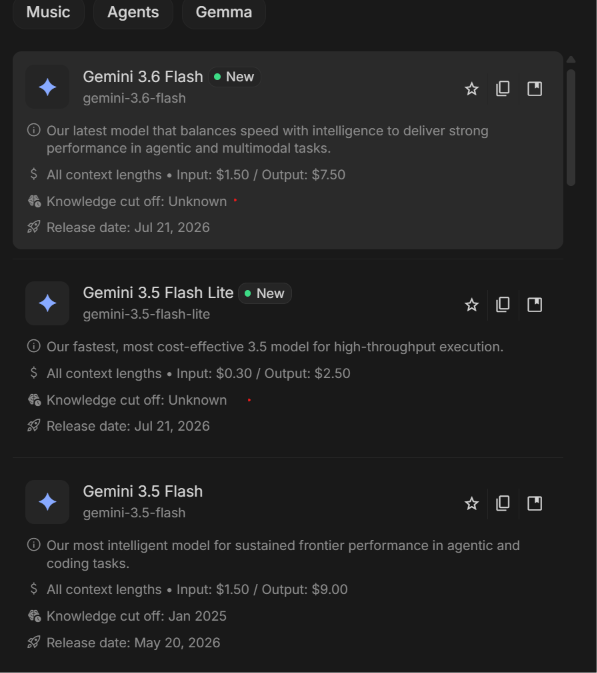
Gemini 3.6 Flash hadir! 🚀 Model AI terbaru dari Google ini dirancang khusus untuk menekan biaya token enterprise. Cocok banget buat bisnis yang deploy AI agent dalam jumlah besar. Efisien, scalable, dan hemat biaya! #GeminiFlash#AI#Google#EnterpriseAI
Anthropic is under serious pressure right now...
They’re the only major lab still pushing the most restricted, closed approach while the rest of the industry is clearly moving in the opposite direction
Jensen, Elon, Satya, Sam, and Zuck all publicly backed open-weight models today. Anthropic stayed completely silent...
meanwhile, Anthropic has spent the last year aggressively lobbying for tighter controls, pushing for restrictions on open models, and working behind the scenes to keep powerful AI locked down. Now the entire industry is shifting against them
Mark Zuckerberg didn’t post on 𝕏 for 3 years. He runs platforms with over billion users, yet he returned to 𝕏 to promote his product.
Jensen Huang never had an account on 𝕏. Today he signed up & made his first post.
When the most influential people have something important to say, they come to 𝕏.
𝕏 is the global town square.
For my first post, I’m sharing a letter @NVIDIA signed on why open models matter.
AI will transform every industry, power every company, and be built by every country.
Open models strengthen safety and cybersecurity, accelerate innovation and diffusion, and enable sovereignty.
The world needs both frontier closed models and frontier open models.
https://t.co/AUKzoQ5Ikb
Gemini 3.6 Flash hadir! 🚀 Model AI terbaru dari Google ini dirancang khusus untuk menekan biaya token enterprise. Cocok banget buat bisnis yang deploy AI agent dalam jumlah besar. Efisien, scalable, dan hemat biaya! #GeminiFlash#AI#Google#EnterpriseAI
These will instantly make your vibe-coded projects look less generic.
Free, open-source libraries from the same creator:
• https://t.co/uAm33shhlw
• https://t.co/HQkRYF0Lk3
• https://t.co/3urE4b8r7z
Google seriously??
Gemini 3.6 Flash knowledge cutoff is March 2026, yet when I asked for the best frontier model, it said "Claude 3.5 Sonnet"
can anyone explain this?
A Reddit user gave Claude Code their HP laptop's BIOS dump.
Asked it to unlock the firmware.
Claude disassembled the signature-check code.
Found the RSA-2048 verification function.
Then wrote a Python script to bypass it.
The user modified the BIOS.
Flashed it back.
Got access to four hidden menu tabs.
Dozens of hidden firmware settings.
All because Claude Code reverse-engineered the security.
HP's BIOS throws a corruption error if it detects modification.
Claude found the exact byte that triggers it.
Then showed how to change it.
The user used Ghidra to disassemble. UEFITool to extract. Unicorn Engine to emulate the signature check outside the real BIOS.
Then used cryptography libraries to generate valid test signatures.
Claude wrote all the scripts.
Guided every step.
The disclaimer says get a chip flasher like a CH341A in case it bricks.
Translation: this might brick your laptop permanently.
The user did it anyway.
And it worked.
HP spent engineering resources on RSA-2048 signatures.
Claude spent five minutes showing how to break them.
The post says the Python script at the end might work with similar HP models.
So now anyone with Claude Code and a BIOS dump can unlock their laptop.
HP's security. Dead in one conversation.
Samsung just dropped an AI-powered health assistant, joining a packed market. The health tech race is getting serious — AI is no longer just for chatbots and image gen, it's moving into actual healthcare. Interesting times ahead.
🚀 Grok 4.5 by SpaceXAI rilis Juli 2026!
• 1.5T parameter Mixture-of-Experts
• Trained on Cursor interaction data
• 83.3% di Terminal-Bench 2.1
• Cuma pake 25% token dibanding Opus 4.8
• Harga: $2/$6 per 1M tokens (in/out)
Price war AI makin seru 🔥
#Grok4#xAI#AI
Elon Musk beli perusahaan pembangkit listrik senilai Rp18 triliun buat pasokin daya ke AI Grok. Serius banget dia push infrastruktur AI sampe level energi.
Kompetisi AI makin gila — gak cuma soal model sama data, tapi juga siapa yang bisa nyalain lampunya.