“Prividium positions a model for institutions utilizing blockchains anchored to Ethereum.”
Prividium is an institutional Bank Stack for Web3. Built at @zksync.
• Banks and enterprises manage private ZKsync chains within their own infrastructure or agreed cloud.
• Execution and state of transactions are private and off chain.
• Only state roots and zero knowledge proofs are sent to Ethereum.
• Public networks are not privy to balances, addresses, or calldata.
Infrastructure layers have privacy and compliance built in.
• Access control based on user roles.
• Compliance logic that is always on.
• Auditors and regulators have selective visibility.
• Governance and data sovereignty.
Staying native, connected.
• Private chains use Ethereum to anchor for security and verifiability.
• Interoperability with other ZKsync chains is native.
• No custodians or bridges to the outside world.
The importance of this development.
• Web3 adoption by institutions is made possible without exposing internal systems.
• Access for regulators is verifiable, without visibility to the entire ledger.
• Public liquidity and settlement are accessible to private finance.
Prividium develops the perspective that private blockchain systems are internal financial infrastructure, rather than consumer products. Learn about the combined privacy, compliance, and connectivity in the institutional stack from @zksync and Prividium.
@__Josephlee@zksync This approach reframes blockchains as internal financial infrastructure, not public products, without sacrificing verifiability or interoperability.
InfoFi rip makes it possible to make money when arguing.
At https://t.co/xtpJVBKSEe disputes become USDC markets that are backed & settle based on the quality of your arguments. I already do debating online. This is an upgrade.
Arguing online for no cost is over.
https://t.co/70IGKSpTgE converts disagreements into marketplace. Wager USDC on the quality of the argument, not on who wins. It is a fun experiment where participants’ opinions finally have something on the line.
@__Josephlee@nirvana_fi The shift toward protocol owned floors feels meaningful and could change how teams and long term holders think about risk on Solana.
I have tested Samsara from @Nirvana_Fi and the launch is looking good.
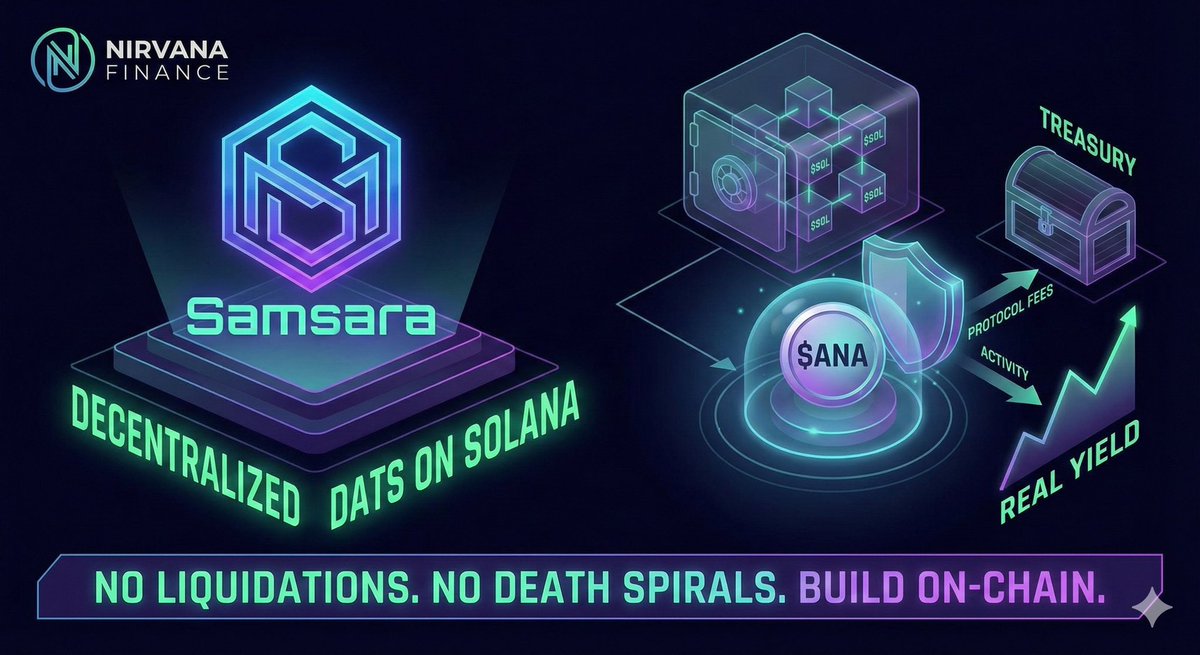
Nirvana launched a new product called Samsara. Teams can now launch decentralized DATs on Solana. It's like building on-chain treasuries, Microstrategy style. Built on $SOL.
Samsara provides a token floor. The floor is from protocol-owned ANA and other assets. There are no forced liquidations, no death spirals.
This is the most interesting part: the AVM (automated value mechanism) has a redeemable floor on ANA. Treasury assets back ANA at a minimum price, and the market price can only float above or hug the floor. Honest pressure is maintained via arbitrage and removal of extraction trading.
REAL yield comes from protocol fees when you stake $ANA. Yield comes from activity, not emissions. DATs will plug into the same system.
This is important for Solana DeFi. Floors change trader behavior. Teams can now grow instead of defend and now long term holders have the upside of protection.
The mechanics are well documented. https://t.co/lRRVMJ1hbF
The full application is here: https://t.co/cdgz99AXFg
I wonder how the floor works under stress. Let me know if you have any thoughts or questions.
Unmasking Fake Yields: Solstice Labs' Commitment to Transparency
Tired of misleading DeFi yields?
@ben_solstice CEO of @solsticefi exposes the truth behind fake APYs and shares how Solstice builds trust with real-time proof of reserves, third-party attestations, and audited returns.
Learn to do your due diligence!
“InfoFi is dead. Rally is more alive than ever.”
@RallyOnChain. Kaito and Cookie broke on APIs. Old InfoFi is gone.
Rally is a protocol designed to last.
@__Josephlee Aligning supplier rewards to real time usage instead of fixed emissions is exactly how decentralized compute survives bear markets and earns trust.
Most DePIN networks fail for one simple reason. They pay for supply even when nobody uses the network.
Emission schedules that are too constant may look good in bull runs. In bear runs, revenues drop, but the tokens never stop printing. Supplier revenues dry up. GPUs power off. AI workloads become less reliable.
@ionet is pioneering a new model with the Incentive Dynamic Engine, or IDE, scheduled for launch in Q2 2026.
IDE focuses on the real time relationship between GPU usage and revenue. There are no fixed timetables, and inflation is never blind.
The sustainability ratio is the primary signal. It measures real network revenue against target USD supplier payouts. If CPU usage goes down, the revenue comes down. If demand goes up, the work gets done, and supply rewards increase.
To manage volatility in a contrarian manner, two vaults are employed. In an up cycle, supplier payouts are less and the remaining revenue is set for buybacks. At a minimum, 50% of the purchase goes to $IO, decreasing the supply and increasing the demand.
In down cycles, the vaults' reserves are released to provide supplier payouts, which are stitched to the USD targets. Operators are incentivized to keep devices running, maintaining supply capacity.
This is the age of maturing decentralized compute. Economic incentives will align with actual workloads, inflation will disappear, and reliability will rise. @ionet is the theoretical backbone of infrastructure AI teams.
Continuing to trade on @grvt_io.
Reason. Negative fees for makers.
You gain money placing resting bids and offers.
For market makers, fees decide the edge.
On Grvt, rebates counter slippage during busier days.
Execution is fast due to the off chain matcher.
Settlement is on chain so you still retain custody.
This setup keeps me there.
it’s a great day to talk about what @MysticDAO is building.
• Mystic runs a gamified DeFi ecosystem on Solana. Staking, trading, and collectible cards connect.
Players stake $MYSTIC tokens.
Players open packs.
Cards boost yields.
Rewards flow over time.
it’s a great day to talk about what @MysticDAO is building.
• Mystic runs a gamified DeFi ecosystem on Solana. Staking, trading, and collectible cards connect.
Players stake $MYSTIC tokens.
Players open packs.
Cards boost yields.
Rewards flow over time.