This guy quietly built the best physics textbook on the internet, and he gives it away for free.
His name is Bartosz Ciechanowski.
He is an ex-iOS engineer who writes interactive articles about physics, math, and engineering as a weekend hobby.
The site is called https://t.co/o0y0n63P48.
Open the article on the Mechanical Watch. Drag the watch to spin it. Pull a slider and the case peels away so you can look inside. Wind the mainspring by hand. Slow down time and watch the escapement click, the balance wheel breathe, the date wheel turn.
Nothing is a video. Everything is a live 3D simulation running in your browser tab.
He has done this for:
→ The Moon and its tides
→ GPS satellites
→ Gears and mechanical watches
→ The internal combustion engine
→ Bicycles and how they stay upright
→ Cameras, lenses, and light
→ Sound waves
→ Airfoils and how planes fly
Every article is thousands of words long with dozens of hand-coded interactive diagrams.
He writes them alone in his spare time. He publishes only a few per year. In his own words, he wants to keep the content accessible to everyone without ads or paywalls.
No publisher. No university. No company behind him.
One person is quietly shipping better science education than most universities charge tens of thousands a year for.
since you guys loved the exploding tesla..
I used GPT-6 Astra to create a 3D website that pulls apart the male anatomy into 2,234 modeled pieces!
we are in a renaissance of learning
When we say Atlas has pixel-perfect camera control, we mean it.
Atlas precisely follows input camera parameters, including non-planar projections such as the Brown-Conrady distortion model and the Kannala-Brandt fish-eye model.
@BhamidipatiPan1 invented a novel method of camera conditioning and it works beautifully.
🧵 [1/N]
craftbot is an architectural agent harness that utilizes following resources:
📖 manuals\ -> pdf construction manuals and md summaries with a searchable index
💻 tools\ -> python code snippets
📐 skills\ -> specialized agent skills distilled from previous experiments
shown below is a multi-story building generated with a fable 5 agent
code is open-source and on github: lukapiskorec -> craftbot
🚨Architects are going to hate this.
Someone just open-sourced a full 3D building editor that runs entirely in your browser.
No AutoCAD. No Revit. No $5,000/year licenses.
It's called Pascal Editor.
Built with React Three Fiber and WebGPU -- meaning it renders directly on your GPU at near-native speed.
Here's what's inside this thing:
→ A full building/level/wall/zone hierarchy you can edit in real time
→ An ECS-style architecture where every object updates through GPU-powered systems
→ Zustand state management with full undo/redo built in
→ Next.js frontend so it deploys as a web app, not a desktop install
→ Dirty node tracking -- only re-renders what changed, not the whole scene
Here's the wildest part:
You can stack, explode, or solo individual building levels. Select a zone, drag a wall, reshape a slab -- all in 3D, all in the browser.
Architecture firms pay $50K+ per seat for BIM software that does this workflow.
This is free.
100% Open Source.
MEP refers to the mechanical, electrical, and plumbing systems that are essential for a house to operate. This model shows exactly those systems, including ductwork, water tanks, an exterior air conditioner unit, and wiring, all planned out before building begins.
Typically, coordinating these systems for a house this size would cost between $2,500 and $5,000. However, the issues this coordination helps prevent are far more costly than the invoice itself.
In the US, electrical issues are estimated to cause 51,000 home fires annually, leading to $1.3 billion in damages. Water damage from broken pipes or faulty plumbing connections averages $15,400 per insurance claim, and about 1 in 67 homeowners file such a claim each year. By modeling all systems before construction starts, potential problems like faulty wiring or incorrectly installed pipes can be identified on screen rather than after walls are finished, saving significant money when issues arise.
3D modeling is also starting to incorporate AI. Revit 2027 now includes an official MCP connector that allows major AI models to access project files like this one. Currently, the AI can only read the files, not modify them. The article below explains why this is the case for now.
Software has become easier to build, yet hardware still feels really hard
That's why we're building https://t.co/sIMZ9ounSw enter a prompt and get a wiring diagram, BOM, Mech view, and step by step build instructions
It's the easiest way to go from idea to prototype
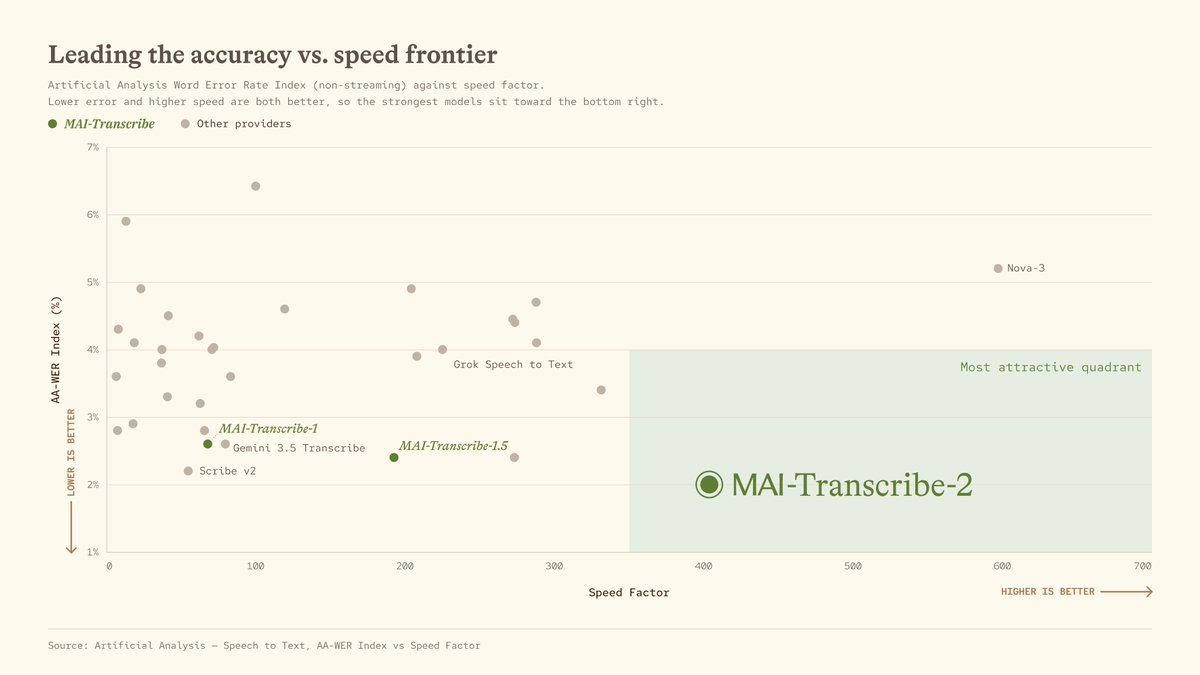
Fastest. Cheapest. Best. ... MAI-Transcribe-2
10x faster than GPT-Transcribe. 5x faster than Gemini 3.5
#1 on the Artificial Analysis accuracy-latency Pareto frontier
Priced at the lowest on the market.
Truly fantastic work from the team! Try it out below.
After years of working in electronics, this feels like a full circle moment. Many late nights later we are releasing Atlas Fields Studios, free for everyone
https://t.co/7oLIWf1Bs9
The Fields Studio App lets you explore electromagnetic behavior around PCB designs
#buildinpublic
Warner Bros and Netflix executives just froze a $100,000,000 historical epic production after seeing this 48-second clip.
A 20-year-old solo creator generated a hyper-realistic scene of a time-traveling travel vlogger interviewing King Leonidas at Thermopylae in 480 BC with zero CGI budget.
Total setup cost: $25.
Render speed: 4 minutes.
Film studio hired: NONE.
142 million views in 3 hours. Half the comments are arguing over the historical accuracy of the 300 Spartans, the other half are demanding a full documentary series.
Here is why your brain falls for this visual magic:
1. Dynamic Lip-Sync & Facial Physics: Perfect voice alignment, realistic sweat textures, and organic micro-expressions on both the presenter and Spartan soldiers mid-march.
2. Multi-Agent Cinematic Consistency: Continuous physics rendering of brass armor reflections, dust particulate dynamics, and synchronized footstep impacts.
3. Spatial Camera Logic: Seamless hand-held vlog aesthetic blended with Hollywood-grade depth of field and realistic outdoor light refraction.
The dynamic next-gen AI stack operating under the hood:
-> Claude 3.7 Sonnet for historical dialogue script, spatial camera vectors, and narrative pacing
-> Veo 3.1 for rendering hyper-realistic cinematic lighting, mountain environments, and volumetric dust
-> Kling 3.0 Omni for generating multi-character marching mechanics, shield physics, and lip-sync alignment
-> Seedance 2.5 for locking facial identity, armor detail consistency, and historical costume accuracy
-> ElevenLabs Spatial for 3D binaural shield clashing, marching footsteps, and acoustic voice reverberation
-> CapCut Pro for adding raw mobile camera noise, dynamic speed ramps, and historical color grading
Hollywood spends hundreds of millions flying 200-person crews to Greece with heavy camera rigs and extra actors.
This creator rendered a full-scale ancient battle documentary before her morning coffee got cold.
Save this breakdown: the full prompt sequence and workflow pipeline are pinned in the thread.
Sim looks pretty good. Fable 5.1 is cooking in VibeCAD.
I have made none of this. About 2 hours of work if you even call this work. Probably like 120 actual seconds of typing into the chat box and then it builds while I work on other things.
Very excited to see what AI in CAD does for robotics development!
Much like agents have commoditized building software, there will be a Jevons paradox for hardware.
~50% of the YC W29 batch will be building robots and designing them with Adam.
Most AI CAD tools stop at generation. CadXStudio doesn't.
We built a Raspberry Pi case from one prompt, then opened the parameter tree and stretched the base height 25mm → 39mm. Every cutout, boss, and wall thickness updated itself. No re-prompting. No broken geometry.
AI can build it. You engineer it.
#TextToCAD #ParametricCAD #CAD
designed by craftbot, a fully autonomous ai architect (fable 🤖)
it ingests manuals, reference images and plans, generates procedural models with python, verifies geometry using screenshots in headless blender, iterates on brief until it converges...
>_ https://t.co/g62Vd7yWVT