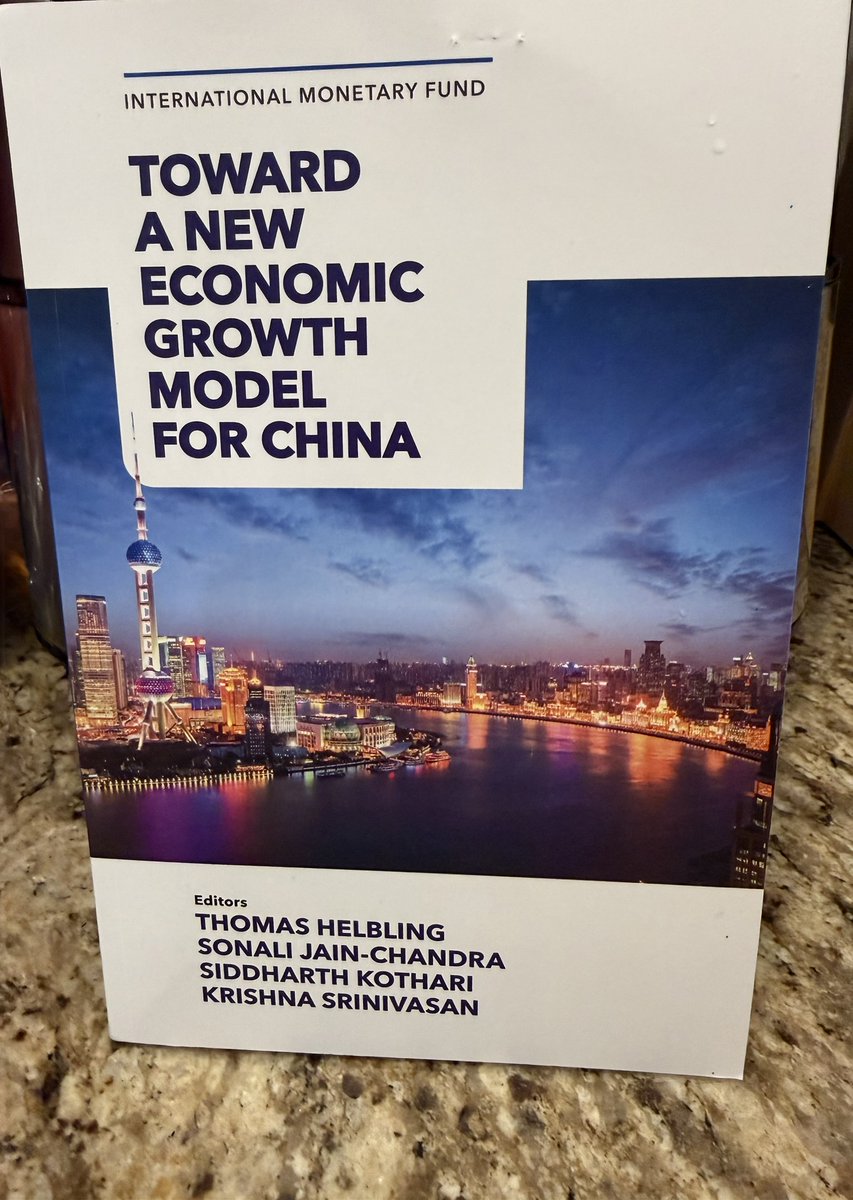
A must read book on China, on what's worked, what hasn't, and what is needed. Rigorous and thoughtful analysis from @IMFNews. Read here: https://t.co/2LW3AZRErB
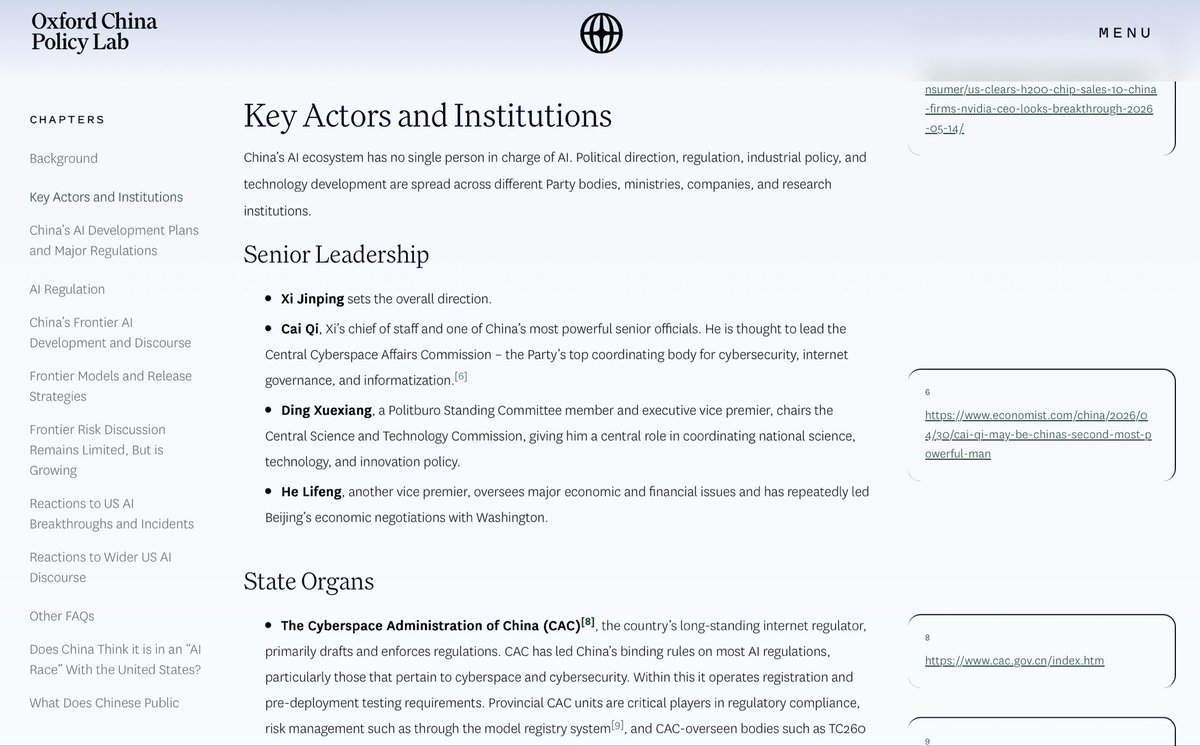
My amazing old team at Oxford China Policy Lab has just released an essential primer on China’s AI landscape. It’s non partisan and objective, bringing together key people, state organs, institutions and regulations.
https://t.co/J4BwW0aKA8
1/ China AI Bulletin Issue 12 is out: developments from September 9–23 (plus the Trump–Xi summit). Xi and Trump discussed AI, but no AI agreement. Also: a proposed BRICS AI open-source zone and Alibaba says Qwen3.8-Max made progress toward recursive self-improvement. 🧵
In July, Moonshot AI, the Beijing lab behind the Kimi chatbot, paused new consumer subscriptions. It said demand since the K3 launch had pushed close to its capacity limit.
This week Amazon added K3 to Bedrock, its model platform. Bedrock customers now run K3 on Amazon's servers.
In July I wrote that at the frontier, the reward for winning is a larger compute bill. My read is that Bedrock moves part of that bill onto Amazon. What Moonshot earns in return likely runs through a licence clause. Neither side has disclosed the financial terms:
https://t.co/8vbHIoEWnc
Stanford just leaked this free class that explains how Claude and ChatGPT work from the inside
Most people waste 90% of their potential
Stanford teaches it to you in 1 hour and 50 minutes
Bookmark this so you don't miss it.
New newsletter: WHY WE'RE WRONG ABOUT CHINA AND AI
America's frontier AI policy seems to hinge on China. But when you talk to people at or near the frontier, it's astonishing how little we seem to know about how China thinks about AI.
So, I talked to several experts—@jordanschneider, @kyleichan, @mattsheehan88, @RushDoshi, @ChorzempaMartin, @pstAsiatech and more—and pooled their most interesting comments under 7 big questions, inc:
- What don't the frontier labs understand about China?
- What would actually scare the CCP into taking AI safety as seriously as, say, Anthropic?
- Does China think our AI safety concerns are legitimate, or a conspiracy to keep them down?
- What should we actually do now?
https://t.co/twTk1HPiyT
Just finished narrating The Investing Mind with the wonderful folks at Factory Underground @fustudios. It was a grind but fun to go back through the material: https://t.co/naNUKz4FpL Order now if you you like to listen to books - it will release at the same time as the physical book!
Great chart by @fundstrat. Always loved this one, and it's an important reminder of how the relationship between stocks and rates dramatically changes depending on the level of rates.
To be clear, I’ve always said that Chinese AI leaders were very explicit about aiming for AGI and even RSI.
It’s Chinese political leaders who don’t seem AGI-pilled. And that matters a lot because that’s the great fear in Washington. https://t.co/TFcckA961Q
My latest memo discusses recent attempts to rein in long-dated government bond yields and why the only sustainable solution is responding to the underlying factors pushing interest rates up, even if politically uncomfortable.
You can read it here: https://t.co/RakxMnFvOY
Everyone has a take on China and AI right now. Very few have actually been to China.
I spent last week in Beijing and Shanghai meeting most of the major model labs, researchers, VCs, and founders building Chinese AI. This trip meant a lot to me beyond the work. My parents were born and raised in Beijing. I spent my earliest years growing up in my grandparents' Xicheng district apartment. As a child, I wanted to be a diplomat because I thought US–China would be the defining relationship of the next hundred years. I got as far as spending a decade investing across both and then the two halves of my identity stopped being compatible. This was my first trip back since.
Below is a write-up of what I found. In short: there is no version of the next decade where Chinese open models don't matter.
https://t.co/gpFas0ABtC
Li Xunlei, Chief Economist at Zhongtai Financial: “The conclusion is clear: the places that built the most expressways were often those where freight demand grew the least.”
The East is Red has translated an article by Li Xunlei on how China’s infrastructure spending may have served the economy poorly, something he seems to have been worrying about even longer than I have.
He attributes local officials’ enthusiasm for infrastructure partly to the belief that “if you want to get rich, build roads first,” and partly to the tendency to measure performance by highly visible projects rather than underlying problems such as population outflows and weak local industries.
The underlying mistake is common, and not just in China. Policymakers too often treat infrastructure spending as a source of growth, so that when an economy faces institutional, demographic or other constraints that keep growth below expectations, their response is to increase infrastructure spending in order to goose economic activity.
But this often has it backwards. If those constraints limit productivity growth, the value of additional infrastructure is likely to be lower, not higher. Infrastructure spending, in other words, is not a source of growth. It is a cost of growth, and it makes an economy richer only when the productivity gains it generates exceed the cost of building and maintaining it.
Otherwise it makes the economy poorer. And the fact that local-government debt has grown so much faster than provincial GDP for nearly two decades suggests how years of overinvestment can leave less productive regions deeply indebted, with spectacular infrastructure but inadequate economic activity to support it.
It is encouraging that more and more Chinese economists and policy advisers are questioning this model. But changing it will be difficult. Infrastructure projects reliably produce a short-term boost to activity, making them especially tempting when growth slows and unemployment rises, until debt constraints finally make further spending impossible.
https://t.co/0nRzbQ2LjF
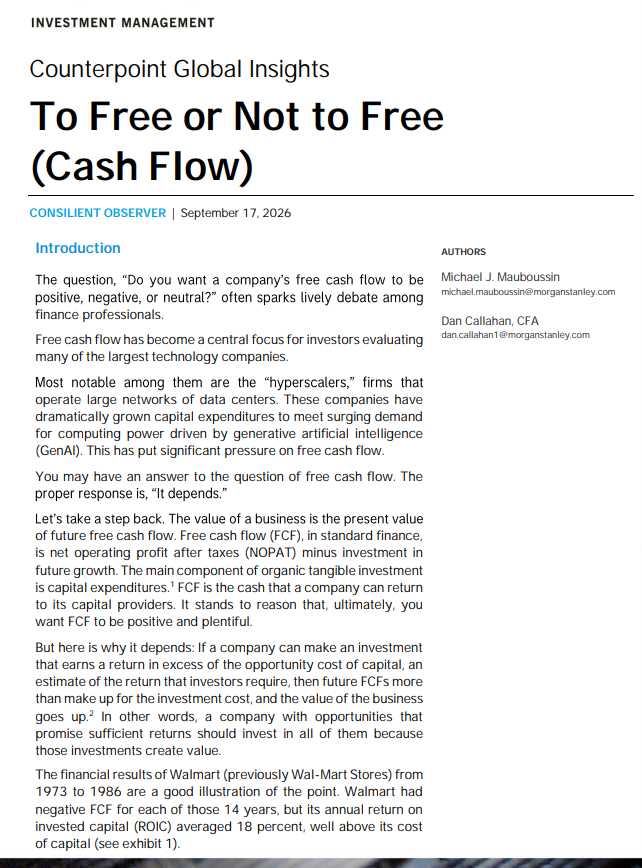
From 1973 to 1986, Walmart reported negative free cash flow for 14 consecutive years. Its stock returned 33% annually over that period, three times the return of the S&P 500.
@mjmauboussin’s framework for understanding free cash flow. 10 lessons for investors:
1. A company’s value is the present value of its future free cash flow. Free cash flow is profit after taxes minus investments in growth, primarily capital expenditures. An investor’s job is to find the company that will ultimately generate the most FCF. But that FCF will not always be positive along the way.
2. Negative FCF is not always bad. If a company invests at a return above its cost of capital, it creates value. People love posting charts showing negative FCF at the hyperscalers. What matters is the return those investments will generate over the following years.
3. The Walmart lesson. From 1973 to 1986, Walmart had negative FCF for 14 consecutive years because it invested aggressively in expansion. Its return on invested capital averaged about 18%, well above its cost of capital. The stock returned 33% annually, three times the return of the S&P 500. Negative FCF was a sign of growth, not weakness.
4. Focus on investment returns, not the minus sign. The key question is whether revenue and profit are keeping pace with capital expenditures. If profit grows faster than investment, value is being created. If it falls behind, cash is being destroyed.
5. Watch return on incremental invested capital (ROIIC). It measures the return generated by each new dollar invested. If ROIIC is above the company’s current average return on capital, its overall return should rise. If it is lower, the average should fall. Hyperscalers’ combined ROIIC is currently near its peak at more than 35%, compared with a cost of capital of about 8%.
6. Subtract stock-based compensation. Paying employees with shares is effectively a combination of issuing stock and paying wages. If SBC is properly deducted from operating cash flow, the reported cash flow of large technology companies falls by 10% to 20%. Many investors ignore this and overstate the true figure.
7. A mature company can return to growth. A sharp increase in capital expenditures can move a business back to an earlier stage of its life cycle. Alphabet, Meta, and Oracle moved from “maturity” to “growth” after accelerating data center construction. This is not deterioration. It is a new investment phase.
8. The current decline in hyperscaler cash flow is expected to be temporary. Combined FCF for Amazon, Alphabet, Microsoft, Meta, and Oracle falls from $170 billion in early 2024 to negative $265 billion in 2027. Consensus then expects it to recover to ~$505 billion by 2030. Returns on capital remain above the cost of capital throughout this period. Microsoft is the only hyperscaler expected to maintain positive FCF across the entire forecast horizon.
9. Returns arrive with a delay, so patience matters. Amazon CEO Andy Jassy explained it directly. During periods of rapid growth, capital expenditures rise faster than revenue. This weakens near-term cash flow. The returns appear a few years later, after the new capacity is operating and generating revenue. Investors who focus only on current cash flow see the worst part of the cycle.
10. Consensus forecasts are not facts. The further out the forecast, the less reliable it becomes. Watch how estimates change. Are revenue and profit expectations rising as quickly as capital expenditure forecasts? The differences can be enormous. The 2027 EBIT forecast for Micron was raised by $192 billion, while Nvidia’s was raised by $231 billion. Their capital expenditure forecasts increased much less. That is a sign that investors expect those investments to generate strong returns.
$MSFT $META $AMZN $ORCL $SPCX $NVDA $MU
Instead of spending 2 hours on a movie...
Spend 1 hour watching this Anthropic Claude for Finance lecture.
It might be the most valuable free resource on quant AI available right now.
Bookmark it, make time for it today, and thank yourself later.
Google's Jeff Dean just released the best 1-hour lecture on AI engineering: from basics to Graphs
1:45 - LLM from scratch
17:22 - how to use AI models
30:03 - prompt engineering
52:35 - one human coordinating 100 agents
1:02:40 - where the coordination actually lives
27 years of building AI at Google, compressed into one hour
Prompts → Agents → Loops → Graphs
most people will stop at the prompt engineering chapter and call it learning
he spends the last twenty minutes on the part that is still true next year
same model, same tokens, completely different week
watch it today
the full guide on graph engineering is below, save it while it is still early ↓