On a hillside this summer, a man will pay good money to take the coat off a sheep, then watch that coat earn him almost nothing at all.
This is the wool trade now. A thing his great grandfather built a life on, worn down to a chore he runs at a loss.
So look at the maths square in the face. It costs him around two pounds to shear one ewe. The fleece that comes off her, even now, in the best year for a decade, brings back about a pound and a half if she is a fine crossbred. If she is a hill sheep, a Welsh Mountain or a Swaledale, he might get thirty pence for the whole fleece. British Wool says the price would have to nearly double again just to cover the shearing.
So every sheep he clips, he loses on. And he has to clip every one.
A sheep left in her fleece overheats, cannot walk right, and gets eaten alive by maggots. The wool has to come off, for her sake, whatever it is worth. He pays, quite literally, for the privilege of being kind to his own animals.
Now feel the weight of what we have let go.
Wool once made this country rich. Whole towns were built on the back of it, and the great wool churches still standing across the Cotswolds were paid for with it. To this day the Lord Speaker of the House of Lords sits on a woolsack, set there centuries ago so nobody in the room would forget where England's wealth came from.
A fleece was worth fourteen pounds a kilo in the 1950s. The wool cheque, in his father's day, paid the rent for the year.
Today it will not cover the diesel to deliver it.
And so, in farmyards across the country, men who would rather not are quietly burning the fleeces off their own sheep, because a fire is cheaper than the trip to the depot. A material so fine that a kingdom was built on it, going up in smoke in the yard because nobody will pay a pound for it.
And what did we reach for instead. Plastic. Most of our clothes are now spun from oil, polyester and acrylic and nylon, shedding tiny threads into the sea with every wash, into the fish, into our own blood. It will not rot for generations.
So here we stand. A fibre that grows back every spring on nothing but grass and rain, that warms a child and then feeds the soil when its work is done, burning unwanted in a field.
While we dress ourselves, head to foot, in the very oil it was meant to spare us.
The sheep on that hill is still growing the finest coat in the world. We simply stopped being worthy of it.
This is how the Japanese raise their children: the secret behind a generation of geniuses.
While in many countries intelligence is rewarded with medals, in Japan discipline, humility, and constant effort are rewarded.
From an early age, Japanese children learn a powerful truth: talent without hard work is worthless, and true brilliance is born from consistency.
Over there, it is not unusual to see a six-year-old child going to school alone, crossing streets, taking trains… because from the very beginning they are taught to be responsible, courageous, and self-sufficient.
It is not about overprotecting them, but about preparing them for life. Japanese parents do not do homework for their children, nor do they make excuses for them… they guide them, but teach them that the journey is theirs.
Japanese students clean their own classrooms, sweep the hallways, and wash the bathrooms. In many elementary schools there is no cleaning staff.
Why?
Because educating does not simply mean filling the mind with information, but shaping character, humility, and respect.
Children are not seen as kings, but as part of a community. And this gives them a unique strength.
Japanese brilliance is not luck or genetics. It is culture, values, and well-directed effort from childhood.
Do you want a brilliant child?
Teach them more than mathematics.
Teach them to be disciplined, patient, and curious.
Do not protect them from failure: let them learn from it.
Because, in the end, it is not only about raising intelligent children… but about shaping human beings who shine with their own light.
— Adrian Năstase
This Ron Paul quote hits hard after watching what they did with Ukraine.
They stole money from working class Americans and send it to Ukraine. Then Zelensky and his rich buddies were buying yachts, vacation homes, sports cars etc.
The American people are fed up with this junk.
So, I make $100 and the government takes 1/3 of that.
I take the 2/3 remaining to me and I buy something that I need.
They tax that.
I take what is left over and split it in half: half to the bank and have to an investment account.
The interest I make from the bank?
They tax that.
The interest I make from my investments?
They tax that.
If somehow, after all the confiscations, I’m able to buy myself a piece of land they will tax my purchase.
Then, even though they pretend I owe the land, they charge me every year for the right to live on it.
While the Democrats and Republicans keep us fighting each other over how much billionaires are taxed, we stop looking at how much money they take from us and pour into a monstrous bureaucracy that every day seems to take away a little more of our freedoms and give us less in return.
Just a note for all of you who have picked a side in the tyrannical two party system.
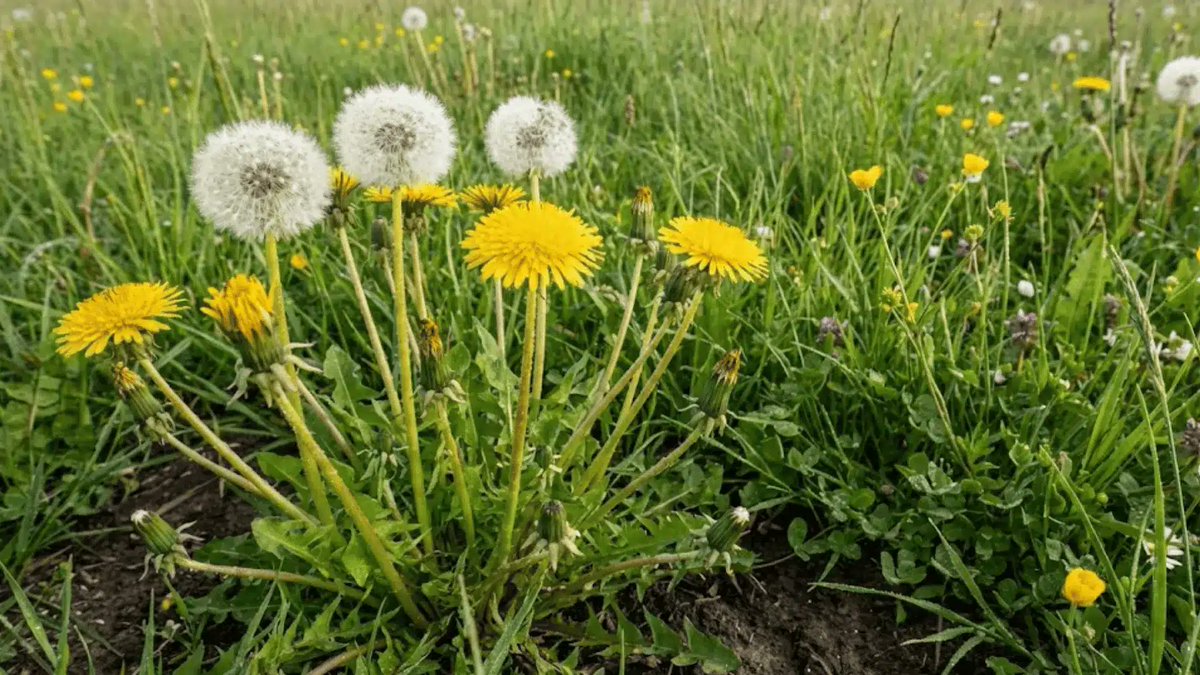
The reason we think dandelions are weeds is because of a 1950s marketing campaign.
Dandelions, native to Europe and Asia, were brought to North America in the 1600s by European colonists who grew them deliberately.
Every part is edible. The leaves are a salad green, the flowers were made into wine, and the roots were roasted as a coffee substitute and used medicinally for liver and kidney conditions for thousands of years. They were a kitchen-garden staple well into the 1800s.
The shift happened after World War II, when 2,4-D (originally developed for chemical warfare research) was approved as a residential herbicide. Companies like Scotts built the modern lawn-care industry around the idea that a perfect green lawn meant zero broadleaf plants.
Dandelions, being bright yellow and resistant to mowing, became a visible enemy, and the campaign worked. By the 1970s, "dandelion-free" was synonymous with "well-kept."
They aren't native, but they aren't doing significant ecological harm either. The herbicides used to kill them, on the other hand, kill bees, contaminate groundwater, and have been linked to non-Hodgkin lymphoma in humans.
If you hate dandelions, it's most likely due to a marketing campaign that ran before you were born.
When I was Muslim, I used to ask Christians:
“If Jesus was really God, why did He eat, sleep, and bleed like us?”
And honestly, I used to ask it with pride like it was some unbeatable argument.
But later I realized something:
That question was not exposing Christianity.
It was exposing my misunderstanding of what kind of God Jesus claimed to be.
Because the real question is not:
“Why would God become weak?”
The real question is:
“What kind of God would willingly step into human suffering at all?”
Islam taught me about a God who was distant and untouchable.
But Christianity introduced me to a God who stepped into hunger, exhaustion, grief, pain, betrayal, blood, and suffering with us.
And suddenly His humanity stopped feeling like weakness to me.
It became proof of love.
If Jesus ate, it means He came close enough to experience hunger beside us.
If He slept, it means He embraced the exhaustion we carry.
If He bled, it means He did not stand above suffering watching us from a distance.
He entered it Himself.
Philippians 2 says Christ emptied Himself and took on flesh.
Not because He stopped being God, but because He wanted humanity to finally see what God is actually like.
And it turns out God is willing to suffer for the people He loves.
That changed everything for me.
Because every other religion demanded sacrifice from humanity.
Jesus became the sacrifice Himself.
And no prophet in history ever claimed that.
Talking to independent physicians, it's obvious that the big insurance carriers are doing to them, what their PBMs are doing to independent pharmacies.
They deny, underpay, slow pay, clawback, and create administrative mazes, knowing their victims don't have the time or resources to fight.
Why ? By putting financial pressures on physicians and pharmacies, it makes them more likely to sell their businesses to them , close their doors, or refer the business to their captive pharmacy or provider. All benefitting the biggest insurance companies
We need to ditch the concept of "claims" and make every delivery of medications or care as a billable event that must, by law, be paid on a timely basis , with interest charges for any delays. If the physician or pharmacy doesn't deliver , the carrier has plenty of legal options already. As does the patient.
This is not an efficient market. This is the big guy abusing the little guy. It needs to change to better the care we get in this country
THE CHURCH FATHER WHO WROTE THIS IN 107 AD AND IT SILENCES EVERY PROTESTANT ARGUMENT
St. Ignatius of Antioch was a student of the Apostle John. He was arrested and sent to Rome to be eaten by lions.
On the way, he wrote seven letters. In 107 AD, within living memory of the Apostles, he wrote:
“Where the bishop is, there let the multitude of believers be; even as where Jesus is, there is the Catholic Church.” (Letter to the Smyrnaeans, 8:2)
This is the first recorded use of the term “Catholic Church” and it comes from a man who personally knew the Apostle who leaned on Jesus’ chest at the Last Supper.
He also wrote:
“Take note of those who hold heterodox opinions… They abstain from the Eucharist and from prayer, because they do not confess that the Eucharist is the flesh of our Savior Jesus Christ.”
Real Presence of Christ in the Eucharist. The Catholic Church by name. Obedience to bishops in apostolic succession.
107 AD. Not the Council of Trent. Not the Middle Ages.
The next time someone tells you the Catholic Church invented these doctrines centuries later, show them Ignatius.
He wrote this on the way to die for it.
Who will share this?
The USDA has kept raccoon rabies out of the central United States for over 30 years by air-dropping fish-flavored ravioli from helicopters.
Each one is a small packet coated in fishmeal with an oral rabies vaccine inside. Raccoons, foxes, coyotes, and skunks find them by smell, bite through, and swallow.
Many animals that consume the bait develop immunity, helping build a protective barrier across populations.
The bait is generally considered safe for pets and tested in many non-target species.
The USDA's Wildlife Services has been running this since 1995. Without the bait program, raccoon rabies very likely would have spread much further west.
A federal program you've probably never heard of is protecting your pets and your kids by feeding wild animals ravioli from a helicopter.
12 Saint Quotes That Make It Impossible to Attend Mass the Same Way Again... ⤵️
1. "When the Eucharist is being celebrated, the sanctuary is filled with countless angels who adore the divine victim immolated on the altar."
- St. John Chrysostom
2. "The angels surround and help the priest when he is celebrating Mass."
- St. Augustine
3. "The best time to ask and obtain favors from God is the time of the Elevation."
- St. John Bosco
4. "The celebration of Holy Mass is as valuable as the death of Jesus on the cross."
- St Thomas Aquinas
5. St. Teresa was overwhelmed with God’s Goodness and asked Our Lord , “How can I thank you?” Our Lord replied, “ATTEND ONE MASS.”
6. “My Son so loves those who assist at the Holy Sacrifice of the Mass that, if it were necessary He would die for them as many times as they’ve heard Masses.”
- Our Lady to Blessed Alan.
7. "When we receive Holy Communion, we experience something extraordinary – a joy, a fragrance, a well-being that thrills the whole body and causes it to exalt."
- St Jean Vianney
8. "There is nothing so great as the Eucharist. If God had something more precious, He would have given it to us."
- Saint Jean Vianney
9. "Be eager to go to Mass on weekdays also, even if it costs a sacrifice. Our Lord will reward you with His Blessings and make you succeed in your undertakings"
- Don Bosco
10. "When we have been to Holy Communion, the balm of love envelops the soul as the flower envelops the bee."
- St Jean Vianney
11. "It would be easier for the world to survive without the sun than to do without Holy Mass."
- St. Pio of Pietrelcina
12. "If we really understood the Mass, we would die of joy."
- Saint Jean Vianney
💬 Which quote hit you the hardest?