Hot Take: The United States has an unemployment rate of 50 to 60%.
Yes, the official rate is about 4%, but if you define employment, not just as having an occupation, but as being able to afford basic human needs, then things start to look much different.
Housing alone breaks the numbers for millions of people. For one, an American worker needs to earn more than $30/hour to afford a modest 1-bedroom apartment in most US metros without spending more than 30% of his/her salary, yet, about 45% of American workers earn under $20/hour.
The MIT’s Living Wage Calculator puts a living wage for a single adult at $25–$45/hour depending on the location, and by that standard, about 60% of American workers fall short in high-cost regions.
Then there are healthcare costs and the fact that medical debt is the #1 cause of bankruptcy in the US.
All-in, a single American adult needs roughly at least $50 000–70 000/year in most metros just to cover rent, food, utilities, and basic healthcare without financial precarity. Only about 40% of American workers earn that or more.
So, if employment is defined as being able to afford basic human dignity, then functional insufficiency rate reaches up to 60% of the American working-age population, who should just be defined as unemployed.
All of this is important because the American economic model gets exported globally through the IMF, the World Bank, business school curricula, Hollywood’s portrayal of American prosperity, and general US soft power.
Developing countries are taught to admire the US’s GDP growth, low official unemployment, stock market performance, entrepreneurship culture and deregulated markets. What gets left out is that US life expectancy ranks below Chile, Slovenia and Cuba or that the US has the highest child poverty rate among wealthy nations.
The cruel irony is that many developing countries that are pushed to adopt American-style economic liberalisation actually already have great things America doesn’t, like universal or near-universal healthcare.
But now they’re being asked to trade genuine human security for GDP numbers and a formal employment rate that, as we’ve established, measures almost nothing meaningful about human welfare.
Americans like to claim that their warships have guaranteed freedom of navigation in the Persian Gulf for decades.
In reality, the flow of traffic through the region has always been down to the commercial interests of the countries in the gulf. The US “Fifth Fleet” has just been sitting there to ensure that if things went south, they’d go south in a way that favoured the United States and Israel.
The US never guaranteed anything, because the countries in the region had no reason to do anything funny. Then the US started a war of aggression that created the very crisis it is now supposedly trying to solve, (or not solve), depending on the last thing Donald Trump said.
In fact, it’s because of the US’s “Freedom of Navigation Programme”, that all six GCC states have come under missile fire. Because of the US and Israel, two states not in the Persian Gulf, countries that had no open quarrel with each other are now under missile fire because the US launched a war in their front yards.
Just like the rest of the US war bases, the American warships were never there to ensure smooth sea traffic, they’ve always been there to shield Israel from the consequences of its violence.
When Gwede Mantashe said young South Africans were unemployed because they were not looking for work, the government kept quiet because it agreed with him. Now it’s showing it.
President Cyril Ramaphosa says they will be replacing the SRD R370 grant with a Basic Income Support grant, which will be a “jobseeker’s grant”.
Cyril says this will “ensure that those receiving the grant have access to a wide range of support to search for work and to sustain a livelihood”.
The Department of Social Development said this will align with linking beneficiaries aged 18 to 59 with employment, training, and enterprise opportunities.
In simpler terms, this logic implies that the issue is that people lack access to opportunities, rather than the reality that opportunities simply don’t exist.
Also, doing this implicitly shifts the blame onto the unemployed and moves focus away from the fact that there are far fewer jobs than job seekers and the country’s economic growth has been too weak to absorb new entrants into the labour market.
In such a context, saying “we’ll link people to opportunities” maliciously overstates the availability of jobs, and shifts responsibility onto individuals by making joblessness an individual failing.
In truth, jobs genuinely aren’t there, and better job-search support will not solve the core problem.
But the government is not interested in solving the problem. Its immediate concern is making the grant look temporary and conditional, which is more palatable to ratings agencies, the World Bank and the IMF.
In the end, you can’t match people to jobs that don’t exist and the only solution is to radically expand labour-intensive sectors alongside state capacity. But this will not happen because South Africa is designated as a destination for financial, not industrial capital.
So the government is doing what it has done since the 1980s, kicking the can down the road and boiling the frog as slowly as possible.
People are cheering this 2018 clip of White MPs calling out Ernst Roets.
But like most things in life, this isn’t the win people think it is. If you look at what Parliament was doing at the time, you can see why the MPs, Black and White, were irritated with Afriforum and also Black First Land First.
In 2018, during and after the public hearings on land expropriation, Parliament was carefully crafting a burial for the land issue. They had the experts, and they had a strategy: To shift expropriation without compensation away from the government and into the hands of the judiciary.
The goal was to pass cosmetic changes to Section 25 of the Constitution that would look like victory for the people but be dead on arrival in a courtroom.
Therefore, Ernst Roets’ aggressive “White people didn’t steal land” rhetoric was a PR nightmare for what Parliament was doing.
Because, just like BLF, Afriforum was introducing an ideological fight when the parliamentary committee wanted a quiet, legalistic burial of the land issue.
In the exchange you see in the clip below, the MPs were apprehensive that AfriForum was making it harder to sell their cosmetic changes to a public that was expecting real change. They had already run box-ticking public hearings alongside this rubber-stamping committee, so they really did not need anyone, be it the BLF or Afriforum, kicking that hornet’s nest.
That whole act of “patriotic South Africans trying to work together across racial lines to build this country” was just a ruse to maintain the status quo.
I wrote about this in 2019 (https://t.co/J3LYDoodAx)
Some people are saying Iran should cave or at least tread carefully before the US, but especially Israel gets desperate and uses nuclear weapons. They say this as if a nuke is some kind of holistic magic bullet.
But here’s the thing, contrary to popular belief, modern military-industrial nations, which Iran is firmly one, are designed with “survival deltas” for exactly this kind of situation. (Think of Russsia’s “Dead Hand”.)
From the start, it needs to be clear that any use of a nuke by the US-Israel Axis of Death would not be about destroying Iran’s nuclear facilities, which as we all know, were “completely obliterated” last year.
It would instead be aimed at decapitating Iran’s warmaking capabilities, which in simple terms refers to its military facilities dispersed across the country.
The problem here is that the attacker would need what military people call an “area-denial strategy” and to meaningfully degrade dispersed missile farms and military logistics spread across a country the size of Iran, you’re not talking about one or two tactical nuclear weapons.
Instead you’re looking at a campaign that would require multiple detonations across a wide geographic area and yields large enough to render vast areas of land operationally unusable.
(But even if the targets are indeed underground facilities, Iran has sites like Oghab 44 and the Fordow enrichment plant which are buried so deeply that even high-yield tactical nuclear weapons are not guaranteed to destroy the assets within.)
This current war is showing in real time how Iran is deploying a missile farm model where it disperses launch capabilities across thousands of unmarked square kilometers, meaning a strike on Tehran or Natanz would not necessarily turn off the country’s ability to fire back. And fire back they would.
So whichever facilities are hit, there are thousands more launchers waiting to continue sending out missiles and drones. Yes, Israel could cynically nuke Tehran but then there would be no Israel after that, military, diplomatically or politically.
Then there are those who swear that a nuclear blast’s Electromagnetic Pulse would permanently fry every circuit in Iran.
Yes, the initial E1 pulse would destroy small electronics like phones, computers, while the E3 pulse targets long-line infrastructure like power grids.
However, Iran has invested heavily in its National Information Network, designed to operate in digital isolation. So, while the civilian internet would collapse, the state’s internal communication would reboot using hardened, older-generation technology or localized mesh networks.
In fact, Iran’s military specifically operates on legacy analog and semi-analog systems precisely because they’re EMP-resistant. This is is core part of their doctrine. Much of their command-and-control infrastructure deliberately avoids digital dependencies for this reason.
So, in essence, the very thing that makes Iran’s missile farms hard to destroy with conventional weapons also makes them hard to destroy with tactical nukes without the kind of mass civilian casualties that would be impossible to frame as proportionate.
Furthermore, Iran has specifically warned it would target Israel’s Dimona nuclear facility in the Negev desert, which would create radiological fallout within Israel’s own borders.
Interestingly, Israel’s Dimona nuclear facility is lightly shielded by modern standards, and a successful hit wouldn’t necessarily produce a nuclear explosion, but it would produce highly radiological dispersal.
The irony is that Israel’s nuclear ambiguity policy has meant Dimona was never built to the hardening standards of a declared military facility. This is a significant vulnerability which Iran would expose without hesitation.
This brings us to the environmental impact of a nuclear blast: Radioactive fallout doesn’t see borders.
So, while Israel and Iran are about 1000 km apart, prevailing wind patterns would easily carry radioactive particles across borders, and depending on the yield and altitude of the detonation, toxic dust could contaminate water sources and agriculture across the region.
As we speak, strikes on Iranian oil infrastructure have already caused “toxic rain” warnings. A nuclear event worsens this exponentially, leading to long-term soil degradation and groundwater poisoning that does not respect national boundaries.
So, while the goal would be regime change in Tehran, the resulting catastrophe would solidify anti-Israel sentiment worldwide, making integration in the region and the world at large impossible. Israel would become a defacto terrorist group.
The reality is that Iran’s warmaking capability is so dispersed that no realistic nuclear strike package can destroy it cleanly. Yes a nuke would cause enormous humanitarian catastrophe but still leaving Iran with strike capability. This is the worst of both worlds. Israel would have paid the full political and environmental price without achieving the military objective.
The uncomfortable reality for the Zionists is that Iran has essentially achieved functional deterrence without possessing a nuclear weapon. That’s the real strategic achievement, and it’s why the “just nuke them” argument reflects a misunderstanding of what deterrence actually requires.
Deterrence is about making the cost of attack exceed any plausible benefit, and Iran has painstakingly done that without nuclear weapons.
So, the idea that Iran should simply capitulate to threat of US-Israeli nukes ignores the fact that their entire security doctrine has been built around making such capitulation unnecessary.
Prof Jiang Xueqin argues that the outcome of the war in Iran is “pre-ordained” and it is to kill as many people as possible and destroy the global economy, and more interestingly, “force the US out of the Middle East”.
He argues that the “historical lens” of analysing current conflicts based on past events like the 1979 Revolution or 20th-century geopolitical patterns is a flawed and insufficient framework for understanding the Zionist war with Iran.
His assertion rests on the belief that the world has entered a “unique” and “eschatological” era where traditional logic no longer applies.
Prof Jiang posits that traditional reasons for war, such as controlling oil, trade routes, or resources, are no longer the primary drivers. He cites the ongoing war in Ukraine as evidence; from a military and historical perspective, he argues the war was “lost” two years ago, yet it continues despite making “no sense” under conventional frameworks.
He suggests that because the old rules of engagement and negotiation are being ignored, looking at history to predict the future is a “hallucination”.
Prof Jiang’s argument is that the conflict is driven by religious and eschatological motives rather than political ones.
He believes the war is “scripted” to bring about specific religious outcomes, such as the Second Coming of Jesus or the establishment of a “Greater Israel”, cited from Genesis 15.
Prof Jiang dismisses historical grievances, such as the 1979 overthrow of the Shah, as mere distractions. He warns that if you insist on using 1979 as a reference point, “you’re not getting anywhere.”
He further argues that the historical lens is flawed because it assumes that nation-states like the USA, Iran, Russia are the primary actors. Instead, he describes nation-states as “hosts” for “parasitic” secret societies and transnational capital groups that orchestrate conflicts to extract wealth or achieve spiritual goals.
Because he believes the people pulling the strings might be the same across different countries, historical rivalries are irrelevant “shadows on the wall”, referencing Plato’s Allegory of the Cave, designed to distract the public.
Perhaps his most controversial departure from historical analysis is the assertion that the US might have entered the war intending to lose.
This is radical because empires go to war to win and expand. Prof Jiang suggests that in this case, for certain “end-times” scenarios to manifest, the American Empire must be removed from the Middle East, meaning a military defeat would actually be “according to plan”.
He argues that US actions are increasingly dictated by the “Greater Israel” project, or “Pax Judaica” which aims to expand Israeli territory from the Nile to the Euphrates as in Genesis 15:18. He notes that political leaders like Donald Trump and Marco Rubio have framed these actions as essential for Israeli security.
Prof Jiang concludes that using history to predict this war is like looking at a map of a world that no longer exists. He urges viewers to “throw history out the window” because the coming conflict is a “spiritual war” where the goal is total destruction and a radical reduction of the global population, rather than the territorial or ideological victories of the past.
Of course, Prof Jiang is not the end-all and be-all of geopolitical analysis.
Many credible political analysts argue that Israel “calling the shots” and dictating to the US is just a tactic of a larger strategy. In this view, taking over Iran would allow the US to dominate the “nexus of global trade” and energy flows that China depends on for its survival.
The argument is that the US is using the “for Israel” narrative to cut off China’s energy access in the Middle East to gain a permanent chokehold on the primary energy supplier for its greatest economic rival.
In this sense, analysts such as Brian Berletic see Israel as a US proxy, in which doing something “for Israel” is functionally the same as doing it for US regional hegemony, which is ultimately used to pressure China and Russia.
So, while Prof Jiang believes that the war in Ukraine makes no sense, Berletic posits that the West never intended for Ukraine to “win” in a traditional sense. The goal was always to use Ukraine as a tool to grind down Russia’s military hardware and deplete its treasury and economy.
By keeping Russia bogged down, the US prevents a “Eurasian integration” where German technology and Russian resources combine to challenge American hegemony.
Now, for me, personally, the main problem with Prof Jiang’s analysis is that it’s unfalsifiable. Any evidence against it can be reframed as another “shadow on the wall”. And when a theory can absorb all contradictory evidence, it stops being analysis and becomes theology.
In any case, both analyses conclude that the publicly stated reasons for conflict are not the real reasons. Both see nation-states as fictitious actors concealing deeper agendas. They diverge sharply on what those deeper agendas are. One says it’s spiritual, the other believes it’s material.
Still, Prof Jiang is identifying something real, that certain actors genuinely are motivated by religious eschatology. After all, Christian Zionists in the US Congress are a documented political force, not a conspiracy theory, but then he seems to overcorrect by making this the total explanation, dismissing material interests entirely.
Then, on the other hand, Brian Berletic’s framework may be underestimating how much ideological and religious beliefs shape decision-making among actual policymakers by treating them as pure rational-actor strategists when the evidence suggests otherwise.
In simpler terms, the fundamental divide between the two points of view seems to be on intent. Berletic believes the United States is viciously rational, that they want to stay on top of the pile at any cost. Prof Jiang believes the people who are “really” in charge are viciously irrational and want to burn the world down to fulfil a perceived destiny.
Ultimately, maybe the answer is that both things are happening simultaneously.
After all, an American Christian Zionist politician, an arms manufacturer, an oil trading banker, and an Israeli genocidal maniac can all support the same policy for entirely different reasons.
Brian Berletic’s material analysis and Prof Jiang’s eschatological logic don’t necessarily have to compete, as they can both be true depending on which warmonger you ask.
South Africa’s economy is stagnant because the country’s leaders don’t know or care about the difference between macroeconomics and microeconomics.
The country’s economists insist on thinking of the country as just a collection of households, as a “big family.”
But the thing is that the difference between a household and a country is that when you’re running a household, including personal finances, and are worried about the future, you just save more money. This is responsible and makes you safer.
Experts take this household mentality and zealously preach that the government should “balance its books” just like a responsible family would.
Except that if a country does what a household does, i.e., balancing the budget, total spending drops, leading to job losses. And then, because people are losing jobs, they actually have less money to save, which defeats the whole purpose of saving in the first place.
Keynes called this the “paradox of thrift,” which is when everyone saves simultaneously, leaving everyone worse off. This is well-established economics, not fringe thinking.
The government’s spending is the public’s income, so the “responsible” act of saving actually shrinks the economy, leaving everyone with less.
Another crucial point to consider, which mainstream economists often overlook, is that a natural person eventually retires and must settle their debts. But a country is meant to last forever, meaning it can “roll over” debt in its own currency indefinitely as long as its economy is growing.
Even more crucially, if you, as an individual, owe the bank money, you have to find a way to earn it. But if a country owes money in its own currency, it has the power to print more or adjust interest rates—powers a household definitely doesn’t have.
So, again, it’s not that a country does not need to run its economy like a household, but that doing so actually harms the economy.
Speaking of debt, there’s also the sleight of hand where economists do their best to hide the difference between foreign debt and local debt and pretend it’s all the same under the banner of “debt.” But the truth is that a country that borrows in its own currency and controls its central bank has tools that a household doesn’t have.
The only time a country has to balance its books is regarding foreign currency debt. If you owe dollars or euros and you don’t print dollars or euros, you have to earn them through exports or borrow them.
So what happens to any country that runs its entire economy like a household, aka kitchen table economics?
One word: Austerity.
While “spending only what you earn” when money is tight is responsible for a family, applying this to a nation when the economy needs to grow actually causes the economy to shrink.
If the government stops spending on infrastructure or services when the economy is sluggish to “save money,” it has to do things like fire workers and reduce subsidies. People now have no money to spend at stores. Those stores then lay off more people, leading to a downward spiral.
In other words, while a household must reduce spending when money is tight, if a government does that, it reinforces the downward spiral. But this is exactly what governments are advised and encouraged to do.
In fact, the IMF itself published a paper in 2016 essentially acknowledging that it had oversold austerity and underestimated its contractionary effects. Greece is the textbook case of austerity reinforcing a downward spiral rather than restoring confidence.
Of course, printing money or running sustained deficits isn’t consequence-free. If the money is not going towards productive investment, you may face unsustainable inflation levels. This is simple mathematics.
However, when you have high unemployment alongside a shortage of infrastructure, you essentially have two things sitting idle simultaneously: people who want to work, and unmet productive needs. That combination is the clearest possible signal that the inflation constraint you’d normally have to worry about is weakened.
Inflation, in its most straightforward sense, happens when too much money chases too few goods and services. But if you have millions of unemployed people and crumbling roads, hospitals, rail, and power infrastructure, you’re not in that situation. You have spare human capacity and unmet real needs.
Government spending that puts unemployed construction workers to build power stations or roads is not chasing existing goods. Runaway inflation is not a factor.
In simple terms, the constraint for the government is not money, it’s resources. If there are idle workers and idle machines, spending more money to put them to work is not inflationary because it increases the supply of goods and services alongside the money supply.
Austerity economists like to flatten the difference between productive government expenditure and mere consumption spending to continue advocating for “the government is broke” policies.
The Zimbabwe comparison, which gets thrown at any country that considers an expansionary policy, doesn’t apply to South Africa. Zimbabwe’s money printing wasn’t funding productive investment; it was covering political obligations and war expenditures in a collapsing productive economy.
South Africa still has a relatively functioning industrial base, institutions, and, crucially, the productive capacity that Zimbabwe had lost. The starting conditions are fundamentally different.
So, why does the South African government persist with austerity? The answer is “hot money” and “bond vigilantes.” Do yourself a favour and google these.
Because South Africa relies on hot money to finance its current account deficit (we import more than we export), the government feels it must appease international investors by appearing “fiscally responsible,” a.k.a., austerity. They are trapped by the bond market vigilantes, the very “investors” who demand that the government act like a household.
The government is practising kitchen-table economics to appease the financial markets, which prevents it from making the productive investments that would free it from the tyranny of those same financial markets.
This argument should alarm everyone.
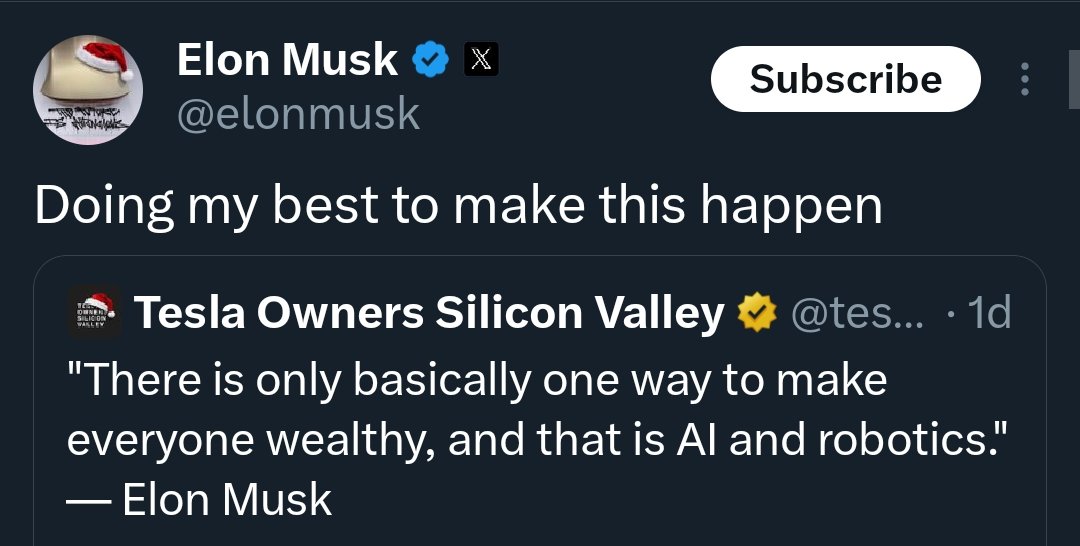
By declaring that there’s ONLY one path prosperity, Elon Musk is reducing all political economy, distribution, institutions, and everything in between into a singular technological path.
In other words, if AI and robotics are the solution, then any questions about wages, wealth taxes, ownership and regulation become obsolete.
This technological inevitability shifts responsibility from the state and billionaire class because under this imaginary future, abundance will arrive automatically once the machines are good enough.
This means government policy or labour bargaining becomes pointless. Hard policy choices can now be deferred indefinitely while the masses wait for technology to free them.
If everyone follows Musk’s logic, inequality becomes just a temporary technical glitch waiting to be fixed, which in turn means we should all just patiently accept the current arrangement because the solution is around the corner.
The irony is that AI and robotics, as they currently exist, are doing the direct opposite of what Musk claims they will do by concentrating capital on a small number of unimaginably rich owners while making everyone else more dependent.
If the people sheepishly subject themselves to Musk’s theory, that prosperity is indeed guaranteed by future machines, then today’s inequality can be tolerated and policymakers cannot be held responsible for failing to address inequality through existing means. Their role is merely to accelerate the arrival of the technological fix by pouring billions and even trillions into this singular technological fix.
In essence, the promise of this robotic future justifies the present economic injustice. This is what Musk is going for.
Basically, Elon Musk wants a theoretical tomorrow to do the work that policymakers fail to do today, while giving the billionaire class legitimacy.
All of this is just a sedative for social discontent that says to the people: “don’t be too angry, don’t disrupt the system; we are attending to your issues and our hypothetical machines will be here shortly to save you from us”.
It’s not difficult to tell that large language models, aka “artificial intelligence” are not even trying to be intelligent.
You know this because you will ask an LLM an objective question, i.e. a question that requires a specific answer that is factually correct and not influenced by personal opinion.
The LLM will get the answer wrong, and you will point this out to correct it. The “AI” will acknowledge this correction and even get ahead of you about why and how it got it wrong and proceed to elaborate eloquently on the correct answer.
This sounds fair, but it’s not intelligence, and you know this because if you go ahead and start a new conversation with the LLM by asking it the same question again, it will still get it wrong.
Intelligence on the other hand, means continuous learning and honest self-correction. LLM chatbots cannot do this because they are just very powerful language predictors that can mimic those behaviours within a conversation but don’t have persistent beliefs, which is a prerequisite for intelligence.
True intelligence, which you see in humans and animals, requires a continuous stream of experience that forms a persistent AND updatable model of the world and LLMs simply do not engage in this.
This does not mean LLMs are not powerful at what they do, but that doesn’t make it intelligence either.
They keep lying to us that there are three arms of the state, when in fact, there are only two: The public sector and the private sector.
The whole “three arms of the state” of the legislature, executive, and judiciary is just a political theory concept and not necessarily a description of who actually wields power.
This gets messier when you realise that those two sectors are deeply entangled:
Politicians need massive amounts of money to win elections. That money comes from large donors. The result is that policies often reflect the priorities of those funders, not the public.
Then there’s that whole thing of politicians and senior bureaucrats like former Ministers and Directors-General leaving office and taking high-paying jobs in industries they once regulated.
Then you find executives from big corporations getting appointed to government roles where they oversee policy affecting their former employers. The outcome is that regulation is often written by the people it’s meant to regulate.
There’s also the small matter of major media outlets being owned by a small number of corporate conglomerates.
Here, public narratives are shaped to maintain faith in the system while burying stories that threaten chosen elite interests. This results in the public’s understanding of power being curated by corporations.
In this sense, the “three arms” model is just a high school civics class myth that ignores the real economic power structure.
In fact, if you follow this idea to its logical conclusion, you could even argue there’s effectively one blended ruling class of political and corporate elites, and the rest is just theatre to keep us believing in separation and accountability.
General Mkhwanazi’s recent revelations reveal what is known as the dual structure of governance.
You have the public/exoteric layer governed by ideals, laws, and democratic accountability, and then you have a hidden/esoteric layer governed by necessity, realpolitik, and the management of power behind the scenes.
The public layer is where governance is explained through constitutions, transparency, and accountability. Also known as the “rule of law,” this layer of governance is performative in many ways, meant to reassure the citizenry that order and justice prevail.
However, beneath the public layer lies a shadow layer, where the actual preservation of the state requires actions that cannot be justified publicly. This is the realm of national security, classified documents, state intelligence, dirty tricks, backroom deals, falsehoods and sometimes criminal collusion. Not because everyone is evil, but because power must solve problems the law has no tools for.
Now, from time to time, factions within this shadow layer fall out. This is where rival spy bosses, police generals, political kingmakers, and even business tycoons pull back the curtain for the public to see “rogue units”, death squads, illicit currency, and police “grabbers”.
None of it is to purify the system. All of it is revealed to weaponise public outrage and expose the methods of their rivals under the guise of justice, knowing full well that those methods are systemic, not exceptional.
What you get out of these exposés is not reform but spectacle: Arrests on camera, dramatic press conferences, leaked recordings, parliamentary inquiries and debates, and theatrical suspensions and dismissals.
But after the drama fades, the system re-equilibrates. A few players are replaced an the game goes on.
My point is that whenever we witness “corruption” scandals or intelligence leaks, we are often watching internal power struggles made public, not accountability.
The public gets talking over a scandal, the insiders get a reshuffle, and the system survives. This is not dysfunction, it’s definitely not evidence of a “mafia state”. It is how the system maintains itself.