Can a company escape liability because its web developer “accidentally” published your professional identity?
In Opinya & Others v Brainstorm Insurance Brokers Ltd, the ODPC said no. Unlawful processing remains unlawful, and KSh1,012,500 was awarded to the complainants.
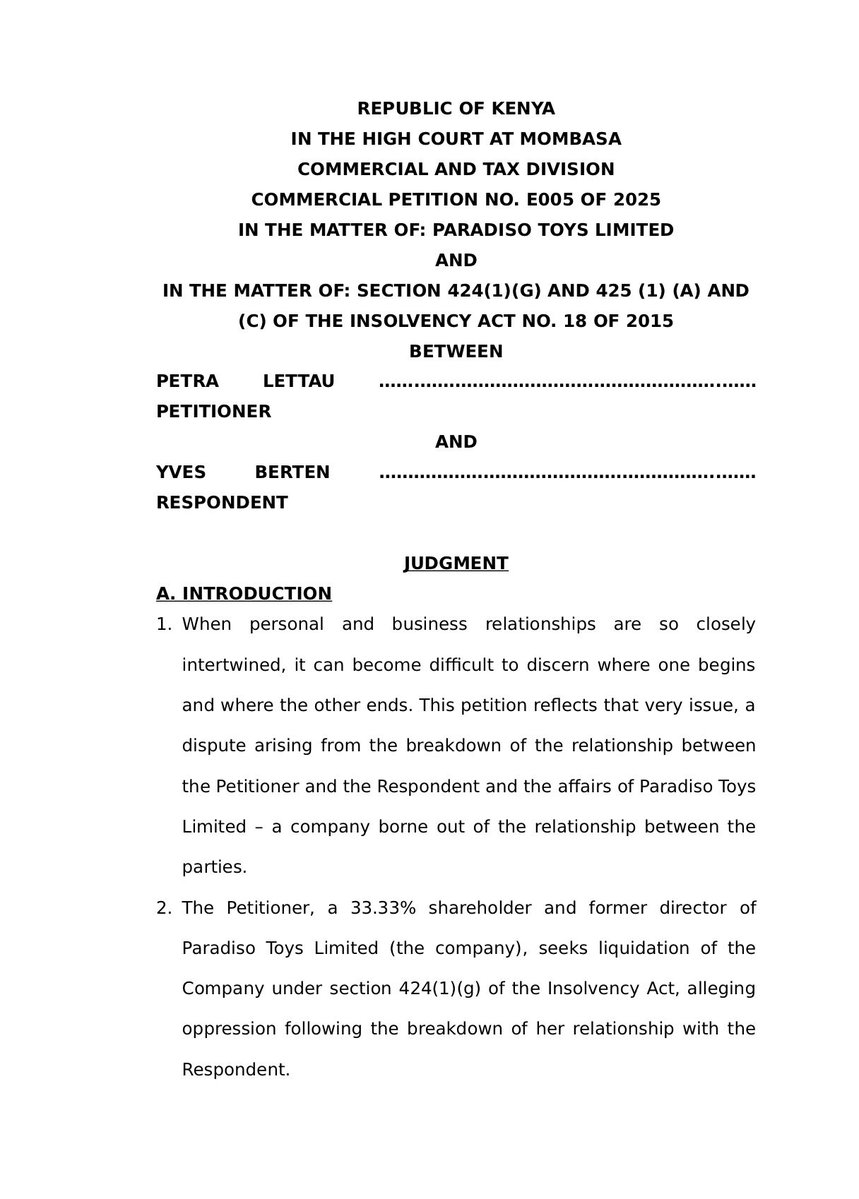
🚨 Court orders a buy-out, not a shut-down, in a bitter fallout between two business partners whose company outlived their relationship. When their friendship collapsed, one wanted the whole company liquidated. The court found a better answer, and it protects shareholders trapped in a broken partnership.
The case involved two shareholders, Mr Berten and Ms Lettau, whose closely-held company was built on their personal relationship. When that relationship broke down, Ms Lettau was excluded from annual general meetings and denied access to company records, though she kept her shareholding. She rejected a €100,000 offer for her shares, proposed an independent valuation, and, when that failed, petitioned to liquidate the company. The court declined to wind it up, and ordered a buy-out instead.
Two principles sit at the centre. First, the difference between oppression and unfair prejudice. Under the Companies Act, a shareholder can seek relief where a company's affairs are conducted oppressively, or in a manner unfairly prejudicial to their interests. The court held the conduct did not quite meet the high bar of oppression, burdensome, harsh and wrongful, but that the company's evolution after the breakdown had become unfairly prejudicial to Ms Lettau as a member. That lower threshold was enough. You need not prove full oppression; serious unfair prejudice suffices.
Second, liquidation is a last resort. As in the RAK Limited case, a court will not wind up a solvent, functioning company merely because its owners have fallen out. Where the business remains a going concern, the fair remedy is to let one shareholder exit at a fair price. The court ordered an independent valuation by certified public accountants within 30 days, failing which ICPAK would nominate the valuer, and a buy-out on that basis.
A shareholder locked out of a company they part-own cannot be left trapped with no exit, yet liquidation would punish everyone and destroy a viable business. The buy-out reconciles both. The court also rejected the argument that this was merely a romantic breakup rather than a corporate wrong, what matters is the effect on the shareholder's rights, not the origin of the discord. This tracks settled authority, in Warari v Suntap Kenya, the High Court likewise refused liquidation and ordered a valuation and buy-out.
Exclusion from management and denial of information are real, actionable wrongs, and a court-ordered buy-out is often better than liquidation. And for anyone going into business with friends or partners, agree a clear shareholders' agreement and exit mechanism upfront, before the relationship sours.
👉 Follow @Lexken_EMSLaw for practical legal insights on company law, shareholder disputes and corporate governance.
Imposter syndrome hit like mad when I was preparing this Application. 🥹
Today, I have obtained orders for the arrest of a vessel on behalf of my client.
Might mess around and add “Maritime Lawyer” to my resume. 😂😂
Siku njema huonekana asubuhi kweli.✨