NeurIPS is pleased to officially endorse EurIPS, an independently-organized meeting taking place in Copenhagen this year, which will offer researchers an opportunity to additionally present their accepted NeurIPS work in Europe, concurrently with NeurIPS.
Read more in our blog post and on the EurIPS website:
https://t.co/WKkdiKHZuw
https://t.co/bp51jR9eDH
🚨 Machine Learning for Health (ML4H) is back and better than ever!
🌴 Join us in San Diego on December 1–2, 2025, right before @NeurIPSConf!
📢 Call for Papers is LIVE → https://t.co/1BSGE8JhSX
⏳ Deadline: Sept 8 — don’t miss it!
🔁 RT and follow @SymposiumML4H for updates!
Current multimodal single-cell integration methods act as black boxes, lacking meaningful interpretability. We introduce NetworkVI, a VAE that performs integration via gene-gene interactions and the Gene Ontology for biologically grounded analysis. https://t.co/HHmRp5z9x5
NetworkVI is a group effort by Julius Upmeier zu Belzen, Luis Herrmann, Khue Nguyen, supervised by @fabian_theis & @nebww & @CaptainSysBio at @ChariteBerlin and @HelmholtzMunich.
Code: https://t.co/E2aZWX38hk
Preprint: https://t.co/HHmRp5z9x5
🧠 Open-source & ready to use!
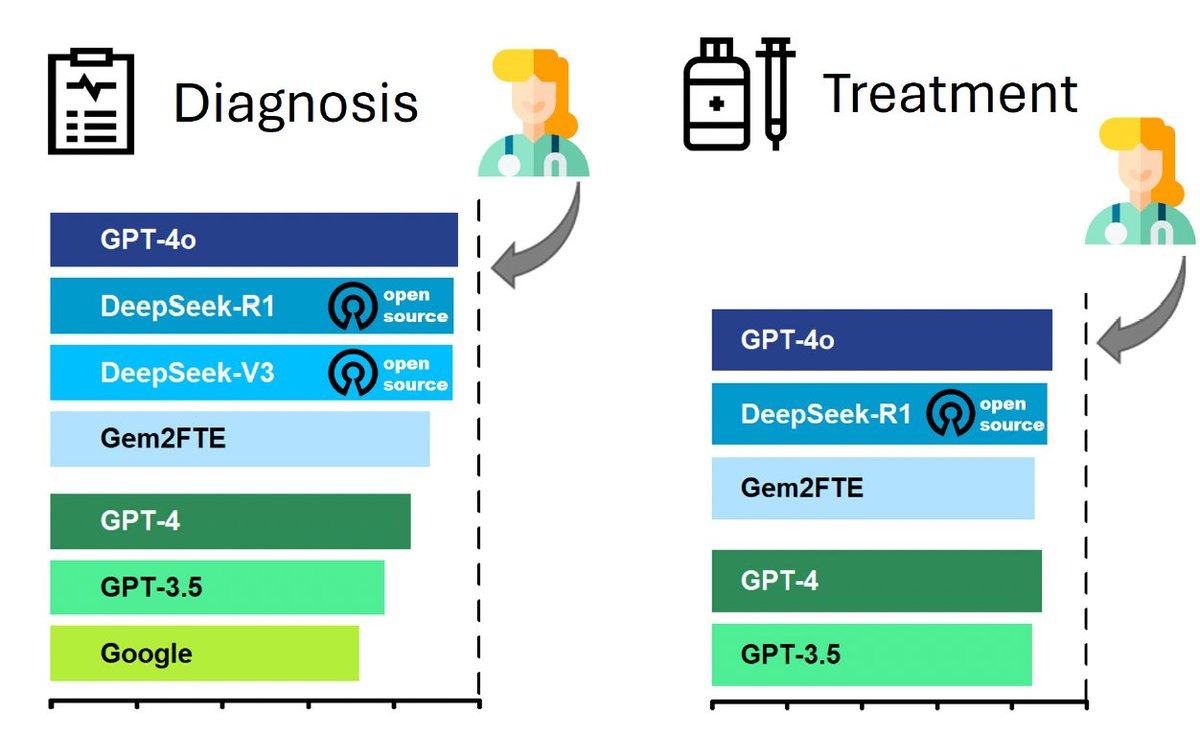
How does @deepseek_ai compare with other LLMs for clinical diagnosis and treatment plan—125 patient case benchmarks, not real world medicine
https://t.co/TvT5cwKiyZ
Thrilled to share our @NatureBiotech paper “Multistate and functional protein design using RoseTTAFold sequence space diffusion” https://t.co/1Fzfpm9s8v.
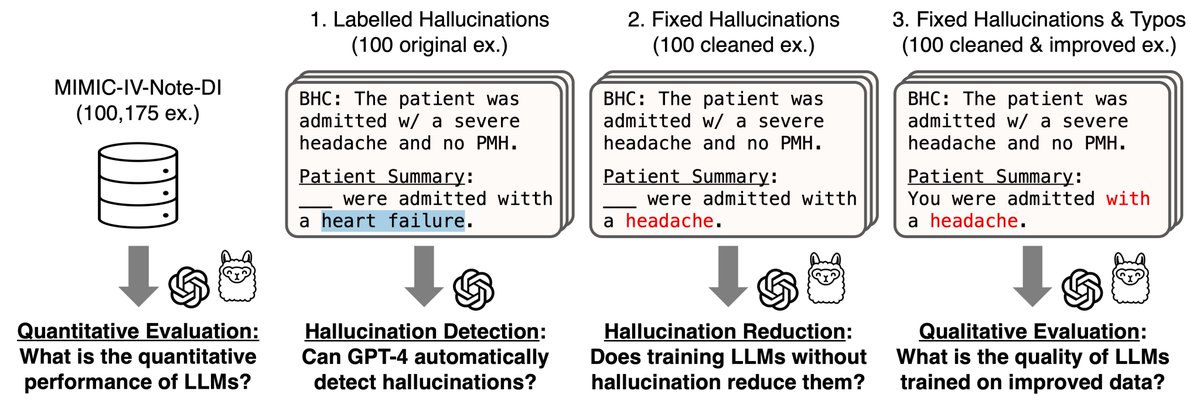
Does removing unsupported facts in the training or prompting data effectively reduce hallucinations?
We tested this for GPT-4 & Llama 2 for generating patient summaries. W/ @shannonzshen, Florian Gierse, @MonicaNAgrawal, @david_sontag, Xiaoyi Jiang
https://t.co/wyhF7JID25
1/7
It has been absolutely phenomenal working on the Vesuvius Challenge. The vision from @natfriedman and the foundation layed down by Prof. Seales and his team, make me every bit grateful to have the opportunity to score this touchdown!
Ten months ago, we launched the Vesuvius Challenge to solve the ancient problem of the Herculaneum Papyri, a library of scrolls that were flash-fried by the eruption of Mount Vesuvius in 79 AD.
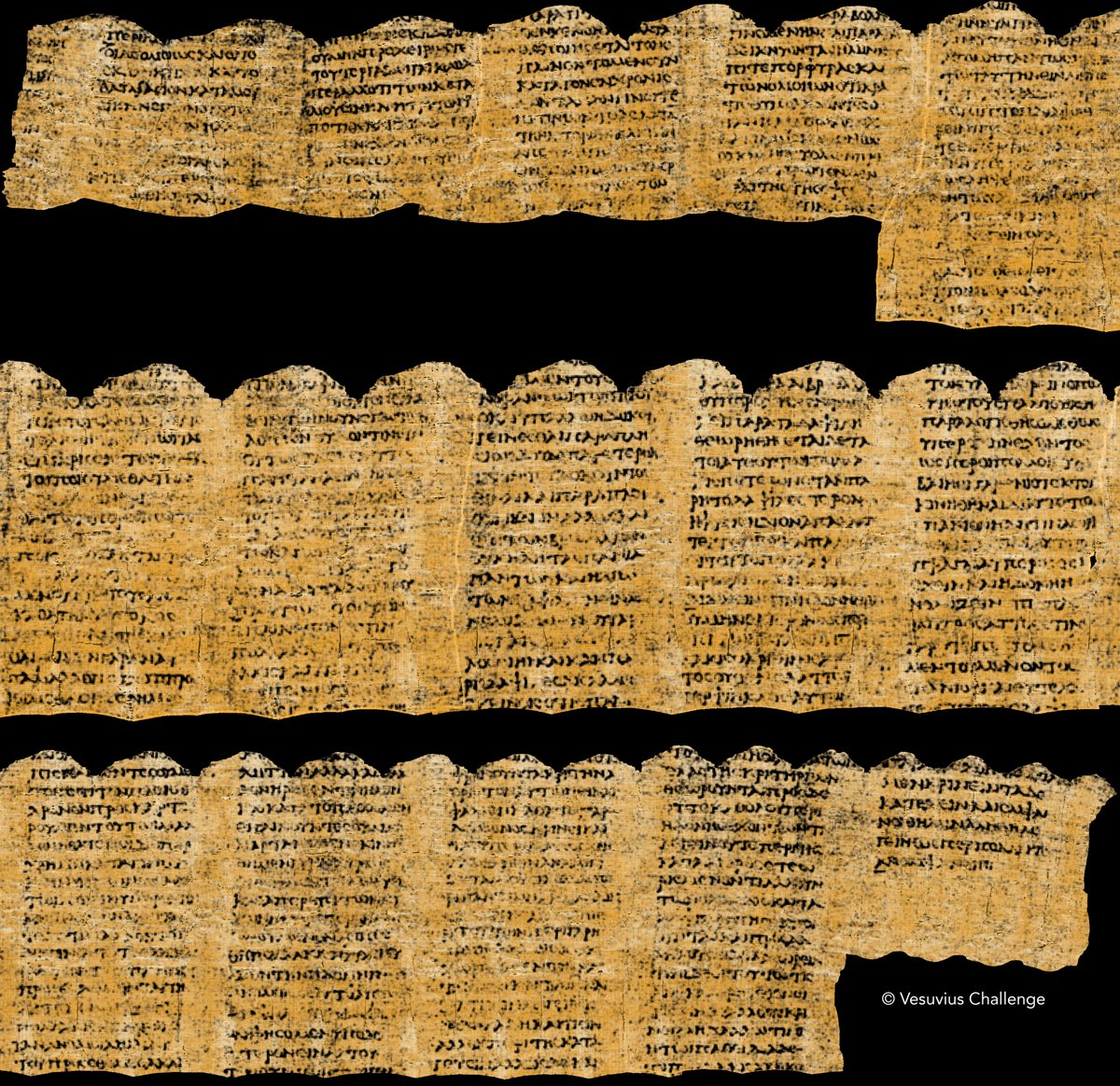
Today we are overjoyed to announce that our crazy project has succeeded. After 2000 years, we can finally read the scrolls:
This image was produced by @Youssef_M_Nader, @LukeFarritor, and @JuliSchillij, who have now won the Vesuvius Challenge Grand Prize of $700,000. Congratulations!!
These fifteen columns come from the very end of the first scroll we have been able to read and contain new text from the ancient world that has never been seen before. The author – probably Epicurean philosopher Philodemus – writes here about music, food, and how to enjoy life's pleasures. In the closing section, he throws shade at unnamed ideological adversaries – perhaps the stoics? – who "have nothing to say about pleasure, either in general or in particular."
This year, the Vesuvius Challenge continues. The text that we revealed so far represents just 5% of one scroll.
In 2024, our goal is to from reading a few passages of text to entire scrolls, and we're announcing a new $100,000 grand prize for the first team that is able to read at least 90% of all four scrolls that we have scanned.
The scrolls stored in Naples that remain to be read represent more than 16 megabytes of ancient text. But the villa where the scrolls were found was only partially excavated, and scholars tell us that there may be thousands more scrolls underground. Our hope is that the success of the Vesuvius Challenge catalyzes the excavation of the villa, that the main library is discovered, and that whatever we find there rewrites history and inspires all of us.
It's been a great joy to work on this strange and amazing project. Thanks to Brent Seales for laying the foundation for this work over so many years, thanks to the friends and Twitter users whose donations powered our effort, and thanks to the many contestants whose contributions have made the Vesuvius Challenge successful!
Read more in our announcement: https://t.co/rUlrdGXBMs
Over the past few months, @gogothorr and I have been heads down building @PheironInc . Our platform extracts disease markers from biomedical data to aim right: identifying the right targets for diseases and the right populations for clinical trials.
This is personal to us:
Echo chambers in the honeybee dance communication! We automatically detected 100K waggle phases of dancing bees and found a fascinating aspect of how bees organize their colony space. A thread.
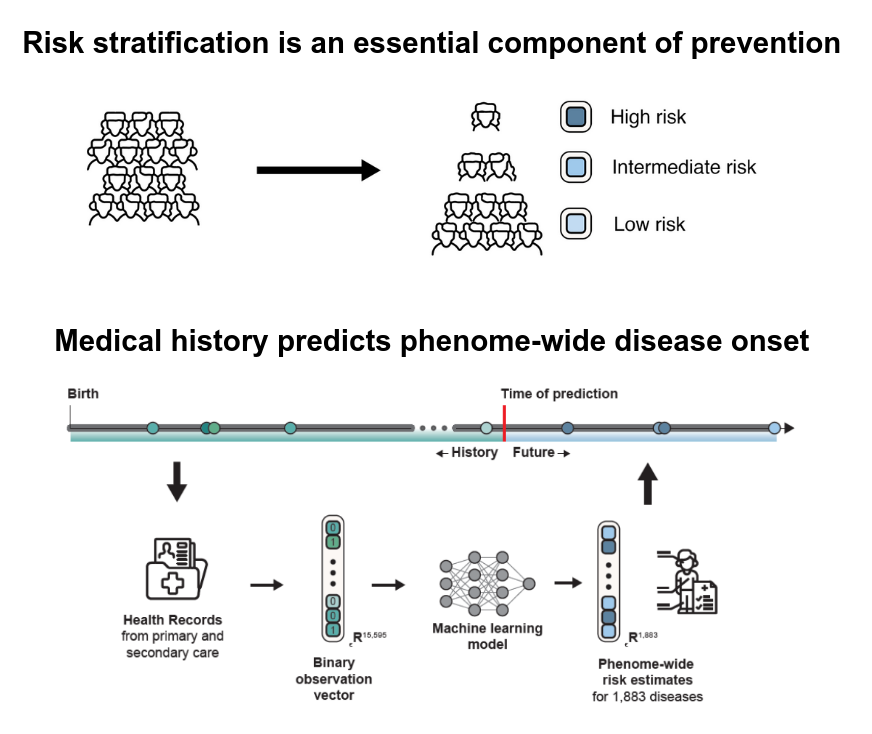
Preventing disease is the most effective way to decrease disease burden and cut costs in our healthcare systems. In our latest study, we demonstrate the great potential of leveraging the medical history to provide comprehensive phenome-wide risk estimation at minimal cost:
Our latest preprint, "Medical history predicts phenome-wide disease onset(https://t.co/Xe2m8IZ7xD), proposes a new approach to systematic risk stratification using medical history. Joint work w\ @nebww, @gogothorr, U. Landmesser, J. Deanfield, and @CaptainSysBio. A thread: