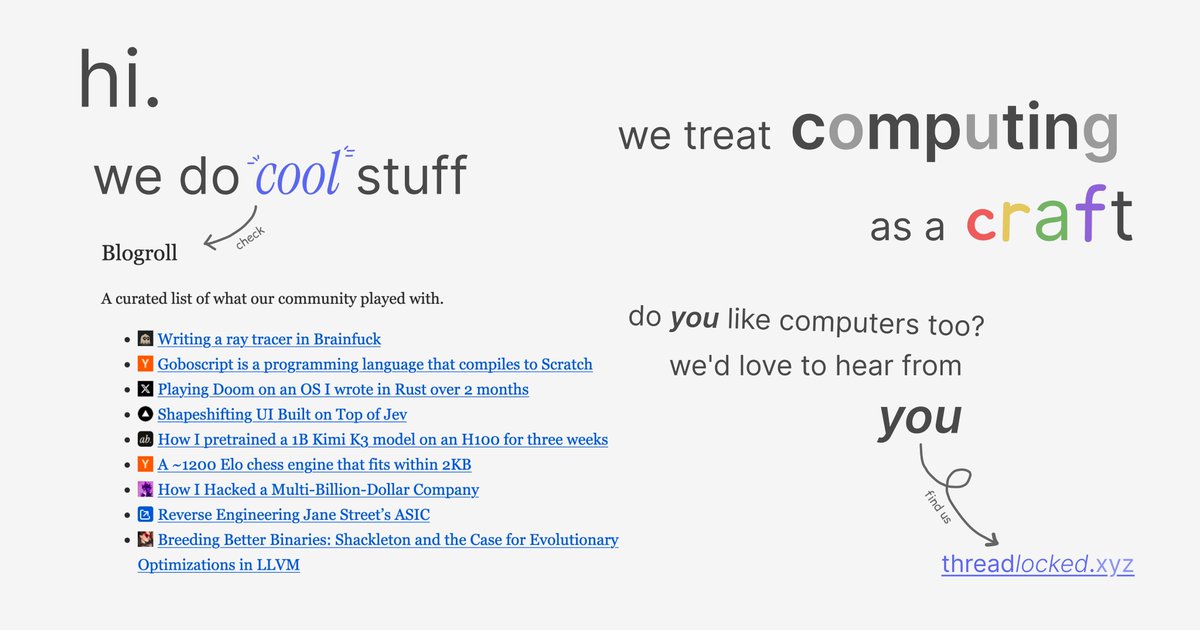
Hi, we're Threadlocked, a small collective of young researchers and hackers scattered across India and APAC.
We're sick of watching an entire generation mistake salary packages and credentials for the pursuit of computer science itself.
We're looking for curious hackers and researchers who still dare to take the road less traveled by treating computing as a craft.
We grew up in obscure corners of the Internet and learnt from strangers who encouraged our curiosity, shared their knowledge and even helped us access resources we couldn't afford. Somewhere along the way, we found our people. Now that we're in a position to do the same for others, we'd like to return the favor.
If any of these feel familiar we’d love to hear from you.
Making the ASCII MMORPG of my dreams!
Right now, I’m mainly working on gameplay, but I’m also polishing the visuals.
Finally added a fake shadow for the character, made cloud reflections now that we have clouds, and fixed a bunch of little things.
Ansenjeo. #mmorpg#indiegames #ascii
Лучшее, что я видел за последнее время — чел пилит ASCII MMORPG, в которой вся графика состоит из букв и символов.
Да, буквально весь мир, персонажи, окружение и спецэффекты нарисованы разноцветным текстом.
Автор сейчас экспериментирует с магией, визуалом и боссами. Я прям залип на то, как из нескольких десятков символов получается такая красота.
Буквально сны при температуре 37,2.
Via: https://t.co/vtYXAaEioi
After TEN LONG YEARS, Order of the Sinking Star is out Now! On Switch 2, PS5, and ... it's at the top of Popular New Releases on Steam, already!
Thank you everyone for your support during this long, long, long, long, long development!
@sagarbhute1@Nithin0dha Nope,system can flag it easily if same customer paid within time range to the merchant
And merchant may also get flagged so they mostly don't allow it
I just released a tool that helps you learn Linux by practicing it.
Shell Gym is an interactive Linux command-line trainer built on years of teaching experience. Basically, I extracted the core of iximiuz Labs and turned it into a standalone daemon.
https://t.co/FszEuoQqpT
Today I'm writting the next chapter of the "Understanding the Linux Kernel" series: the block layer. Last time we followed a read() down through the VFS but I didn't get in the details of what happens when the page cache missed, and ext4 had to go "read the disk." I'll get into that in this article.
There are three key objects:
- The bio (Block I/O) is a wish: "read these 4 KiB from this spot on the disk into these pages."
- The request. It is a job on the device's work list. One request contains multiple bios.
- The queues come in two levels: one software queue per CPU, so 64 cores never fight over a single lock, mapped onto the queues the device actually has.
I'll publish it on Monday.
Want these articles directly in your inbox? Subscribe to the newsletter: https://t.co/vpnOuQRpUO
#Linux #Kernel
@rfleury@theitiev@fzen_t Yess
Idk why such simple concept people can't understand, allocation and reservation has subtle difference ,
Reservation helps for long running processes so that it can use that reserved memory address which usually when it need easily (saving cpu cycle)