Kids don't need vegetables to be healthy.
The nutrients we push vegetables for (eg. fiber, vitamin C, folate, potassium, and antioxidants) are also in fruit. Meat, dairy, and eggs cover the iron, zinc, calcium, protein, and vitamin A. If your kid refuses vegetables but eats beef/chicken/fish, whole milk, eggs, butter and plenty of fruit, they're getting most of what they need.
Stop stressing about the broccoli.
Coffee on an empty stomach first thing in the morning is harder on women than most realize.
Your cortisol is already at its peak in the hour after you wake up. Coffee on top of nothing in your stomach pushes it higher. If you're postpartum, breastfeeding, depleted, or already prone to anxiety, you really should not be doing coffee on an empty stomach.
Eat something first. Coffee after.
Your 90-year-old grandmother could put on 174% more leg strength in 8 weeks of weight training. Doctors proved it in 1990 by running ten nursing home residents (ages 86 to 96) through high-intensity strength sessions. Their walking speed climbed 48% and their muscle size grew 9%.
They ran it again four years later, on 100 frail residents whose average age was 87. Strength climbed 113% in 10 weeks, and the oldest participant was 98 years old. Even at 90, the body still builds new muscle. It just needs the signal.
Without that signal, your muscle starts shrinking around age 30. You lose 3 to 5 percent every decade until 60, then twice that much per decade after. By 80, somewhere between 1 in 10 and 1 in 2 adults have lost so much muscle they struggle to open a jar or stand up from a chair. Doctors call this sarcopenia. Most of what looks like "getting old" (trouble standing, weak grip, falls, frailty) is actually this one process.
A UK study tracked 845 people past their 85th birthday for nearly ten years. One of the cleanest predictors of who'd still be alive at the end was how hard they could squeeze a grip meter. Women losing 1 kilogram (about 2.2 pounds) of grip strength a year had a 33% higher chance of dying. For people whose grip strength went UP, yes even after 85, the death rate dropped 31%.
In a US study of 216,339 older adults, any weight training cut overall death rates by 6% and heart disease deaths by 8%. A 15-year follow-up of older Americans who lifted weights twice a week (the official guideline almost no one follows) found 46% lower odds of dying.
And then the falls. If you're 65 or older and you break a hip, around 27% of you die within the year. Ten years out, only 8.5% of hip fracture patients are still alive, compared to about 40% of people who didn't break one. Strength training does two things at once. It prevents most falls in the first place. And it builds enough bone density to survive the ones that still happen.
Taiwan officially became a super-aged society this January. One in five Taiwanese is now 65 or older. They got there in 7 years, while Japan took 11 and Germany took 36. Of all the things Taiwan could be throwing at this, putting 89-year-old grandmothers in front of a barbell might be the cheapest, most evidence-backed thing on the list.
Your baby is not a blank slate at birth. They have been collecting data for months. One example of this is that newborns can recognize melodies they heard in the womb.
In one study, mothers played a specific piano melody twice a day during weeks 35 to 37 of pregnancy. A month after birth, those babies were played the familiar melody and an unfamiliar one. Their heart rate dropped twice as much for the song they had heard in the womb. They had never heard it outside their mother's body, but their brain responded to it like something familiar.
By the time you hold them, they already know your voice, your heartbeat, and the rhythm of your day. You are not a stranger to them.
Yesterday I worked out in our home garage gym and brought my almost 4 year old and almost 2 year old with me. There was a big box of old toys I had stored in the garage and they asked if they could open it. I said sure. Their eyes lit up.
But it was strange to watch. They would pick up a toy, play with it for a minute, drop it, and grab the next one. It looked like a series of small dopamine hits. They went through the entire bin in about 30 minutes and then lost interest and started exploring the tools in the garage instead.
Compare that to what happens when my son is outside. He will spend hours with trees, branches, bugs, flowers, and random things he finds on the property. He is not cycling through stimuli looking for the next hit. He is genuinely curious and engaged. He digs into one thing, examines it, comes back to it, builds something with it, runs to the house to tell us about it, then goes back. The quality of attention is completely different.
I am not anti-toys. We own a ton. Some toys are great and can hold a child's attention for a long time. But watching my kids move through that toy bin like that was eye opening.
Nothing beats nature as the perfect toy. It is endlessly variable, always changing, and it rewards curiosity in a way that a plastic bin of manufactured stimulation never will.
People who moved abroad alone in their 20s, handled all docs, bank account, visa, tax, jobs, accomadation, and culture difference
These people fear nothing anymore
My daughter's current favorite book is 10 pages long and I have read it approximately 4,000 times this month. She knows every word. She still wants it again.
Toddlers do this because repetition is how their brain learns. Each time they hear the same story, the neural connections for language and comprehension get a little stronger. They are not bored of the book. Their brain is still getting something out of it. The words become more familiar, the patterns become more predictable, and that predictability feels good to a brain that is still figuring out how the world works.
This is also why toddlers love routine in general. Same bedtime ritual, same order of events, same songs, same foods, etc. Predictable sequences help their brain organize information and most importantly, feel safe.
The repetition that drives you crazy is exactly what they need.
Thamizhum Naanum is coming to the USA in May 2024! Brought to you by @PrimeMediaUS and Hobnob Connect - Ticketing links on https://t.co/TZkH4heGHd - Early bird booking until 8th March!
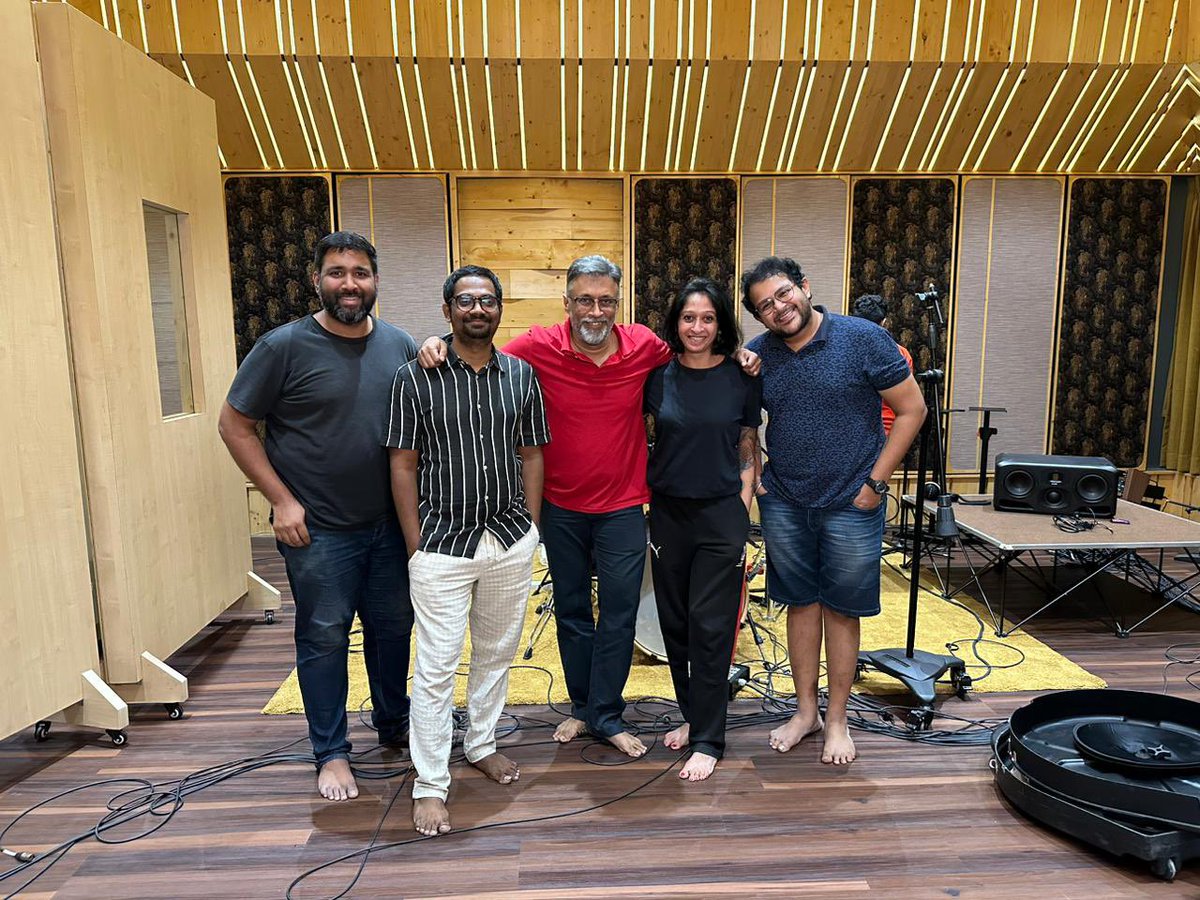
Anbenum Peruveli is an album that is a result of days of talking, discussing, jamming, recording, remote recording & delivering. It was 11 months back when I approached Sean Roldan with a proposal to do an album of Vallalar songs. It was a project that was conceived & commisioned by Vignesh Sundaresan & his Onemai Foundation. As we sat & discussed on what we wanted to do, Sean suggested we form a band specially for this purpose. He wanted to go totally old school – get the band together, jam around, come up with the songs before recording. The first meeting was with Sean, Vikram (Guitar) & Ramkumar (Drums) at Beachville café. As we bounced ideas we knew we were on to something. I was the old fogey desperately wanting to get out of my comfort zone. Sean was the brain who would put it together. Vikram & Ramkumar were seasoned professionals who realized what this could be and where it could take us. We needed a bass player to complete the circle & Vikram suggested Shalini Mohan from Bangalore.
The driving force to the whole experience was Sean & his restless, boundless energy and creativity. We were not even sure what genre we were aiming for. Just mentioning rock, celtic, jazz, blues in the conversation resulted in phrases, grooves, beats & notes taking form. It was a wonderful process of creation with a composer leading it & the band following suit adding a note here or an idea there. At the end when we sat & finished the whole recording sessions & heard the first scratch it was one of the most fulfilling of experiences.
Of course more work was to be done. Kalyani Nair joined the project to assist in the arrangements & remote recording with an orchestra in Macedonia & Celtic folk instruments at Abbey Road studios, London. The whole process was also simultaneously video documented by a team lead by Director Rafiq Ismail. The result is the documentary film that was released. Besides the team also created 6 music videos of the songs visually showcasing the brilliant creative interpretations by different artists and artistic forms. The website https://t.co/eQ9i4mt4qU will house the entire project including the album, music videos & the documentary film.
We indians use carbs as a carrier of other things in our plate. That's why it dominates our plates.
We do not know how to eat without it.
You don't need rice or roti or bread to be an agent to deliver eggs, meat , paneer , lentils, legumes, veggies into our mouths.
Once you know this, it's a game changer.