This study finds that in biomolecular #Condensates, the process of aging emerges from basic physical principles — a potential mechanism that could explain why these droplets, which are initially fluid, gradually solidify over time.
Learn more: https://t.co/l8Y1SzZlz1
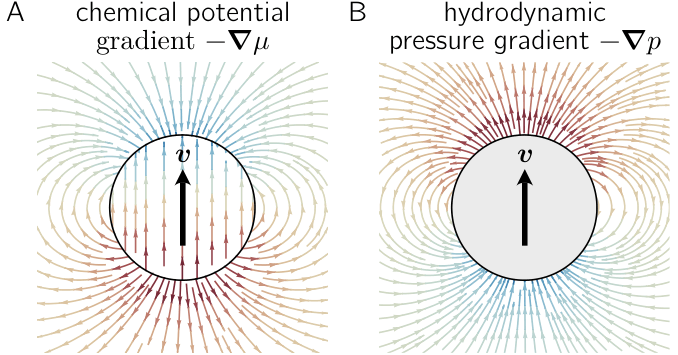
A new study suggests that motion of #BiomolecularCondensates is different from that of colloidal particles. Externally-controlled dynamic states, such as condensate motion, lead to polarization and dipole force fields.
🔗 https://t.co/9NBhki4ckv
Why does biological temperature dependence deviate from the Arrhenius equation? A new study paints a more nuanced portrait of diverse temperature-scaling behaviors and could help predict how biological processes respond to environmental shifts.
🔗 https://t.co/2UftkdOLms
Could cells use phase transitions to process information? This perspective paper argues that biomolecular condensation, the process of forming small droplets full of proteins and nucleic acid, could contribute to cellular information processing.
🔗 https://t.co/64RYLI8IUZ
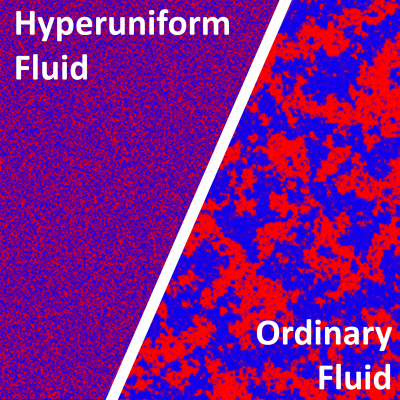
Where ordinary #fluids show wild fluctuations and critical opalescence, hyperuniform fluids of spinning particles stay unusually calm yet highly susceptible at the liquid–vapor critical point, a new study shows.
🔗 https://t.co/q2W12DiPoE
Fatigue failure refers to a material’s loss of rigidity after repeated application of stress or deformation. Simulations of model glasses now show that failure times display a power-law divergence and a strong dependence on annealing.
https://t.co/kmIsiNmF4F
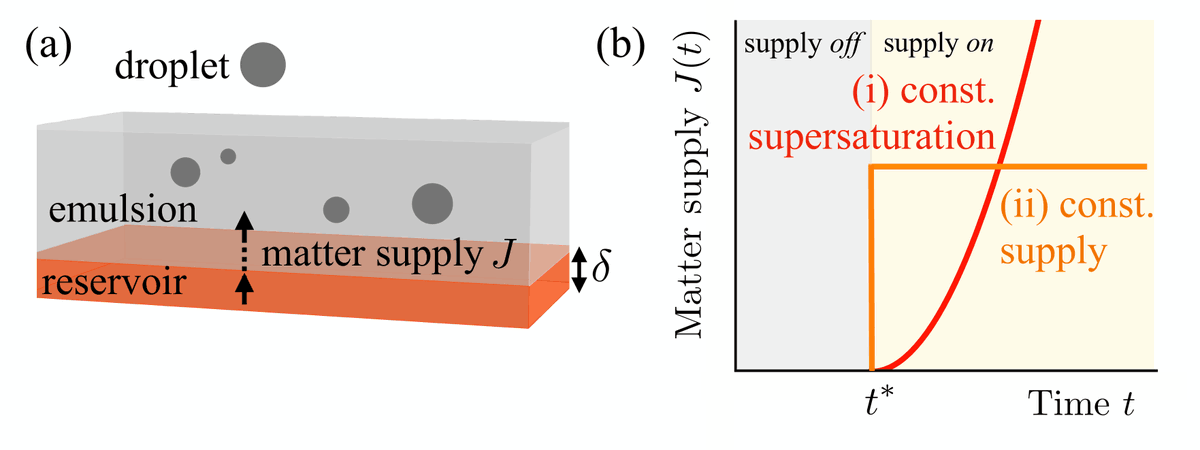
How do droplets grow when matter is continuously supplied?💧
Extending Lifshitz-Slyozov-Wagner theory, researchers have observed novel behaviors like universal coarsening kinetics. The work is relevant to biomolecular condensates in living cells.
🔗 https://t.co/LBfAQyvSDG
Is it possible to develop a “physics of language?” 💬
This study presents a statistical field theory model for the evolution of different linguistic variables, then tests that model using dialect survey data from the 20th century United States.
🔗 https://t.co/ez2W01utJq
#Glasses are simpler than we thought.
Across polymers, liquids, and inorganic networks, relaxation dynamics collapse onto ONE curve—controlled by just two parameters.
A step toward a universal theory of glassy dynamics in our new @PhysRevE Letter paper: https://t.co/5W3RiVhmcU
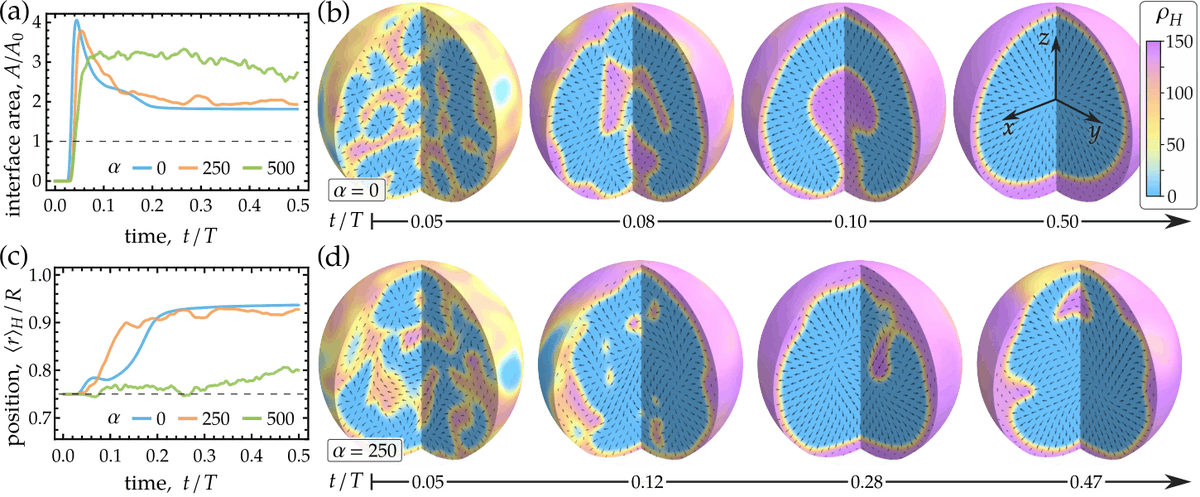
To understand the spatial organization of the genome inside the nucleus, physicists are taking a new approach: a hydrodynamic framework that describes the macro behaviors of euchromatin and heterochromatin as two distinct fluid components.
🔗 https://t.co/VjHdhj1Lww
In a 2D model, repulsive random kicks between particles can generate an active hexagonal crystal with collective ring diffusion. A single parameter both orders and disorders the system, revealing a new paradigm for non-equilibrium phase transitions.
🔗 https://t.co/Zr8zmTNpQI
Theoretical physicist @ekindogus started the company @periodiclabs to accelerate physics R&D and discover new materials. In his experience, the hottest research in his field is happening in the private sector. #whatcanphysicistsdo#ai
https://t.co/TXdPDPzBW4