Our First Nations people are the oldest living culture in the world. This is of great significance not just for all Australians, but for all humanity. 65,000+ years of life - They are asking for a voice, they asking to be heard - please, find it in your hearts to listen.
"Emperor penguins have no external threats except climate change and sea ice".
In other words, the only threat they face is us. 💔
We must *urgently* stop expanding coal and gas.
#GlobalBoiling#ClimateActionNow
https://t.co/sB4yrfAVGM
What the hell is an ampersand and why does it look like that?!
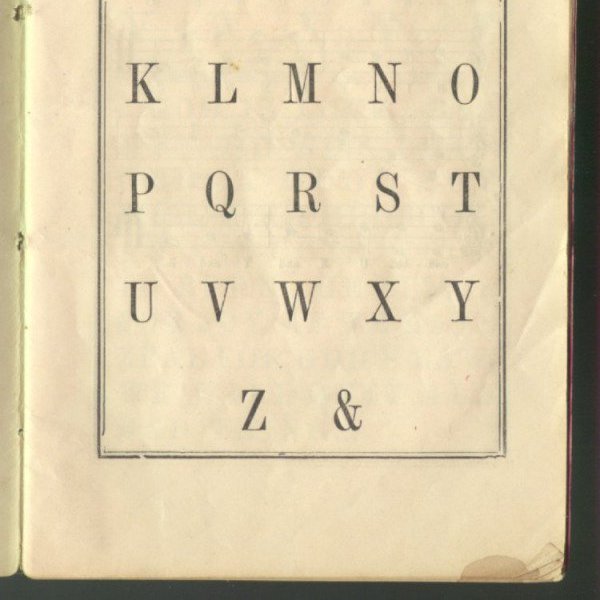
The first thing you need to know is that "&" used to be the 27th letter of the alphabet...
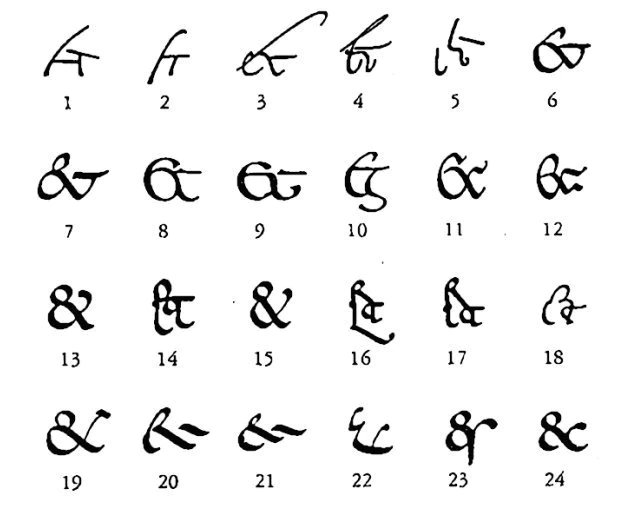
But there are three parts to this story. And the first begins over two thousand years ago in Ancient Rome with a single word: et. It's the Latin for "and". At some point Roman scribes started combining the two letters of et into a single symbol, which was the ancestor of our modern &.
The earliest example of the "et" symbol is actually from graffiti in Pompeii. In any case, it did not disappear with the fall of the Roman Empire.
Latin survived as the language of the Catholic Church and of scholarship in Medieval Europe. Scribes during the Dark Ages continued to use the & symbol. It evolved down the centuries, in places losing any semblance of the letters e and t whatsoever.
The second part of the story is that during the 18th and 19th centuries, as education and the teaching of literacy spread, & was added to the end of the alphabet as a sort of 27th letter.
On a related note, although "et cetera" is now usually just abbreviated as etc., for a long time it was instead abbreviated as "&c". The & was for et and the c for cetera.
The third and final part of the story is about how the alphabet was taught to children — and how it was read out loud.
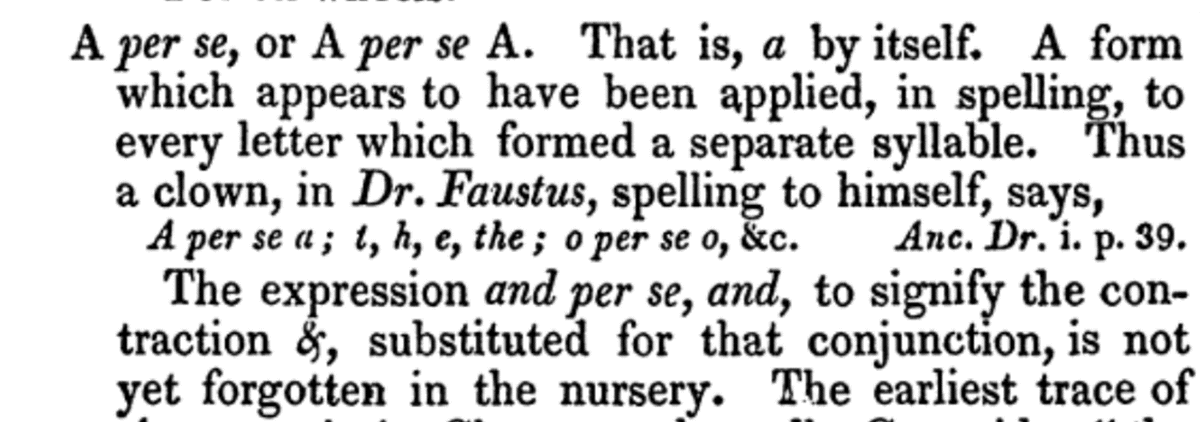
As this 1822 Glossary of Words and Phrases explains, it had been normal during the Renaissance, when speaking the alphabet, to add "per se" before any letter which could also be a word on its own — "per se" means "by itself" in Latin.
Take the letter A, which can also be a word of its own. When reading out the alphabet people would say "A, per se A, B, C, D, E, F, G, H, I, per se I..." and so on. O was also considered a word of its own.
Which means, when people got to the end of the alphabet, with & being the 27th letter, they would say: "S, T, U, V, W, X, Y, Z, and per se &."
When this old way of reading the alphabet was taught to children in the 18th century and they were reciting it aloud, they would garble "and per se " into what eventually became... ampersand.
A Dictionary of Slang and Colloquial English from 1905 relates some of the many other pronunciations school children apparently came up with:
"Ampersand. The sign &; ampersand. Variants: Ann Passy Ann; anpasty; andpassy; anparse; apersie; per-se; ampassy; am-passy-ana; ampene-and; ampus-and; ampsyand; ampazad; amsiam; ampus-end; apperse-and; empersiand; amperzed; and zumzy-zan."
Well, of all the many pronunciations that might have stuck, it was "ampersand" which came to be accepted and is now the official name for &... rather than zumzy-zan. So, from hurried Roman scribes to unruly school children, that's where "&" came from.
Anyone else feel a bit sick that this week's news has mostly been about 5 rich people drowning in the middle of the Atlantic instead of 700 desperate people drowning in the Mediterranean?
Internal emails obtained under freedom of information laws reveal top NSW Police officers covered up the Tasering of 95-year-old Clare Nowland. Thread and story below 👇@smh https://t.co/CYxn6s5yp6
Very interesting and challenging keynote from Donald Christie. Lots to think about and reflect on. Acknowledging misplaced optimism from the earlier years of open source but also pointing to things we can do to make the future better #DrupalSouth
No. Here is the weirdest story ever.
King Umberto I of Italy went to a restaurant on July 28, 1900. He had a trusted aide with him and apparently there were a couple witnesses to this. King Umberto and his friends all noticed the owner of the place looked exactly like Umberto.