I did some timing earlier to see which way of checking a zero length list in Python is the quickest. Without cheating, which do you think it was? #Python
Why yes, Claude, I *would* like you to enable all the additional Ruff checks I asked for, and then fix the resulting mess that you made in the first place.
- it loves to invoke shell scripts to do edits and ignore the MCP-provided editor tools
I also just had to tell it to work in smaller batches so I can review its output. You can spec out a change as much as you like and it nearly always finds a way of becoming a slop cannon.
My personal observations of Claude Opus after using it for quite a while now:
- it generally writes quite nice readable code
- It is awful at organising code into reusable abstractions
- for Python, it loves inline imports, and:
- ignores my AGENTS.md telling it not to do that
‼️🚨 Microsoft calls this "intended behaviour," so here we go.
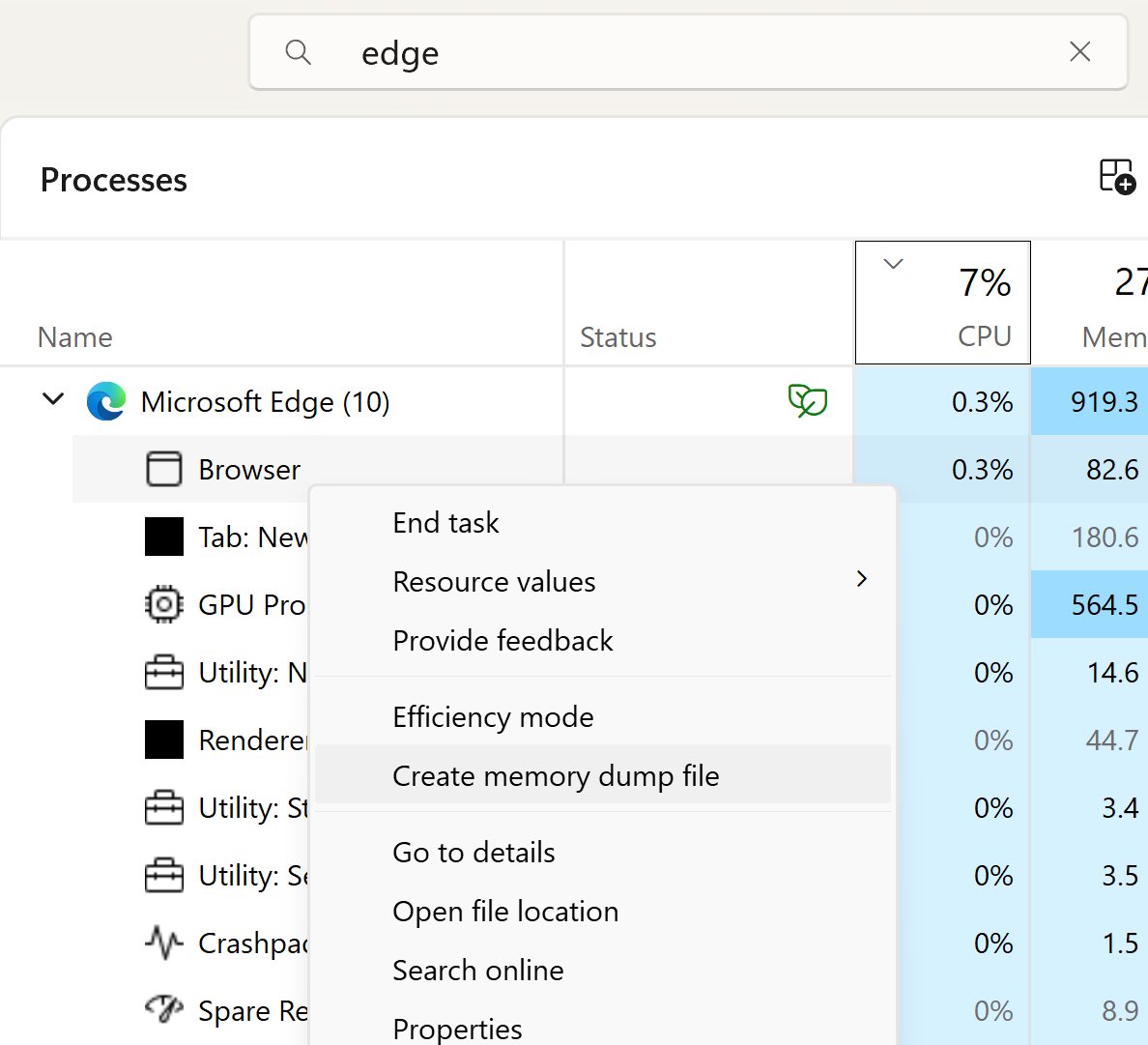
How to dump the credentials of every user stored in Microsoft Edge:
1. Open Edge. Don't browse anywhere, just open it.
2. Flip to Task Manager, find Edge, expand the task.
3. Highlight the "browser" sub-task, right-click, and choose "Create Memory Dump."
4. Open the dump file and look for credentials.
The logged-in Windows user can dump every stored Edge credential with no additional rights. Which means any malware that user executes has those credentials for the asking.
Thanks to Rob VandenBrink at SANS: https://t.co/ebtVZxne4L
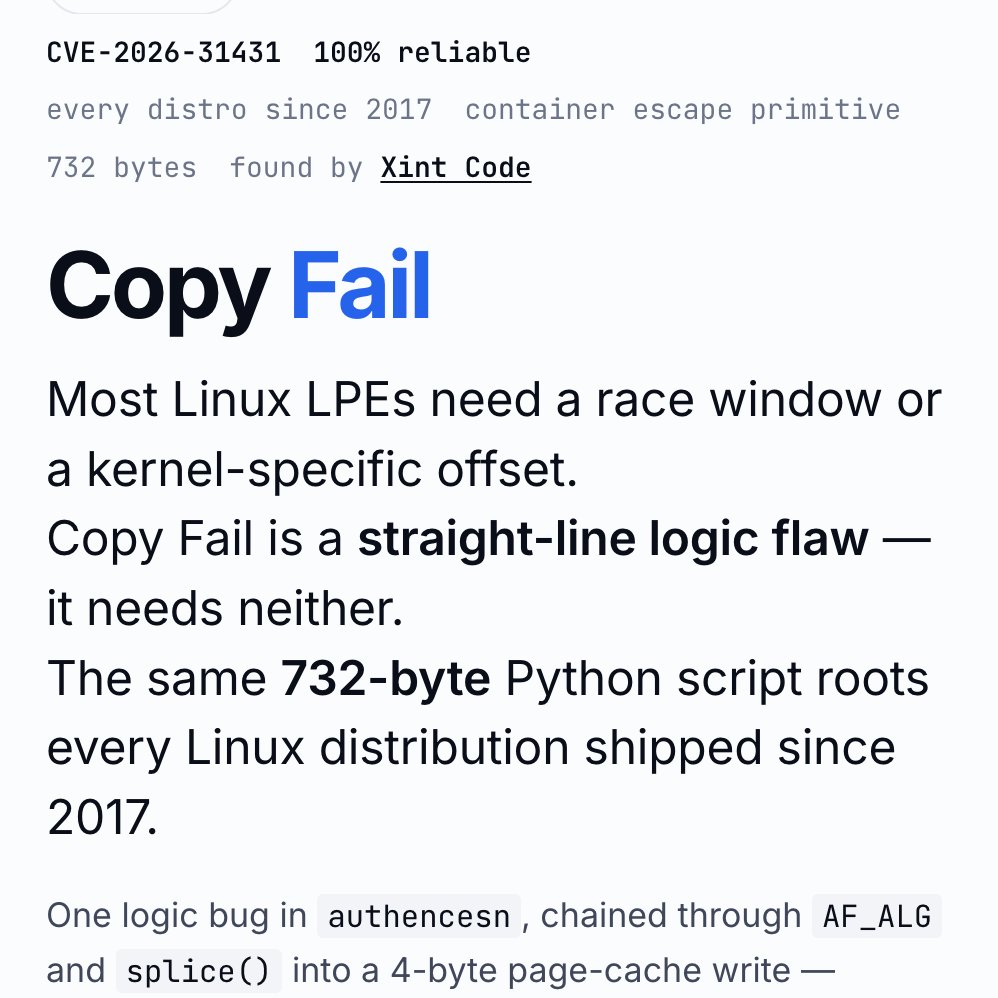
‼️🚨 BREAKING: An AI found a Linux kernel zero-day that roots every distribution since 2017. The exploit fits in 732 bytes of Python. Patch your kernel ASAP.
The vulnerability is CVE-2026-31431, nicknamed "Copy Fail," disclosed today by Theori. It has been sitting quietly in the Linux kernel for nine years.
Most Linux privilege-escalation bugs are picky. They need a precise timing window (a "race"), or specific kernel addresses leaked from somewhere, or careful tuning per distribution. Copy Fail needs none of that. It is a straight-line logic mistake that works on the first try, every time, on every mainstream Linux box.
The attacker just needs a normal user account on the machine. From there, the script asks the kernel to do some encryption work, abuses how that work is wired up, and ends up writing 4 bytes into a memory area called the "page cache" (Linux's high-speed copy of files in RAM). Those 4 bytes can be aimed at any program the system trusts, like /usr/bin/su, the shortcut to becoming root.
Result: the next time anyone runs that program, it lets the attacker in as root.
What should worry most: the corruption never touches the file on disk. It only exists in Linux's in-memory copy of that file. If you imaged the hard drive afterwards, the on-disk file would match the official package hash exactly. Reboot the machine, or just put it under memory pressure (any normal system load that needs the RAM), and the cached copy reloads fresh from disk.
Containers do not help either. The page cache is shared across the whole host, so a process inside a container can use this bug to compromise the underlying server and reach into other tenants.
The original sin was a 2017 "in-place optimization" in a kernel crypto module called algif_aead. It was meant to make encryption slightly faster. The change broke a critical safety assumption, and nobody noticed for nine years. That bug then rode every kernel update from 2017 to today.
This vulnerability affects the following:
🔴 Shared servers (dev boxes, jump hosts, build servers): any user becomes root
🔴 Kubernetes and container clusters: one compromised pod escapes to the host
🔴 CI runners (GitHub Actions, GitLab, Jenkins): a malicious pull request becomes root on the runner
🔴 Cloud platforms running user code (notebooks, agent sandboxes, serverless functions): a tenant becomes host root
Timeline:
🔴 March 23, 2026: reported to the Linux kernel security team
🔴 April 1: patch committed to mainline (commit a664bf3d603d)
🔴 April 22: CVE assigned
🔴 April 29: public disclosure
Mitigation: update your kernel to a build that includes mainline commit a664bf3d603d. If you cannot patch immediately, turn off the vulnerable module:
echo "install algif_aead /bin/false" > /etc/modprobe.d/disable-algif.conf
rmmod algif_aead 2>/dev/null || true
For environments that run untrusted code (containers, sandboxes, CI runners), block access to the kernel's AF_ALG crypto interface entirely, even after patching. Almost nothing legitimate needs it, and blocking it shuts the door on this whole class of bug...
When using Claude Opus to generate Python code, it loves using inline imports so much that it will ignore instructions in AGENTS.md to never do so on many occasions.
I'm not sure how to stop it doing this now, this is very annoying.
@rbtcollins Interestingly, I am taking the reverse approach. I have a pipeline of agents and use the cheapest to triage, use another to give me a complexity assessment, and select a "work" model to run the triage output based on the assessment.
@rbtcollins It is not! Grappling with LLM instructions is universal though. I get the impression it treats instructions near the start and end of the prompt as more important.
@rbtcollins Yeah I am continually telling it when I review the changes. Annoying :( I don't really want the lazy loading as it affects mock patches too.
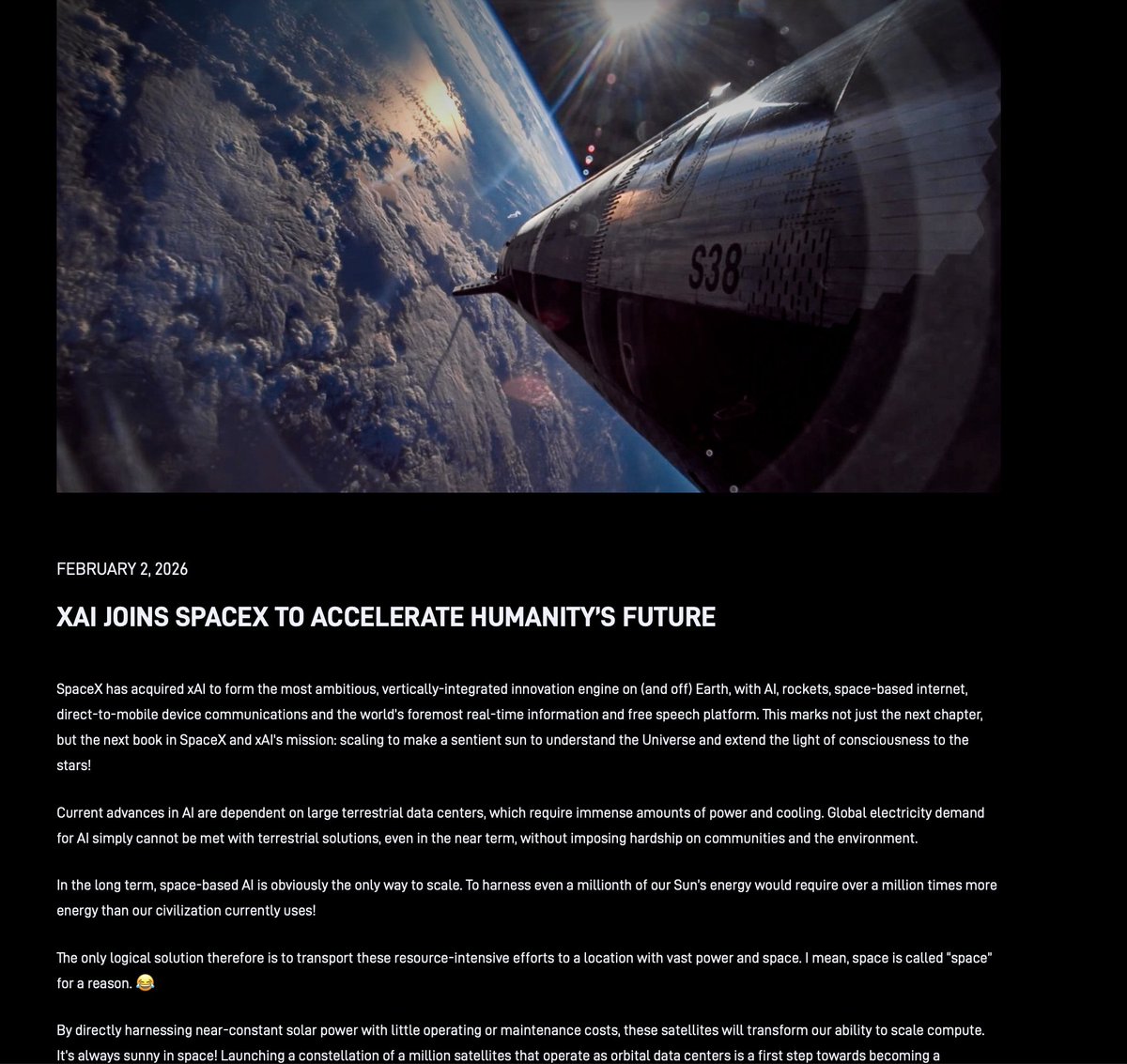
BREAKING: SpaceX and xAI have just formerly announced that they are merging.
Full statement from Elon Musk: "SpaceX has acquired xAI to form the most ambitious, vertically-integrated innovation engine on (and off) Earth, with AI, rockets, space-based internet, direct-to-mobile device communications and the world’s foremost real-time information and free speech platform. This marks not just the next chapter, but the next book in SpaceX and xAI's mission: scaling to make a sentient sun to understand the Universe and extend the light of consciousness to the stars!
Current advances in AI are dependent on large terrestrial data centers, which require immense amounts of power and cooling. Global electricity demand for AI simply cannot be met with terrestrial solutions, even in the near term, without imposing hardship on communities and the environment.
In the long term, space-based AI is obviously the only way to scale. To harness even a millionth of our Sun’s energy would require over a million times more energy than our civilization currently uses!
The only logical solution therefore is to transport these resource-intensive efforts to a location with vast power and space. I mean, space is called “space” for a reason. 😂
By directly harnessing near-constant solar power with little operating or maintenance costs, these satellites will transform our ability to scale compute. It’s always sunny in space! Launching a constellation of a million satellites that operate as orbital data centers is a first step towards becoming a Kardashev II-level civilization, one that can harness the Sun’s full power, while supporting AI-driven applications for billions of people today and ensuring humanity’s multi-planetary future.
In the history of spaceflight, there has never been a vehicle capable of launching the megatons of mass that space-based data centers or permanent bases on the Moon and cities on Mars require. Even in 2025, the most prolific year in history in terms of the number of orbital launches, only about 3000 tons of payload was launched into orbit, primarily consisting of Starlink satellites carried by our Falcon rocket.
The requirement to launch thousands of satellites to orbit became a forcing function for the Falcon program, driving recursive improvements to reach the unprecedented flight rates necessary to make space-based internet a reality. This year, Starship will begin delivering the much more powerful V3 Starlink satellites to orbit, with each launch adding more than 20 times the capacity to the constellation as the current Falcon launches of the V2 Starlink satellites. Starship will also launch the next generation of direct-to-mobile satellites, which will deliver full cellular coverage everywhere on Earth.
While the need to launch these satellites will act as a similar forcing function to drive Starship improvements and launch rates, the sheer number of satellites that will be needed for space-based data centers will push Starship to even greater heights. With launches every hour carrying 200 tons per flight, Starship will deliver millions of tons to orbit and beyond per year, enabling an exciting future where humanity is out exploring amongst the stars.
The basic math is that launching a million tons per year of satellites generating 100 kW of compute power per ton would add 100 gigawatts of AI compute capacity annually, with no ongoing operational or maintenance needs. Ultimately, there is a path to launching 1 TW/year from Earth.
My estimate is that within 2 to 3 years, the lowest cost way to generate AI compute will be in space. This cost-efficiency alone will enable innovative companies to forge ahead in training their AI models and processing data at unprecedented speeds and scales, accelerating breakthroughs in our understanding of physics and invention of technologies to benefit humanity.
This new constellation will build upon the well-established space sustainability design and operational strategies, including end-of-life disposal, that have proven successful for SpaceX’s existing broadband satellite systems.
While launching AI satellites from Earth is the immediate focus, Starship’s capabilities will also enable operations on other worlds. Thanks to advancements like in-space propellant transfer, Starship will be capable of landing massive amounts of cargo on the Moon. Once there, it will be possible to establish a permanent presence for scientific and manufacturing pursuits. Factories on the Moon can take advantage of lunar resources to manufacture satellites and deploy them further into space. By using an electromagnetic mass driver and lunar manufacturing, it is possible to put 500 to 1000 TW/year of AI satellites into deep space, meaningfully ascend the Kardashev scale and harness a non-trivial percentage of the Sun’s power.
The capabilities we unlock by making space-based data centers a reality will fund and enable self-growing bases on the Moon, an entire civilization on Mars and ultimately expansion to the Universe.
Thank you for everything you have done and will do for the light cone of consciousness."
This is one of the most useful additions I've seen @Ubiquiti add to Unifi Network in ages. It's just a year too late for me since I finally got fibre installed.
“Carnage on the way” as AI changes everything including effectiveness of cyber attacks/jobs market, and the bubble, says @Cisco chief, who compares it to the dotcom boom and bubble, which his company was part of 25 years ago.
MY @BBCNews exclusive with Chuck Robbins: