Pleasure to meet w/ @IMOSecGen Arsenio Dominguez at @IMOHQ in London. @IRENA & the International Maritime Organisation are close partners in decarbonizing the maritime sector through an accelerated #energytransition. Looking forward to deepening our ties in the run up to #COP30.
Today at @shippingics head office, the hybrid CEM-HUBS workshop brought together over 50 representatives from governments, industry associations, #ports, #shipping, and senior representatives from Clean Energy Ministerial to discuss next steps of the workstream deliverable.
"If we work together we all end up having a better world."
Born #OTD in 1943, Mario Molina was awarded the 1995 chemistry prize for showing that CFCs damage the ozone layer. He was passionate about solutions to look after Earth. Thanks to his work CFCs were banned worldwide.
"Es una persona que nos sirvió de símbolo deportivo"
"Cuando veían un partido de los tres (Fernado, Julio César Chávez y Hugo Sánchez) se paralizaba país. Ahora Fernando nos ha paralizado a todos"
@hugosanchez_9 rompe en llanto recordando a Fernando Valenzuela
Llevo varios días con una sensación de tristeza y desilusión; por momentos una sensación de culpa. Sé que decir esto no solo me traerá innumerables ataques desde el oficialismo. También sé que tendrá consecuencias, pero no puedo dejar de decir que la madrugada del 11 de septiembre la 4T cruzó una línea que nos obliga a reflexionar si es que estamos ante el inicio de una deriva autoritaria. https://t.co/qucU8beUry
Why don't we see more electrification in the industry sector?
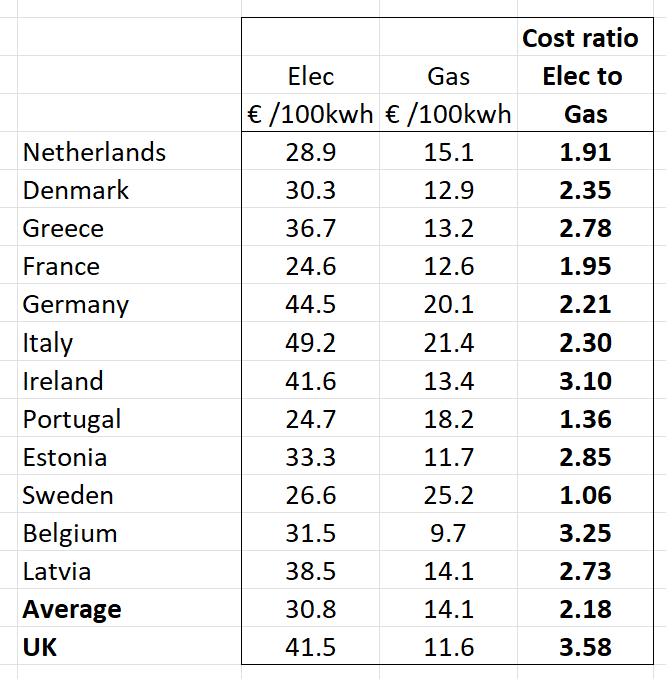
It's the economics: In many European countries the electricity to gas ratio is unfavourable.
This is partly a result of higher taxes and levies on electricity vs gas.
🧵
The UK has by far the highest ratio of Electricity price to Gas price.
This is a result of Tory Government policies:
1. Gas for electricity incurs a Carbon Tax, whereas gas for boilers does not.
2. The price of ALL electricity is set by the price of Gas-fired electricity.
2/
Air to Air heat pumps have seen a lot of technological advancement.
I'm not sure it's common knowledge.
As a result, we also probably don't adequately reflect how efficiently they cool today, and their potential role in space-heating.
https://t.co/ucLBAK13ni
It should be noted, that on top of lowering electricity taxes to all companies, the German government also agreed to extend further support to the most energy-intensive firms, including a 5-year extension of subsidy schemes to offset part of the cost of CO2 emissions.
Invisible flames: A terrifying methanol fuel fire engulfs Rick Mears following a refueling mishap at the 1981 Indy 500. Methanol burns with a nearly invisible flame, making it challenging to determine where to direct firefighting resources. In the midst of the chaos, Mears and some of his mechanics can be observed frantically signaling for assistance to extinguish the fire.
Thankfully, Mears and four mechanics were transported to the hospital, but no one sustained serious injuries.
Latin America can play a major role in the new global energy economy
The region already has one of the world's cleanest electricity sectors, putting it in a strong position for the emerging energy industries of the future
More in @IEA's new report ➡️ https://t.co/2qOCzyCj6F
Hydrogen: the road to nowhere
“Despite sky high ambitions and unprecedented political support, Europe’s hydrogen industry is struggling.
The EU’s goal to produce and import 20 million tonnes of clean hydrogen by 2030 is now widely seen as completely unrealistic.
For hydrogen to take off, the EU needs to dial down its ambitions dramatically.
Even a more achievable 4 million tonne goal would require an 80 fold increase in renewable hydrogen production.
Despite the chasm between hype and reality politicians remain unfazed. For their first big industry dialogue, Ursula von der Leyen and her new Green Deal Chief, Maros Šefčovič, chose hydrogen. Compared to the automotive, wind, chemicals or steel industry, it is a tiny part of the economy. But no industry sells dreams better than the hydrogen lobby.
The trouble is that unless we change course, the hydrogen dream will become an expensive nightmare.
It’s the economics, stupid!
There is a huge theoretical global “project pipeline” of more than 1 terawatt of electrolyser capacity. However, only 4% of hydrogen projects get financed.
That’s because there is no business case for clean hydrogen.
Trucks are a good example. According to the ICCT, in 2030 renewable hydrogen could be delivered to European trucks for €7/kg. That translates into energy costs of 45 cents per km and compares to 31 cents for diesel and 18 cents for an electric truck.
Hydrogen costs may come down a little more in Europe from their current €12/kg or more. The Boston Consulting Group now expects 2030 costs of €5-8/kg – that’s up from €3/kg hopes earlier.”