Physicians, since the medieval ages, have also become worse at using cast iron bone saws and herbal remedies. That's a good thing. Using advanced tools for helping humans is a good thing.
PS: I also think keeping humans in the loop is essential. We can combine our skills with AI
Brain-state-controlled #TMS promises more robust neuromodulation but hasn’t reached protocols like #iTBS yet. We show how to personalize iTBS by syncing delivery to each person’s #EEG theta rhythm - method + rationale inside, clinical results to follow:
https://t.co/G4GoTJzsyr
First paper since joining @GoogleDeepmind! We present 🌍ATLAS (Active Theory Learning for Automated Science), a pipeline that generates interpretable mechanistic models from data and optimizes experiments to test them.
Thread below
Check out my team mates' work on using AlphaEvolve to discover novel cognitive models of learning! This is such an important stepping stone towards building tools that help human scientists gain more insights from their data. We certainly did!
New preprint!
Is reaction time variability just noise? Maybe not.
In our study, early moment-to-moment variability predicted later implicit statistical learning. The strongest predictors were ITRV and Sigma, rather than rare attentional lapses.
https://t.co/rQlA4mD7LZ
You can still submit your presentation about data analysis and statistics in behavioral and related sciences to our local international symposium in Pécs, Hungary, in September 2026. https://t.co/P8s8kFNVTS
Now out in Nature Neuroscience: "Fixation duration on natural scenes is explained by memory encoding not processing demand".
https://t.co/6cBVNRLgsm
Our eyes don't linger because recognition is hard; they linger to remember. Let me take you on a quick tour. 🧵
@PhilipSulewski Fantastic paper. It resonates with our recent eLife study: both suggest that eye movements provide a window into internal model dynamics rather than simply reflecting perceptual processing. In your case, memory encoding; in ours, prediction formation. https://t.co/UqSZkVGU5W
We built a gaze-based method that tracks how people form and revise predictions trial by trial. The key finding: people keep their model unchanged when an error just reflects random noise, but update it when the error signals their model is wrong.
https://t.co/pYcdB1lQRW
New paper in J. of Sleep Research 💤
What fades while we’re awake may be protected when we sleep!
In our study, wakefulness hit weaker memories hardest — while sleep preserved weak and strong declarative memories alike.
https://t.co/SK07TWwPSw
#Sleep@dept_psych_sbg@sleep2app
So pleased that our paper on empowerment and causal models is out and freely available as part of this impressive special issue on world models and AI, with Melanie Mitchell, Josh Tenenbaum, Tom Griffiths and many other stars.
https://t.co/iQMU5gcmDz
This is a really marvelous movie, combining the scientific and the numinous in a way I haven't seen before and also features developmental psychology and the spotlight vs lantern!
https://t.co/SUR93nWiV5
New theory: Analog Cognition and Consciousness.
Cognition may emerge from a dialogue: synapses store information, but brain-wide waves organize and compute, flexibly shaping neural activity into coherent thought and conscious experience.
https://t.co/qUdqhIPKd1
#neuroscience
In our new study, greater childhood adversity was linked to faster statistical learning: faster automatic detection of patterns in the environment, a mechanism relevant for skill learning in domains like sports, music, and language.
https://t.co/tdSDgUgvJw
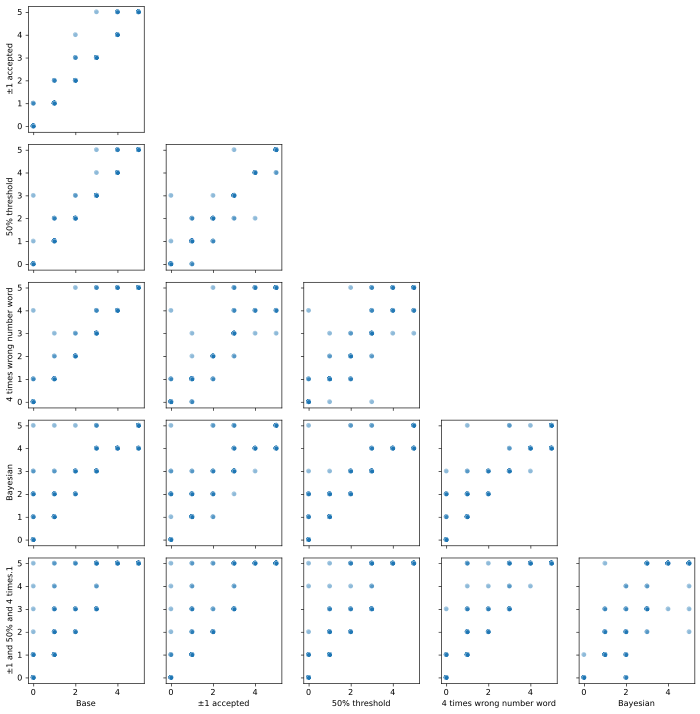
Different evaluation methods may categorize subset-knowers as CP-knowers and the other way around. Picture below: how various methods categorize children differently. See details in https://t.co/VaTOnkPxK7
The Approximate Number System account assumes an imprecise mechanism behind the precise symbolic number comparison. This leads to various contradictions in the model. Read more about it at https://t.co/W02FoM1DMt.