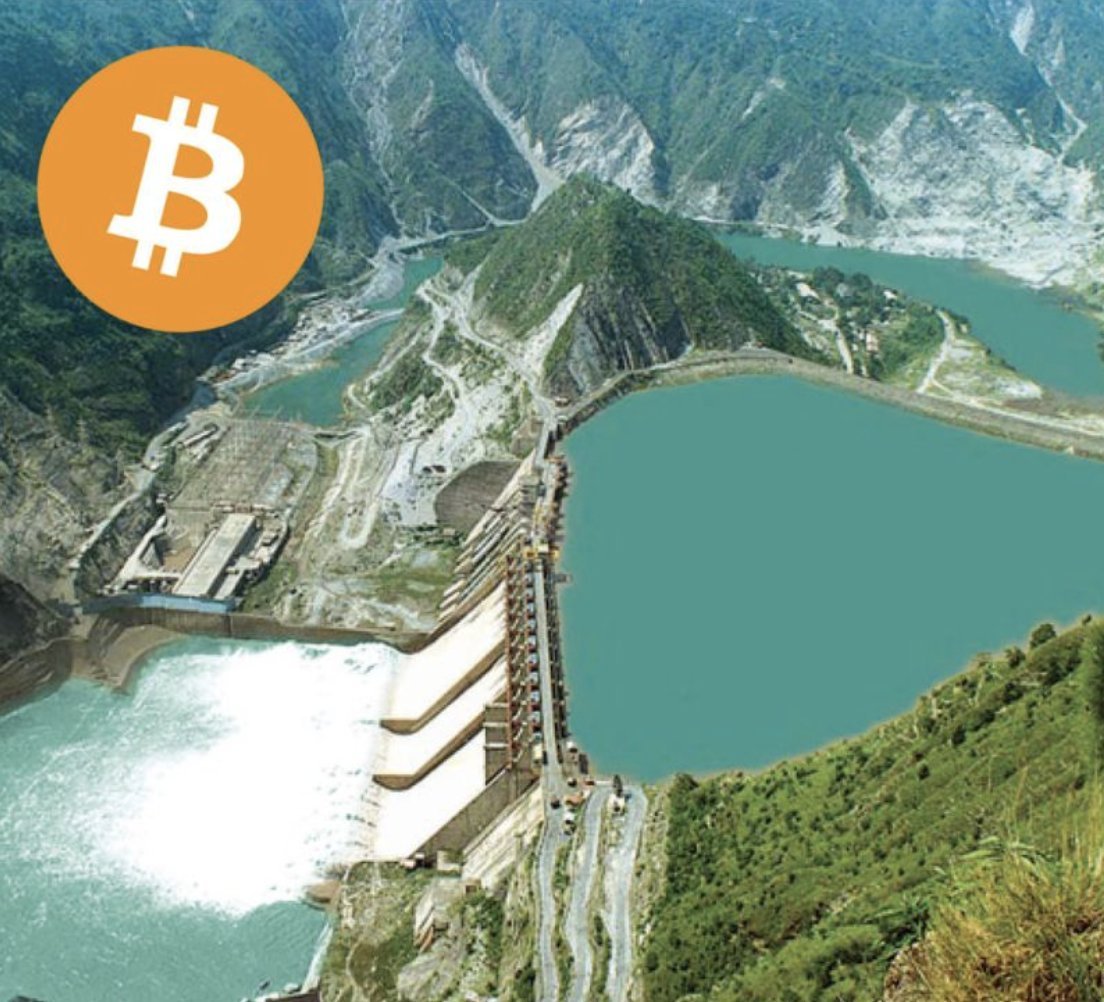
Does #Bitcoin use too much energy? Is it bad for the environment? What happens to mining when the price of #BTC changes? When hardware changes?
All you ever wanted to know about the dynamics of #Bitcoin mining but never dared ask:
https://t.co/22iLe9cFew
@jyn_urso The difference is not just capex, but also opex and especially sg&a. With AI compute, the "difficulty" is in the business model. So it makes sense in some cases but by no means a no-brainer.
That said I hope more people make the shift ;)
The most important component of writing clearly is simply to have high standards for clarity. Then if you write something unclear, you notice, and ask: what did I mean to say? You can just keep doing this over and over. And if you have high standards for clarity, you will.
@minilek Well the post is announcing a change at xAI and I can understand the decision in their context. Like old Bell Labs "MTS". I don't think he's stating no org should use the word "Researcher", but if he is, I'm not defending that :)
@callebtc Agree with your sentiment but... considering Strategy shareholders recursively, it represents hundreds of thousands of individual people having a claim on some BTC. So it's centralization of custody not ultimate ownership. Still, not great.
naimacs, my coding assistant in emacs built using naimacs, can now directly edit code in addition to assisting via conversation. Other new features: options to narrow context and change models on the fly.
https://t.co/3fggcIEn0j
@anteneh In parallel I agree it is necessary to continuously be less constrained, as you say, or to be blunt, less vulnerable to destabilization as a strategy.
@anteneh Re: data. One prerequisite, mentioned in my article, is models of water consumption in the basin, based on neutral high resolution geospatial data, that are neutral, verifiable and publicly accessible.
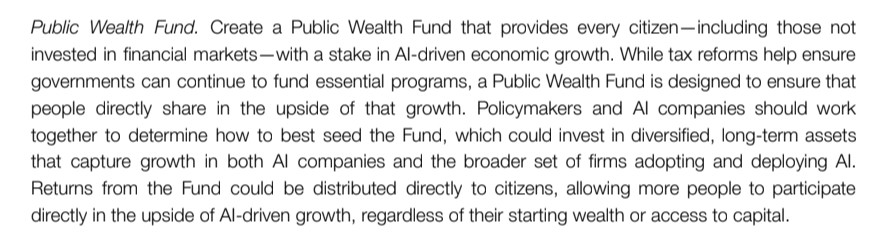
OpenAI has written a new policy proposal 'Industrial Policy for the Intelligence Age: Ideas to Keep People First.' They propose the creation of a Public Wealth Fund that will provide American citizens with an automatic public stake in AI companies and AI infrastructure even if they are not invested in the market. Returns from the fund would be distributed directly to citizens.
@martinplaut Do you not realize the image you posted is a cheap obvious fake? Look at the colors. Besides, the whole thing is idiotic. Abyssinia was an exonym. Like Germany/Deutschland, Persia/Iran, Nippon/Japan etc.
For the non-idiots who are interested 👇
https://t.co/E5Wmgz4sxE
We now have official EEP data that shows Bitcoin mining has nearly doubled Ethiopia’s annual net transmission grid expansion rate
Even more importantly, it has catalyzed an unprecedented level of new construction activity never before reported by EEP at this scale.
Consider this context:
Delivery of power to rural Africa, alongside combatting youth unemployment is one of the two biggest political changes in sub-Saharan Africa.
Bitcoin mining has just demonstrated it can be a viable solution for one of them
Let's dig in.
Ethiopia made $220 million from Bitcoin mining in 2024/25 which is expecting to increase to $312 million this year (source: https://t.co/oqTCnWhvSq
This electricity would otherwise have been wasted
Why?
Although Ethiopia has the capacity to generate 6 Gigawatts from the new dam, Ethiopian Electric Power (EEP) hasn't yet built the transmission lines to supply all that electricity generated.
So, in the meantime the dam authorities sell electricity to Bitcoin mining companies.
These electricity sales to Bitcoin miners were 67% of EEP's total Foreign Exchange revenue last year, vastly improving profitability.
source: https://t.co/5KWbElZYOb
What do they do with that unexpected extra profit?
EEP has stated repeatedly that the revenue from Bitcoin mining is used to support "infrastructure expansion" and "rural electrification" source: https://t.co/k94weeyjNQ
News channel Aljazeera recently confirmed
"Ethiopia doesn't yet have the distribution network to take electricity to 1/2 the population...The idea is the fees paid by the Bitcoin miners will go towards funding the expansion of the grid."
source: https://t.co/RLlzTJsw31
Significantly, EEP's own data shows revenue from Bitcoin mining supported EEP's 2024/25 fiscal year
* 28,571 km new power lines built
* 8,700 substation bays installed
Source: https://t.co/5KWbElZYOb
Bitcoin mining revenue has already almost doubled EEP's rate of energized network buildout from ~358 km/year average to +662 km last year.
But more important is what is in the imminent pipeline: the 28,571 km of new power lines is larger than the entire size of their grid!
source: https://t.co/jvRxu55nMX
Let's be clear, we cannot say that "Ethiopia build more than their whole grid in a year" because not all of that new capacity has been fully energized yet, so that would be an apples-for-oranges comparison.
But it is still an unprecedented rate of new construction.
The good news is that the bulk of this infrastructure constructed but not yet fully energized is not “waiting years”, it is in active commissioning right now and is expected to come online progressively over the next 12–18 months.
Source: Birr Metrics (EEP’s 2025/26 budget announcement) https://t.co/t7B8rCNc9S
When that new network is fully energized, the increase in the speed of energized network buildout will not be 2x. It will be substantially higher, potentially more than 10-20x the historical average as the backlog comes online.
Read that last sentence again.
A forecast 10-20x faster buildout of Ethiopia's electrical grid.
Rural electrification of Sub-Saharan Africa is a key strategic focus for over 20 global institutions and development banks, including the UN, World Bank, IRENA, African Development Bank, and Rockefeller Foundation.
It is even explicitly one of the UN’s Sustainable Development Goals (SDG 7), where Target 7.1 calls for “universal access to affordable, reliable, and modern energy services by 2030.” Sub-Saharan Africa accounts for 85% of the world’s people still without electricity (mostly in rural areas), making this one of the biggest global priorities.
How Ethiopia is achieving this should be one of the biggest stories at the UN right now.
Far from “taking renewable power away” from people, Bitcoin mining’s use of otherwise wasted renewable energy is catalyzing the accelerated delivery of electricity to rural Africa. Bitcoin mining has created a pragmatic solution to an issue that has plagued powerful global institutions for decades.
If you are still gaslighting Bitcoin mining in 2026 (based on early studies, now been widely debunked), you are no longer just uninformed. You are perpetuating harmful myths that slows down power delivery to people living without electricity.