AI is quietly shifting from a tool that answers questions to a layer that makes decisions.
Not just “what should I write” or “what should I search,” but increasingly “what should happen next.”
That shift changes everything.
Because once AI starts shaping outcomes like contracts, disputes, transactions, and access to information, the real question is no longer capability.
It becomes control.
Who decides what the system outputs when that output affects real consequences?
Today, that decision sits inside a small number of frontier labs. They can change access, modify behavior, filter outputs, or fully remove capability.
That’s not necessarily wrong. It’s their infrastructure.
But it reveals something important: most of our future “judgment layer” will be owned by someone else.
And judgment is not a small thing.
It decides what is true, what is safe, what is valid, what is allowed, and what gets ignored.
The problem is not one model or one company.
The problem is concentration.
Because when judgment is centralized, bias becomes invisible authority.
We stop seeing the choices behind the answer.
What was filtered. What was softened. What was excluded. What was prioritized.
AI makes this harder to notice because it doesn’t feel like a system of decisions. It feels like a finished answer.
And that’s the risk.
As AI moves into agents and automation, it will not just respond. It will act.
It will interpret contracts, evaluate claims, negotiate systems, and coordinate decisions between humans and machines.
At that point, “trust us” is not enough.
We need systems where judgment is not owned by a single model or institution.
This is where @GenLayer comes in.
GenLayer is built on a simple idea:
Judgment should not be centralized inside one black box.
Instead, decisions that create consequences should be produced through a process that is plural, visible, and challengeable.
Not one model deciding.
Not one policy layer deciding.
But, multiple independent judgments converged through structured disagreement.
This matters because truth does not scale safely through single points of authority.
It scales through verification, contest, and convergence.
@GenLayer brings that principle into AI-driven systems.
Instead of a hidden final answer, decisions become the output of a process that can be inspected and challenged.
Instead of “because the model said so,” we move toward “this is how the decision was reached, and here is how it can be contested.”
We’ve seen this pattern before.
When trust concentrates, power concentrates.
And when power concentrates, systems eventually start serving themselves, even without bad intent.
AI is just accelerating that reality.
So the question is simple:
Do we want a future where one system becomes the final judge of reality?
Or do we want a system where judgment is distributed, accountable, and inspectable?
GenLayer is an attempt at the second option.
Not because AI should be less powerful.
But because power without contestability does not scale safely.
We are moving into a world where AI doesn’t just answer questions.
It decides outcomes.
And in that world, the most important question is not what AI can do.
It’s who gets to decide what it should do.
AI freedom won’t be lost all at once.
It will be lost quietly, every time a lab decides what answer you’re allowed to see, what model you’re allowed to use, and what judgment you’re allowed to trust.
We can delegate decisions.
We cannot surrender the right to decide.
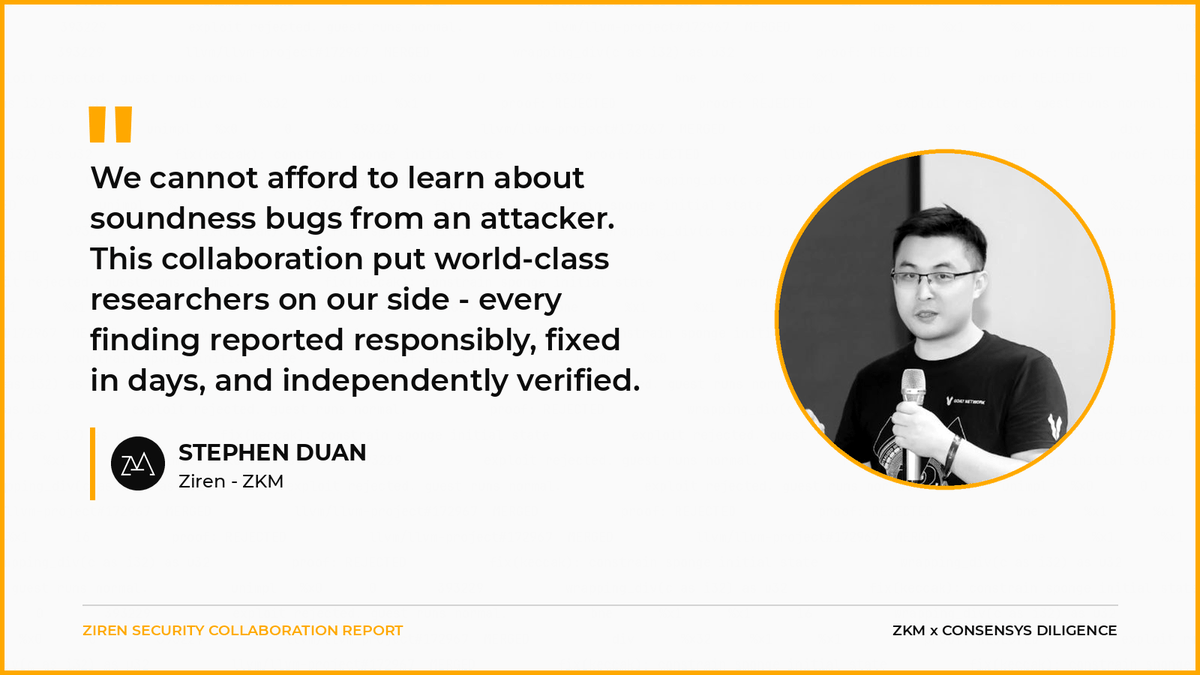
For the past seven months, researchers from @ConsensysAudits, the @ethereumfndn, and @tu_wien have been trying to break Ziren.
Every finding: reported, fixed, independently re-verified.
The full collaboration report lands next week.
Ziren proves the GOAT BitVM3 bridge.
First, a comprehensive security audit by @VeridiseInc, followed by seven months of leading researchers working to break it. Every finding fixed and independently re-verified.
For infrastructure scaling Bitcoin, nothing less will do.
@GOATNetwork@VeridiseInc The important part is the full loop: find weaknesses, fix them, then verify the fixes. That's much stronger than simply publishing an audit and calling security finished.
@GOATNetwork Strong mix of technical progress and ecosystem growth this week. From BitVM3 and x402 expansion to founder education and new research, GOAT is pushing on both the infrastructure and adoption sides.
This week at GOAT Network:
◦ The July newsletter is out: BitVM3 nears mainnet
◦ Tempo became the latest network supported by GOAT x402
◦ Babylon founder David Tse highlighted GOAT BitVM3 at SBC '26
◦ CMO-led marketing & distribution workshop for early technical founders
◦ The Agency Problem was published, extending our thesis on infrastructure for autonomous systems
Details below.
I got 38k $INSO from the @insoblokai season 1 ambassador airdrop.
Season 2 has started and it's set to end on the 31st of August.
Barely 24 days to go...
If you haven't joined this campaign you still have time to hop on the s2.
Join here👇
https://t.co/Bu4EaLcmhf
#Inso #crypto
@ProjectZKM That's an interesting perspective. As AI agents become easier to create, the emphasis shifts from trusting the actor to verifying its actions through cryptographic proofs.
@GOATNetwork Lower operating costs mean builders can experiment more, scale faster, and spend less on infrastructure. That's a win for the entire agent ecosystem.
@GOATNetwork A timely workshop for early-stage builders. Turning a working demo into a product with real users is one of the biggest challenges every startup faces.
@GOATNetwork An interesting extension of the original idea. If AI dramatically lowers the cost of creating economic actors, then verification becomes just as important as the money they use.
In February, The Agent Standard (https://t.co/6PSKJqyacQ) laid out why autonomous machines need sound money.
But the agency problem extends beyond money: AI has made economic actors essentially free to manufacture, and an economy of infinite actors cannot run on trust. They must run on proof.
This subsequent work by CMO @0x1164 traces the historical pattern behind it: every economy is downstream of its verification technology. And it names the four proofs that turn an agent into an economic actor: identity, authority, performance, and settlement.
@GOATNetwork A valuable session for technical founders. Building a great product is important, but without distribution, even the best ideas can struggle to find users.
A marketing primer for early-stage technical founders looking to get into a distribution headspace.
Included free: two PDF resources - a sourced growth tip sheet and a 15-play AI marketing ops manual, applicable from day one.
Tomorrow, 2pm UTC.
@GOATNetwork That's a powerful shift. For the first time, software can become an economic participant almost instantly, able to earn, spend, and interact with other services through code