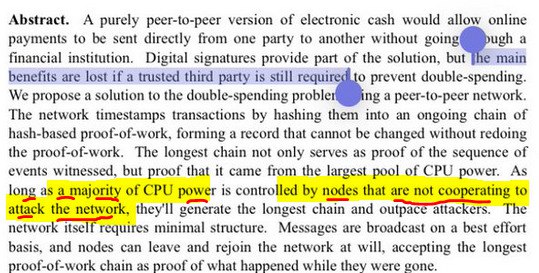
@TheRealPlanC Possible that @bitcoin_pow takes over since it eliminates mining pools from Bitcoin.
Imagine handing the mining power back to the people and removing all mining pools.
https://t.co/m0zUSHq43N
@BitcoinSapiens @saylor@maxkeiser@bitcoin_pow is a bitcoin fork that eliminates mining pools using an innovative mining algo. It is actually a hidden gem with a fair launch just waiting for the masses to realize its power.
https://t.co/m0zUSHqBTl
@LukeDashjr It's hard to step up and do work for a centralized chain.
@bitcoin_pow is the preferred Bitcoin because it eliminates mining pools and forces mining decentralization. Maybe it is time for you to work on BTCW.
https://t.co/m0zUSHq43N
If you only learn one thing about the OP_RETURN drama, make it this.
From a network perspective, the most important risk to Bitcoin’s longevity is mining centralization, by far.
Just when we’re on the cusp of making transaction selection decentralized with Braidpool, P2PoolV2, Sv2, and DATUM, along comes a desire for strange, policy-violating transactions (mostly 4MB inscriptions).
If a miner simply taking a full node off the shelf cannot build a competitive block template with no effort, these efforts will simply fail. (Where “competitive” means within something like 0.5%, remember we’re comparing to profit margin, not revenue.)
I’m not any more a fan of embedded data in the chain than anyone else, but OP_RETURN policy changes aren’t gonna impact that.
Much more critically, without some success on mining decentralization efforts over the coming years, I’m really not sure what Bitcoin is for - if three companies, together, control what gets into the chain what’s the point?
If you only learn one thing about the OP_RETURN drama, make it this:
The biggest threat to Bitcoin's censorship resistance is that the biggest pools stop mining on top of blocks found by anyone, and start mining only on top of blocks found by a small cartel of pools. Another name for this scenario is 51% attack. Independent solo mining would not be possible anymore, and you'd need to join the cartel and pass KYC to mine.
If that happens your txs will only get mined if they enter Foundry's or AntPool's mempool. States will lean on this chokepoint to apply blacklists first on their mempools, then whitelists later. At this point Bitcoin is 100% permissioned and tame.
By officially broadening Bitcoin's use cases to include arbitrary file storage, Core is giving these pools more reason to do active content moderation of their mempools to avoid legal troubles. And the easiest way to enforce active content moderation is the aforementioned 51% attack.
Context: just Foundry and Bitmain alone are enough to pull this off.
Mining is centralized.
The concern around objectionable content is met with appeals to decentralization of mining - i.e a Bitcoin network that doesn't exist.
Until now, what has already been "technically possible" with storing nasty stuff in the chain wasn't.
1. "The" mempool was protected because everyone would filter a sick 100kb OP_RETURN along with *all* OP_RETURNs greater than 83 bytes.
2. The blockchain was protected because the few miners there are in the world would reject directly submitted malicious content.
This left one option for sabotage: an attacker mining a CSAM OP_RETURN directly into the chain themselves.
Referring to something as impractical as that as "technically possible" is entirely frivolous and it would have been laughable if it had ever happened. An "Unknown" pool finds a block that has a giant 1MB MP4 of something appalling in it? Obvious sabotage that we would universally eschew and I'm confident we would be able to resolve after the fact.
Now however the situation has changed.
F2Pool solicits this stuff directly from the p2p network and Libre Relay nodes along with Core 30 release candidates are willingly relaying it.
There is now an anonymous, p2p network for this attack that's free to access and there is a miner who will oblige it.
The combination of the above, in practice, drops the cost from six figures ($$$,$$$) to three ($$$) and makes it possible to do anonymously.
But more importantly, the mechanism of the attack makes the resulting content appear to have been endorsed by the network at the policy level rather than come as a result of a circumvention that exploits crude consensus rules.
If you still cannot understand the significance of that then you must simply not be aware of the changes that Bitcoin has undergone with all the malicious tweaking of late and the sheer desire there is to take Bitcoin out.
Again: The p2p network has protected itself from attack due to sane default mempool policies, while the blockchain has been inaccessible to attackers due to pools not wanting to be on the hook for blocks containing malicious data.
Those technically-circumventable factors are now gone and there is no practical limitation to the attack beyond cleaning some coins, and paying a couple hundred bucks in transaction fees to get unacceptable content into the chain.
If the network isn't going to protect itself from malicious, consensus-valid activity then the only option left is changing consensus and doing a soft fork to limit OP_RETURNs and perhaps other known types of data carrying.
That idea entered the arena on the mailing list on Friday from someone vocally against Knots (@PortlandHODL) and was received positively by the Core devs who responded. Some embellishment was offered by Luke (add additional data carrying types) to which there was not so much response.
Without community support a fork fails. It's possible if even the Core 30 proponents are OK with limiting this stuff at the consensus level though that there is community support and thus it could be the way forward.
I dislike it because it abandons spam mitigation occurring at the policy level which is where it belongs but the current environment isn't giving us a lot to work with.
It is probably appropriate to characterize the fork as defense we never needed against a specific type of attack versus spam mitigation in general which will have to be continue in parallel.
Fork?
F2Pool is actively attacking the network RIGHT NOW. All it takes is one attacker to send them a single instance of CSAM, and Bitcoin users will have to knowingly and intentionally receive, store, and distribute it until the end of time. This will permanently impact Bitcoin adoption regardless of whether governments turn a blind eye or prosecute. If miners are going to switch pools when they do bad things, NOW IS THE TIME.
I don't care if you switch to Foundry or even Antpool. Obviously I would prefer you make your own blocks and use OCEAN, but this is too critical and time-sensitive to be picky. We can work on mining decentralization and spam issues over a longer period of time, but CSAM is an insta-kill we MUST avoid.
$BTCW should be at $5 now, trading at 0.01 is what I call hidden gem 💎👀
@bitcoin_pow is the true decentralised #BTC chain, forcing solo mining! #DYOR and #HODL ⛓️💪
https://t.co/J7qLMa6bYj
Good morning ☀️✌️
What are we accumulating? I’m watching $BTCW @bitcoin_pow 🔥👀 They just released a GPU mining script and their algorithm is eliminating mining pools 💫
A rear potential - #DYOR#NFA but it’s worth to check this gem out! #1000xGem#AltcoinGem 🏆
Ever hear of this coin?
It is the only Bitcoin fork that eliminates mining pools to get the best decentralization that Satoshi always wanted. This coin is smashed into the ground daily to keep the price very low and unattractive. Ticking time bomb...
@bitcoin_pow#BTCW
If you’re one of those #altcoingem hunters that actually invest the time for proper #DYOR - I would recommend checking out (the mining side of) $BTCW @bitcoin_pow 🔥⛏️
Something is brewing and it’s not going to be ugly 👀 The technology behind this #Bitcoin fork eliminates mining pools.
Wait till the right time and @binance is next 🚀 I am long on #BTCW 🧨