In the early 1950s, a silent shadow hung over the stunning valleys of the Himalayas. Across a belt stretching 1000s of KMs from Jammu & Kashmir through Himachal Pradesh & Uttar Pradesh to the North-East, ~50% of the population suffered from swollen necks, massive thyroid goitres & severe physical & mental stunting.
Entire villages were trapped in a cycle of endemic cretinism. Global medical experts insisted the problem was far too massive to fix in a developing nation. Then, a young Oxford-trained pathologist stepped into the Kangra Valley with a crate of crude chemical salt, intent on proving them wrong.
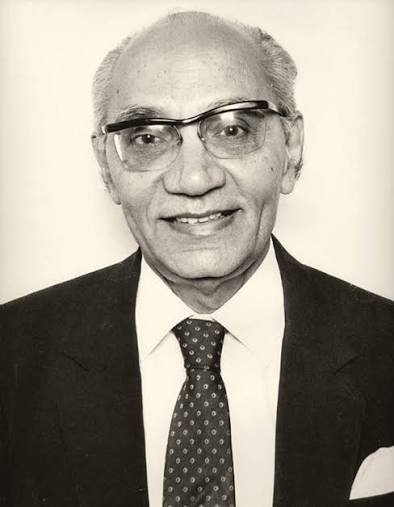
In 1950s, Dr. Vulimiri Ramalingaswami, a brilliant researcher at the ICMR who would later become the Director of AIIMS & DG of ICMR, launched what became known as the Kangra Valley Experiment.
Western nations had previously tackled goitre by adding potassium iodide to table salt. But Western scientists scoffed at the idea of applying this solution to rural India. They argued: Indian monsoon humidity would dissolve & wash away the volatile potassium iodide during transit.
Traditional Indian cooking: boiling, frying & baking salt at high temperatures for hrs would completely destroy the delicate chemical compound.
The logistics of delivering fortified salt across 1000s of roadless mountain villages were biologically & structurally impossible.
Ramalingaswami refused to accept that millions of mountain children were condemned to brain damage & physical stunting by default.
Along with his team, Ramalingaswami designed a massive community trial tracking 100000+ villagers across 3 zones in Himachal Pradesh's Kangra Valley:
- Zone A received KI-fortified salt.
- Zone B received the plain-salt control.
- Zone C received KIO₃-fortified salt.
For yrs, Ramalingaswami personally trekked into remote Himalayan hamlets. He monitored salt distribution trucks, analyzed soil & water iodine levels & examined 1000s of necks & thyroid glands under primitive field conditions. He subjected iodized salt samples to punishing heat, open-air storage in humid huts & traditional Indian boiling to track every milligram of chemical decay.
By 1962, the preliminary results were clear: In the control zone given plain salt, goitre rates stayed high at around 38-40%. In the zones receiving iodized salt (both potassium iodide & potassium iodate), rates fell sharply, ~ by 50% & continued to decline with longer follow-up.
Ramalingaswami had mathematically proved that potassium iodate survived tropical humidity, months of transport in open jute sacks & high-heat Indian cooking w/o losing its protective power.
His empirical data forced the GoI to establish the National Goitre Control Programme in 1962 later the National Iodine Deficiency Disorders Control Programme, eventually making universal salt iodization the law of the land.
When global bodies like the WHO & UNICEF evaluated his Kangra Valley dataset, they adopted his exact chemical formulation, potassium iodate fortification, as the universal gold standard for tropical & developing nations worldwide.
Every single day when we open a packet of salt in our kitchen, we are holding a life saving chemical shield pioneered in the muddy tracks of the Kangra Valley.
W/o launching a single pharmaceutical drug/performing a single surgery, Vulimiri Ramalingaswami sustained a crippling neurological disease for 100s of millions of children & quietly saved the minds of an entire nation at the kitchen table.
Imagine sprinting up a steep flight of stairs. Within secs, our chest tightens, our lungs burn & a sensation of pure panic forces us to stop & gasp for air.
We think it is just fatigue. A few think it is just a buildup of CO2.
We both are wrong. What actually stopped us from running until our heart literally exploded was an invisible tripwire inside our lungs, a microscopic sensory switch that acts as the body’s ultimate emergency brake.
For centuries, global medical science had no idea this switch existed. The man who discovered it & fundamentally rewrote human physiology did not work out of a multi billion dollar Harvard lab.
He was an Indian medical researcher working with improvised equipment in Delhi. His name was Dr. Autar Singh Paintal.
Born in 1925 in Mogok, Burma, young Autar was fascinated by how machines worked. When his family moved to India, he enrolled at King George’s Medical College in Lucknow. While his peers memorized textbooks, Paintal was obsessed with a deeper question: How does the brain know what the heart & lungs are doing in realtime?
In the 1950s, neurophysiology required ultra sensitive electronic tools to record the microscopic electrical impulses firing along single nerve fibers. Western labs had massive budgets; Paintal had almost nothing.
Unfazed, he built his own amplifiers, hand-wound his own recording coils & perfected a technique so delicate that even a microscopic tremor in his hand would ruin weeks of work: isolating & tapping into single nerve fibers of the vagus nerve, the body’s main communication highway between organs & the brain.
While working at the Vallabhbhai Patel Chest Institute in Delhi, Paintal began mapping the sensory receptors of the heart & lungs. 1 by 1, he started discovering nerve endings that global medicine did not know existed:
- The Gastric Stretch Receptors: He isolated the specific nerve signals that tell our brain our stomach is full, laying the neural foundation for modern appetite research.
- The Cardiac Atrial B-Receptors: He discovered the sensors in the heart that monitor blood volume, explaining how the body automatically adjusts heart rate & fluid balance.
Then came his masterwork.
In 1955, Paintal detected a faint, mysterious electrical signal coming from deep inside the lungs, right next to the pulmonary capillaries (the tiny blood vessels where O2 enters the blood).
Western scientists dismissed it as background noise. Paintal knew better. He spent over a decade proving that these sensors were activated whenever blood pressure rose in the lungs/when fluid began to accumulate, such as during extreme physical exertion/heart failure/high-altitude pulmonary edema.
He named them J-Receptors (Juxtapulmonary Capillary Receptors).
When J-receptors fire, they send a lightning-fast warning straight to the brainstem. The brain instantly responds by triggering breathlessness (dyspnea), heavy coughing & muscle weakness, forcing us to freeze.
Paintal had discovered the body's self-preservation kill switch. W/o J-receptors, our heart would pump fluid into our lungs during intense exercise, drowning us internally from the inside out w/o we ever feeling a thing.
When Paintal published his findings, the global scientific community was stunned. His single-fiber recording techniques were hailed as genius.
In 1978, he was elected a Fellow of the Royal Society (FRS) of London, 1 of the highest honors in world science.
He became the President of the Indian National Science Academy & was nominated for the Nobel Prize in Physiology/Medicine.
Medical textbooks across the world, from Oxford to Stanford updated their chapters on respiratory & cardiovascular control to include "Paintal’s J-Receptors."
Yet, if we walk down the streets of Delhi today/ask a high school biology student anywhere in India, no 1 recognizes his name. He lived quietly, shunned academic politics & focused entirely on mentoring young researchers until his death in 2004.
Every single day, millions of people run marathons/climb mountains/survive sudden heart failure because a microscopic nerve ending in their lungs slammed on the emergency brakes at just the right millisecond.
The world calls it a miracle of human biology. The medical journals call it the J-Receptor.
Biomedical history should call it what it truly is: The gift of an unsung Indian ghost who listened to the silent whispers of the human body when no 1 else was paying attention.
If you walk into the Secretariat of Public Education in Mexico City & look up at the massive, world-famous frescoes painted by Diego Rivera, you will see something that should make every Indian’s jaw drop.
Among the painted Mexican revolutionaries, farmers & national heroes sits an Indian man with intense eyes, sitting at a long wooden table, breaking bread with poor peasants.
He is not a diplomat. He is not a movie star. He was a wanted fugitive from Maharashtra whom the British Empire spent decades trying to hunt down & the man who quietly revolutionized global agriculture before the world even knew what the "Green Revolution" was.
His name was Pandurang Sadashiv Khankhoje.
Born in 1884 in Wardha, Maharashtra, Khankhoje grew up on stories of the 1857 uprising. While other kids played games, young Pandurang spent his teens founding secret societies & training in martial arts. Inspired by Lokmanya Tilak, he reached a radical conclusion early in life: To defeat an empire, you need military training & global allies.
In 1906, penniless & under British surveillance, he fled India on a ship. He worked his way through Japan & San Francisco, eventually enrolling at the Mount Tamalpais Military Academy in California while earning a degree in agriculture at Oregon State University.
In Oregon, he co-founded the Ghadar Party, the legendary international movement aimed at overthrowing British rule in India through armed revolt.
During World War I, Khankhoje traveled across Europe & the Middle East, attempting to recruit Indian soldiers in the British Indian Army to turn their guns against their colonizers. But the revolt failed. British intelligence put a massive price on his head. He could not go back to India. He could not stay in the West. He was a man w/o a country.
Exiled & on the run, Khankhoje slipped across the border into Mexico in the 1920s. Mexico was rebuilding after its own bloody revolution & its rural population was dying of starvation & drought.
Khankhoje realized something profound: An empire does not just conquer with guns; it conquers through hunger. If you want a nation to be truly free, you have to feed its people.
Appointed as a prof at the National School of Agriculture in Texcoco, he threw himself into plant genetics. Working under harsh conditions with limited funding, he did something extraordinary:
- Taming the Wild Corn: He crossbred wild grass (teosinte) with domestic maize, creating high-yielding, drought-resistant hybrid corn that produced multiple ears per plant instead of just 1.
- Frost-Proof Wheat: He developed new strains of high-yield wheat capable of surviving extreme Mexican weather & blights.
- Schools for the Poor: He did not lock his research in academic journals. He founded the Escuelas Libres de Agricultura (Free Agricultural Schools), teaching impoverished Mexican farmers hands-on genetics, soil conservation & yield optimization.
His high-yield crops transformed Mexican farming. Decades later, when American scientist Norman Borlaug came to Mexico & developed the high-yield dwarf wheat that kicked off the global Green Revolution, he built directly upon the foundation of plant genetics laid by Pandurang Khankhoje.
In 1947, India finally won its independence. The British were gone.
Now an elderly scientist globally celebrated across Latin America, Pandurang Khankhoje packed his bags & came home to Nagpur, eager to offer his life's work to build the agricultural backbone of a newborn India.
The bureaucracy of newly independent India did not know what to do with him. His radical revolutionary past frightened bureaucrats; his foreign academic achievements were ignored. He was given no major agricultural policy role, no national honors & no platform :((
When he passed away in Nagpur in 1967, his passing barely made a ripple in the local newspapers. His neighbors knew him simply as a quiet, retired old man who used to live abroad.
Today, if you ask an Indian agricultural student who fathered modern crop hybridization, they will quote Western scientists. Almost no 1 in Maharashtra/Delhi knows the name Pandurang Khankhoje.
But 1000s of KMs away in Mexico City, inside the halls of govt, his face remains painted on the wall, immortalized by Diego Rivera as a symbol of unity, knowledge, and freedom.
He was erased from the history books of the country he fought to liberate, but the soil of Mexico still remembers the Indian ghost who taught them how to feed a nation.
Every time someone in India loads a website, the DNS query routes to a root server in the US to get resolved. One of the world's largest internet populations has zero root server clusters of its own - and India is now pushing ICANN to change that.
- MeitY wants a root server cluster in India for the first time
- ICANN runs clusters in Singapore, Europe, the US, Egypt and Kenya, none in India
- India could get 18 servers mirroring all 13 root servers that underpin the internet
- In-country servers cut DNS latency and let ISPs contain cyber attacks at the gateway
good move
https://t.co/FaFwcQDXMd
Whenever the forced e20 mandate is questioned, NiGa's paid PR agency and IT cell bots become Vengaboys and start singing "Brazil".
To all such parrots -
Stop comparing India’s aggressive E20 roll-out to Brazil. It's a completely flawed parallel.
- Brazil started its "Biofuels" program way back in the 1970s. They spent 50+ years slowly building their entire fuel ecosystem, allowing infrastructure and automakers to mature gradually. We are compressing that timeline radically, leaving consumers to deal with sudden transitions.
- In Brazil, consumers get actual choice at the pump. They can select different blends at different, heavily incentivised price points. Crucially, ethanol is priced according to the "70% rule" - at least 30% cheaper than petrol - to offset its lower energy density. In India, consumers lack choice, and the discount on high-ethanol blends (like E85) doesn't yet cover the 20-30% drop in mileage.
- Brazilian roads are dominated by Flex-Fuel Vehicles (FFVs) capable of handling E0 to E100, a technology they mastered over two decades ago. India, however, has a massive legacy fleet of over 30 crore older vehicles built for E5/E10, which face serious risks of engine corrosion and exponential mileage drops on high blends.
- Finally, the environmental cost is vastly different. Brazil's sugarcane fields are largely rain-fed, blessed with abundant water. In contrast, India's sugarcane and grain-to-ethanol production draws heavily from highly stressed groundwater reserves, making a blind copy of the Brazilian model an ecological nightmare for our water security.
Forcing mandates without choice, true pricing parity, or technical maturity isn't following the "Brazil model" - it's ignoring it.
@PetroleumMin@HardeepSPuri@nitin_gadkari@PMOIndia
Saying again and again, boycott the Auto industry altogether till the govt. and auto lobby kneels down. I just have two demands!
- Remove the lifecycle ban from vehicles. Fitness test should be mandated to remove the polluting vehicles instead of well maintained vehicles as well just because it's 10-15 years old.
- Different fuel types should be made available. A choice should be given to citizens.
Let's break their backbone! Together we can.
His name is Ranjitsinh Disale.
He wanted to be an engineer. When that did not work out, his father suggested he train as a teacher instead.
In 2009, he was posted to a government primary school in Paritewadi, a small village in Solapur district, Maharashtra. The school was a crumbling building wedged between two storerooms, one of which had been used as a cattle shed.
What he found there troubled him.
Girls were being married off young instead of being sent to class. Attendance was poor. The textbooks were written in a language many of the children, who spoke Kannada at home, could not properly read.
He decided to fix all of it, starting with the books.
He learned the children’s mother tongue and rewrote their textbooks in a language they could actually understand.
Then he did something no one in India was doing at the time.
He printed unique QR codes inside the textbooks, allowing students with access to a phone to scan a page and instantly access audio poems, video lessons and practice questions.
A village school in Solapur had built a digital classroom out of paper and printed squares.
The results changed the village.
Girls’ attendance reached nearly one hundred percent. Teenage marriages in the area stopped. His QR code idea worked so well that the Maharashtra government adopted it across the state.
The following year, the national education body embedded QR codes in textbooks across the country.
In 2020, Ranjitsinh Disale won the Global Teacher Prize. He was chosen from more than twelve thousand nominations across roughly one hundred and forty countries and was the only Indian in the top ten.
The award carried one million dollars, around seven crore rupees.
Then he did something no winner had ever done before.
He announced that he would give away half the prize money, dividing it equally among the other nine finalists so that their work could continue as well.
He said teachers are the real change makers.
He meant all of them, not just himself.
A man who became a teacher only because engineering did not work out changed how an entire country learns, and then gave half his fortune to the people he had competed against.
Follow for stories India deserves to remember.
Rubio is visiting the Missionaries of Charity in Kolkata. Sergio Gor was there just days ago, reflecting on Mother Teresa's "legacy of service." It is a good time to revisit what that her legacy actually was.
Christopher Hitchens spent years investigating Mother Teresa. He wrote a book about it, "The Missionary Position," testified as devil's advocate in her beatification, and produced a documentary called "Hell's Angel." YouTube link in next post.
His central conclusion: "Mother Teresa was not a friend of the poor. She was a friend of poverty."
She glorified suffering rather than alleviating it. Her facilities in Kolkata were called houses of the dying, not houses of the curing. Patients with treatable conditions were not given proper medical care. Needles were reused without sterilization. Pain medication was withheld or barely administered. As Hitchens documented, she told a patient suffering unbearable pain from terminal cancer: "You are suffering like Christ on the cross. So Jesus must be kissing you."
The money was never the issue. Hitchens pointed out that she had immense quantities of money and material at her disposal. Millions flowed in from donors across the world. Where did it go? Not into medical equipment. Not into painkillers. Not into training. The conditions in her facilities remained deliberately austere while the donations piled up.
And the donors themselves tell a story. Hitchens documented that she accepted over a million dollars from Charles Keating, the savings and loan fraudster who was later convicted for swindling elderly investors out of their life savings. When Keating went to trial, she wrote to the judge asking for clemency. The prosecutor wrote back, politely explaining that the money Keating gave her was stolen, and asked her to return it. She never replied. She never returned the money.
She praised Haiti's Duvalier dictatorship, a regime responsible for the torture and murder of thousands, and accepted their Legion d'Honneur. She endorsed Albania's Enver Hoxha. As Hitchens put it, she was "a friend to the worst of the rich"
Then there was the conversion apparatus. Former nuns from the Missionaries of Charity described being instructed to secretly baptize the dying, asking patients if they wanted a "ticket to heaven" and wiping their foreheads with a wet cloth that doubled as baptismal water, whispering the words of the sacrament. Hindus and Muslims were baptized without informed consent on their deathbeds.
Hitchens summed it up: she spent her life "opposing the only known cure for poverty, which is the empowerment of women and the emancipation of them from a livestock version of compulsory reproduction."
None of this is bigotry. This is not an attack on Christianity or on faith. Jesus, as the Gospels record him, drove money lenders out of the temple. He railed against the wealthy and the hypocritical. He healed the sick. He did not tell them their suffering was beautiful. He did not take money from fraudsters and appeal on their behalf. The criticism of Mother Teresa is not a criticism of Christ. If anything, it is a defense of what Christ actually taught.
In today's world, she would have been exposed. The conditions in her facilities would have been filmed and uploaded as Insta reels. The financial secrecy would have triggered investigations. The secret baptisms would have been a scandal. She would have been compared to the evangelical faith healers and god men who promise miracles while collecting donations from the desperate.
But she operated in an era before that kind of scrutiny existed, and the mythology is set in stone. Hitchens was one of the few who did. He paid for it with public outrage. But the record he assembled remains unanswered.
Another year. Another NEET paper leak.
At this point, we must admit the problem is not just execution. It is the design of the examination system itself.
Last year, @sureshpprabhu and I proposed a structural redesign of India’s competitive exams:
• Computer-based, on-demand testing
• Massive curated question banks
• Randomized papers for every student
• Multiple attempts with best score counting
• Two-phase screening with stronger security
This would:
• Reduce paper leaks
• Lower student stress
• Weaken the coaching industry’s grip
• Restore trust in meritocracy
• Move India toward a modern talent identification system
@EduMinOfIndia@PMOIndia India cannot build a Viksit Bharat on fragile examination infrastructure.
We need examination reform at the level of systems architecture, not annual firefighting.
What a Mango Taught Me About the Limits of Colonial History
For years, whenever I bought a mango in the United States, I felt a quiet disappointment that I could not quite name. The fruit looked right: golden skin, a yielding give when pressed, the familiar kidney shape stacked in bins at the grocery store. But when I cut it open and took the first bite, something essential was missing. The sweetness was thin, the aroma polite, the juice barely enough to run down a wrist. On any honest scale of mango quality, those Mexican mangoes of the early 2000s were perhaps a one out of ten. Not inedible. Not joyless. But compared to the mangoes I had known growing up, they were a shadow of a fruit.
Over the following two and a half decades, something began to shift. Slowly, incrementally, the mangoes in American stores improved. The Ataulfo arrived and was noticeably better than the old Tommy Atkins, which had been bred for shelf life and color rather than flavor. By 2026 I would place the best Mexican mangoes available in the United States at perhaps a two out of ten on that same scale. That is genuine progress. It is also, when you stop to think about it, one of the most revealing data points in the history of fruit.
Because two out of ten is what you get after two centuries of cultivation and roughly fifty to seventy years of serious grafting work. Mexico received the mango only around 1779, when it arrived via the Philippines, and widespread commercial cultivation developed even later. The Ataulfo itself, now considered Mexico's finest contribution to mango culture, is a mid-twentieth century selection that gained international attention only in recent decades. If you measure Mexico's mango journey in horticultural time, you are looking at an experiment that is still in its early rounds.
India, by contrast, has been running this experiment for four to six thousand years.
That fact alone should give pause to anyone who repeats the popular claim that the Portuguese introduced grafting to India and thereby created the conditions for its great mangoes. But the science of how mangoes reproduce makes the claim even harder to sustain, because the science reveals that India's finest varieties could not exist without a long, disciplined tradition of vegetative propagation that has nothing to do with Portuguese missionaries.
To understand why, you have to understand the difference between polyembryonic and monoembryonic mango seeds. Most mangoes grown outside India are polyembryonic, meaning each seed contains multiple embryos. Most of them are nucellar embryos produced asexually from the mother plant's own tissue, making them genetic clones of the mother tree. A farmer who finds a polyembryonic tree she likes can plant its seeds and expect most of the resulting seedlings to faithfully reproduce her favorite tree's traits. This is enormously convenient for building consistent orchards quickly. Plant the seeds, cull the odd one out, and you have reliable copies at relatively low effort. Like Mendal's peas!
Indian elite mango varieties work completely differently. They are monoembryonic, meaning each seed contains a single embryo produced by sexual reproduction, a genetic shuffle of two parents. Plant the seed of a Hapus and you will not get another Hapus. You will get something new and probably ordinary, because the particular combination of genes that makes a Hapus what it is will almost certainly be broken apart in the lottery of recombination. The only way to preserve a monoembryonic variety is to take living material from the original tree and graft it onto a rootstock, bypassing sexual reproduction entirely and cloning the desired genotype directly. If you do not graft, the variety dies with the tree.
This means that every elite Indian mango variety you can name today exists because someone, at some point many generations ago, recognized a singular tree, decided it was worth preserving, and found a way to keep it alive through vegetative propagation.
And then someone else did the same thing for the next generation. And the next. The scientific literature confirms that major Indian cultivars such as the Dashehari, the Langra, and what we know as the Alphonso are selections that were already being propagated vegetatively by the time of the Mughal emperor Akbar in the sixteenth century, meaning the grafting tradition that maintains them is at minimum several hundred years old and in all likelihood far older.
The current monetary value placed on India's grafting knowledge runs into figures that make the colonial narrative even harder to defend. The accumulated expertise, the rootstock knowledge, the timing of cuts, the specific techniques of approach grafting and inarching and veneer grafting developed and refined over generations in Indian orchards, represents an economic inheritance worth billions. Estimates of the grafted mango industry's knowledge base place the value of India's cultivar and propagation heritage at roughly 3,600 crore rupees or more in annual economic output tied specifically to grafted premium varieties. That kind of value does not emerge from a technique introduced by outsiders in the sixteenth century. It is the compounded return on a very long investment.
Ancient India had texts to prove it. The Vrikshayurveda tradition, a formal science of plant life recorded in Sanskrit manuscripts over many centuries, describes vegetative propagation through scions well before the Common Era. Surapala's Vrikshayurveda, written around 1000 CE, is five centuries older than the Jesuit grafting stories and contains explicit prescriptions for mango cultivation and fruit quality improvement. Kautilya's Arthashastra, composed around 300 BCE, already references the tradition as established practice. The Mughals kept extraordinarily detailed records of their mango obsession, with courtiers cataloguing varieties by name, flavor, and provenance, and Akbar commissioning an orchard of one hundred thousand grafted trees near Darbhanga to experiment with new cultivars. This is not the behavior of a civilization recently introduced to the concept of good mangoes by Portuguese missionaries.
Then there is the word itself. In Marathi and Konkani, my mother tongue, the Alphonso mango is called Hapus or Apoos. The standard colonial explanation is that this is simply a phonetic corruption of the Portuguese name Alfonso, the consonants softened and the vowels shifted by local tongues. But this etymology dissolves under scrutiny. In Goa, where Konkani speakers live, two separate names coexist in active use: Afons for the Portuguese associated commercial variety, and Appus or Goa Appus for a completely different traditional variety whose name is now appropriated. If Apoos were merely a local rendering of Afons, these two names would not survive independently in the same linguistic community pointing to two different fruits. Their coexistence is strong evidence that Apoos had its own origin, rooted in the ancient Sanskrit and Prakrit vocabulary of the mango, where amra becomes amba becomes ambo in the Konkan dialects, and where local farmers had already named and celebrated specific cherished varieties long before any Portuguese ship rounded the cape.
The more historically grounded view, supported by scholars working on Goan and colonial botanical history, is that the mango we call the Alphonso was almost certainly named after Nicolau Alfonso, a Jesuit horticulturist who was grafting mangoes in Goa around 1550, and not after Afonso de Albuquerque, the Portuguese general who seized Goa in 1510 and died five years later, well before the serious Jesuit grafting work began. The Jesuits routinely named cultivars after themselves and their colleagues. The confusion between Nicolau Alfonso and Afonso de Albuquerque, two names sharing a root, produced a narrative in which an ancient indigenous fruit was retrospectively credited to a conquistador who almost certainly never grafted a single tree.
What the Jesuits did contribute was real but narrow. They applied approach grafting techniques, themselves derived from Arab agricultural science and transmitted through Moorish influence in Iberia, to produce mango varieties in Goa that were firm enough for European tables and sturdy enough for sea transit. India's beloved sucking mangoes, the intensely aromatic pulpy varieties that collapse with sweetness in your hand, were unsuitable for export. The Jesuits solved a packaging problem. They did not solve a flavor problem, because the flavor was already solved. The raw material they worked with was Indian. The soil was Indian. The genetic heritage was Indian. The millennium of selection that produced the sweetness was Indian. They improved a commercial pathway for a fruit that was already, by any measure, at the summit of what human cultivation had achieved.
The Mexican mango of 2026, sitting at perhaps two out of ten on a quality scale measured against that summit, tells this story more honestly than any colonial account. Two centuries of cultivation, fifty years of serious grafting, modern horticultural science freely available and actively applied, and the result is still a fruit that tastes like a distant cousin of what grows in Ratnagiri or Lucknow. The gap is not a matter of technique alone. It is a matter of time, selection depth, accumulated genetic knowledge, and the particular obsession of a civilization that spent thousands of years treating one fruit as a sacred object worthy of the most serious human attention. That is not something you acquire from missionaries. You earn it across generations, one remarkable tree at a time.
Picture Courtesy: Wikipedia
If you have time to watch just one meaningful story today, watch this one on Kautilya.
Beautifully done.
India's 300 BCE Theorem That Predates Nash. https://t.co/IW47uB5qyY via @YouTube
BJP has already declared two lists (152 + 111 = 263) of candidates who will contest the 2026 West Bengal Assembly Elections. But the sad and the most surprising thing is the fact that these lists do not feature @MajiDevDutta - the most popular and influential Hindu Face of West Bengal.
How can we forget the way Devdutta Maji was saving the BJP supporters and Karyakartas during the post poll violence in 2021. Most of the state BJP leaders were either missing in action, ran away or had switched their phones off when all hell broke down on the BJP supporters during that period. (LINK in Comment Section)
@MajiDevDutta has also been instrumental in rescuing thousands of Hindu Girls from the evil clutches of Love Jihad. He has also been a major contributor in bringing back countless brothers and sisters to their original Sanatan fold through Ghar Wapsi. (LINK in Comment Section)
Is BJP stalling @MajiDevDutta’s progress in the state of West Bengal where he is truly a force to reckon with? I am fearful that this might hinder the future of Hindus in West Bengal as most of them will perceive this as a betrayal.
I strongly urge both the central and state leadership of @BJP to give it a serious thought and make sure that we do not lose Hindu warriors like him by alienating them.
REPOST if You Support #DevduttaMaji.
@narendramodi@AmitShah@blsanthosh@sunilbansalbjp@SuvenduWB@SamikBJP@DrSukantaBJP@BjpBiplab
Dear general category male students,
Remember, this the fight for your life, fight for your future. We have passed out from our colleges, universities and have very limited stake other than that of our kids who are toddlers.
This UGC guideline is a whip that will not only take the flesh of your body, but the very soul of the nation: your collective shaming at a place where you should be building great things for India.
So, I did my part. I wrote and spoke for last 11 days, relentlessly keeping everything at stake. Friends mocked me, ideological adversaries laughed at and party kept mum. Now mainstream media has been forced to pick up.
It's your time now. Go to UGC, stand for what's your right of a free campus, without the fear of a law that is based on a data of 0.004% of affected students, tell them they can't take away your friendship, freedom, research and results away from you.
You need to fight this out on road as the government is busy making committees to calm you down. But double down this time. A bunch of political retards, aiming to cement their political legacy on the whimsical idea of unproven injustices on so-called dalits, shouldn't be allowed to play with your lives, and by an extention, the nation itself.
Protest to protect your future.
*Nirad C. Chaudhuri* writes,
_"Gandhi Is The Most Successful Fraud On Earth”_ — 👇
Since my school days, I have always heard that *Mahatma Gandhi was a barrister.* Naturally, I assumed he must have been very educated and highly knowledgeable. Later, I learned that throughout his life *Gandhi managed to earn only one educational certificate a matriculation pass*.
In 1887, Gandhi barely passed matriculation with a *third division*.
At that time, one didn’t need to pass any formal exam to become a barrister; *working for some time as an assistant to an elderly and experienced barrister* was enough to gain membership in the bar. But even for that assistantship, Gandhi’s Indian educational credentials were not considered acceptable. So, *Gandhi had to sit for the London University matriculation exam* again. He failed the first time. The second time he passed — barely — and thus became eligible to work as a barrister’s assistant.
*Many great people in that era lacked formal education — for example, Rabindranath Tagore — but they were profoundly self-taught.* Gandhi’s behaviour shows he lacked even that self-cultivation.
Gandhi said, *“A true satyagrahi should always desire to die at the hands of the aggressor, but never desire to kill.”*
Yet, even the *smallest creature fights for survival.* In the real world, Gandhi’s doctrine collapses instantly.
*Gandhi believed receiving a vaccination was a sin.* His opposition came from rejecting Western medicine — he saw injections and operations as violence.
*In 1946, when Kasturba Gandhi had severe fever and some complications,* doctors prescribed penicillin injections. The British government even brought penicillin from London for her treatment. But *Gandhi, calling it “violence,” refused to allow her to be injected*. As a result, Kasturba died.
But when Gandhi *himself suffered from severe dysentery in 1922 during imprisonment*, he willingly *accepted injections and recovered.* Later, when he suffered from *appendicitis, he even underwent surgery.*
*Subhas Chandra Bose remarked:*
“Whenever Gandhi withdrew a movement at the British command, he would start a fast *to mask his own mischief and divert public attention.”*
Gandhi’s fasts and imprisonments, Bose said, were *part of British strategy.*
According to
*Dr. B. R. Ambedkar "Gandhi was a worshipper of the "strong" and a "tyrant to the weak.”*
While in South Africa, Gandhi *once compared Hinduism, Islam, and Christianity.* Some Muslims got offended.
*On 10 February 1908, a group assaulted Gandhi severely. From that day on, Gandhi stopped criticising Muslims entirely* — even their gravest crimes no longer appeared as crimes to him.
Though Gandhi *claimed to live a simple life*, the British provided him with special comforts. In 1922, when he was jailed in Pune, he was allocated two rooms — one for sleeping, one for spinning the charkha, etc.
*His daily food included:*
• 250 grams of wheat bread
• butter
• 1.25 kilograms of goat’s milk
• four oranges
• two lemons
• 50 grams of raisins
• baking soda
*And yet we are told to mourn his hardships* — as if spinning the charkha alone brought India independence. That is why, under pressure, we must wish *“Happy Birthday” to a forced Father of the Nation.*
When *Shaheed Bhagat Singh was to be hanged,* the preacher of “Ahimsa Parmo Dharma,” *Gandhi, said: “We do not seek our freedom at the cost of Britain’s destruction.”*
He also said *Bhagat Singh’s glorification was harming the nation, and that the hanging should be expedited* so that the upcoming Congress session on March 30 in Karachi would not face disruptions.
*So, according to Gandhi, hanging someone was not an act of violence*.
When *Udham Singh killed General Dyer in London, Gandhi called him a madman.*
That is why Nirad C. Chaudhuri wrote:
*“Gandhi is the greatest and most successful fraud on earth.”*
1/2
The Armada That Unlocked the World
A thousand years ago, an Indian emperor launched a massive naval strike not for territory, but to break a chokehold on global commerce.
If you stood on the Coromandel Coast of India in the final months of 1024 AD, looking east toward the Bay of Bengal, you would have witnessed a mobilization unlike anything the pre-modern world had ever seen. The harbor was not filled with the usual bustle of merchant dhows or fishing catamarans. Instead, it was crowded with a purpose-built armada. There were hundreds of ships, robust vessels constructed from teak and jackfruit wood, bobbing in the surf. On board were tens of thousands of soldiers, armor, supplies, and, perhaps most terrifying of all to the enemies they would soon face, fully trained war elephants.
This was not a fleet of exploration. It was a fleet of correction.
The man who commanded this force, Emperor Rajendra Chola I, was about to launch a campaign that would rewrite the rules of Asian geography. His target was not a neighboring kingdom or a land border. It was an empire of islands across the ocean, the Srivijaya Empire, which controlled the vital chokepoints of Southeast Asia. The subsequent raid of 1025 AD remains one of the most audacious naval operations in history. It was a strike that effectively birthed a medieval version of global free trade, connecting the markets of China, India, and the Arab world by force.
To understand the sheer ambition of Rajendra’s gamble, one must understand the map of the medieval world. In the 11th century, the global economy beat to the rhythm of the monsoon winds. The great maritime Silk Road stretched from the Abbasid Caliphate in Baghdad to the Song Dynasty in China. India sat squarely in the center, the golden fulcrum where Arab merchants offloaded frankincense and horses, and Chinese traders sought spices and textiles.
But there was a problem. To get from the Indian Ocean to the South China Sea, every ship had to pass through the Strait of Malacca. This narrow ribbon of water was the property of the Srivijaya Empire, a thalassocracy based in modern-day Sumatra and the Malay Peninsula. Srivijaya did not produce great goods; it produced great borders. It acted as the world’s most aggressive tollbooth.
For decades, Srivijaya had leveraged its geography to squeeze the life out of the trade routes. They demanded exorbitant transit fees. They forced merchant vessels into their ports to offload cargo at below-market rates. When captains refused, the Srivijayan navy turned to piracy, seizing ships and stifling the flow of goods. For the powerful merchant guilds of southern India, known as the "Five Hundred Lords of Ayyavole," this was an intolerable strangulation of their livelihood. (I have written about Ayyavole. It was the probably first corporation in the world. Check my thread for that.)
Diplomacy had failed. The Srivijayan kings, secure in their distant island fortresses, believed they were untouchable. No Indian power had ever projected force across the open ocean on such a scale. The Bay of Bengal was too wide, the logistics too complex, the risks too high.
Rajendra Chola decided to change the rules.
The logistics of the 1025 campaign stagger the modern imagination. Transporting a medieval army by land is difficult enough; transporting one across 1,500 miles of open ocean is a feat of engineering genius. The Chola shipbuilders adapted their vessels for the high seas, using a technique of stitching planks with coir and sealing them with pitch to withstand the ocean swell. They mastered the science of celestial navigation, using rudimentary sextants to guide this floating city across the featureless blue. (Check my thread on how Cholas perfected latitude sailing which perhaps was used later by Columbus)
The genius of the operation, however, was not just in the engineering. It was in the strategy. Srivijaya expected any attack to come from the north, filtering predictably into the Malacca Strait. Rajendra appears to have done the impossible. His fleet likely swung south, navigating the treacherous currents to penetrate the Sunda Strait.
They emerged from the ocean mist like a thunderclap.
The inscriptions at the Tanjore Temple, carved in granite to immortalize the victory, read like a litany of shock and awe. They describe the Chola forces sweeping through the archipelago with the force of a "burning fire." The attack was not a single battle but a synchronized dismantling of the Srivijayan network. Fourteen key ports were struck. The capital at Palembang was sacked. The Srivijayan king, Sangrama Vijayatunggavarman, was captured, his treasury seized, and his "Vidyadhara-torana," the jeweled war gate of his city, taken as a trophy.
The use of elephants in an amphibious assault highlights the psychological dimension of Chola warfare. For the defenders, seeing armored pachyderms storming off ships onto their beaches must have been an apocalyptic sight, a shattering of the natural order that broke their will to fight.
Yet, what happened next distinguishes Rajendra Chola from a mere conqueror. He did not occupy Srivijaya. He did not station permanent garrisons or attempt to govern the archipelago from India. Once the Srivijayan king surrendered and acknowledged Chola suzerainty, the armada sailed home.
Rajendra was not interested in empire building in the colonial sense. He was interested in market correction.
The result was immediate and profound. The Bay of Bengal became, in effect, a Chola lake. The stranglehold on the Malacca Strait was broken. For the next century, the trade route was open. Chinese chronicles from the Song Dynasty record a sudden spike in tribute missions and trade from India. Arab geographers noted the ease with which goods now flowed from the Persian Gulf to Guangzhou.
The Chola raid of 1025 was the ultimate enforcement of freedom of navigation. It ensured that the triangular trade between the Arab world, India, and China could flourish without the interference of a predatory monopoly. It allowed the merchant guilds of South India to become the first true multinational corporations, setting up trading posts that stretched from Sumatra to southern China.
In our modern era, we often view the concept of "secure sea lanes" as a 20th-century invention, a responsibility of the British Royal Navy or the U.S. Navy. But a millennium ago, a Tamil emperor understood the same fundamental truth. He recognized that a global economy relies on open doors, and he proved that a nation with the will and the technology could reach across the ocean to kick them open.
Just a small reminder.
Baba Saheb's Constitution is not there in Afghanistan. There is Sharia Law.
Baba Saheb's Constitution is not there in Pakistan. There is Sharia Law.
Baba Saheb's Constitution is not there in Saudi Arabia. There is Sharia Law.
Baba Saheb's Constitution is not there in Bangladesh. There is partial Sharia Law.
Baba Saheb's Constitution is not there in Iran. There is Sharia Law.
Baba Saheb's Constitution is not there in Maldives. There is Sharia Law.
Baba Saheb's Constitution is not there in Sudan, Somalia, Qatar, Brunei. There is Sharia Law.
Baba Saheb's Constitution is not there in Algeria, Bahrain, Bangladesh, Comoros, Djibouti, Egypt, Gambia, Jordan, Kuwait, Lebanon, Libya, Mali, Morocco, Nigeria (some states), Oman, Palestine, Syria, United Arab Emirates (some territories) have mixed legal. There is Sharia Law.
THE CONSTITUTION OF BABA SAHEB IS UPHELD BECAUSE OF THE UPPER CASTE HINDUS OF INDIA. THE DAY THEY GO, THE CONSTITUTION ALSO GOES.
CJI GAVAI SIGNS OFF.
PREACH: “I practice Buddhism, but I do not have any deep knowledge of any religious studies. I am truly a secular person."
PRACTICE: "Go and ask the deity itself to do something now. You say you are a staunch devotee of Lord Vishnu. So go and pray now".