Harappan sites have been known to expand till Alamgirpur in UP. During college days i came across a news headline which made me curious. New findings confirmed that Vaishali in Bihar could now be eastern border of IVC. Brick same as Harappa with the exact same dimensions….
A 2000-year-old Sanskrit inscription in Kharoshthi script, found in the Valley of the Kings of Egypt, records the visit of Kshatriya 'Uta', son of 'Pratava'.
"Uteṇa Pratavaputreṇa Kṣatriyeṇa"
(उतेण प्रतवपुत्रेण क्षत्रियेण)
From @tskrishnan
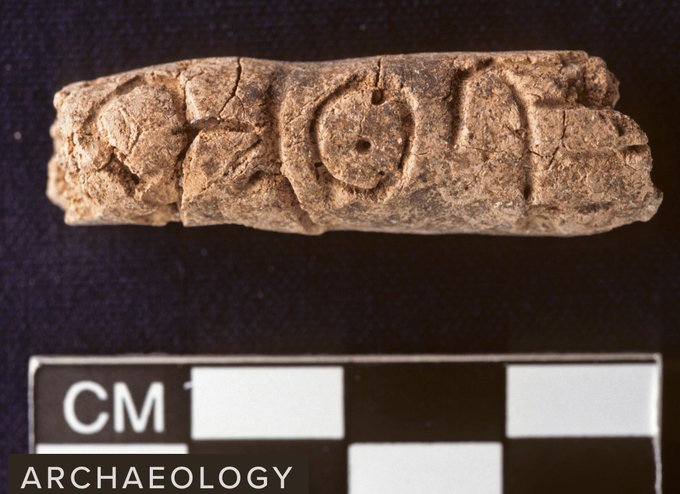
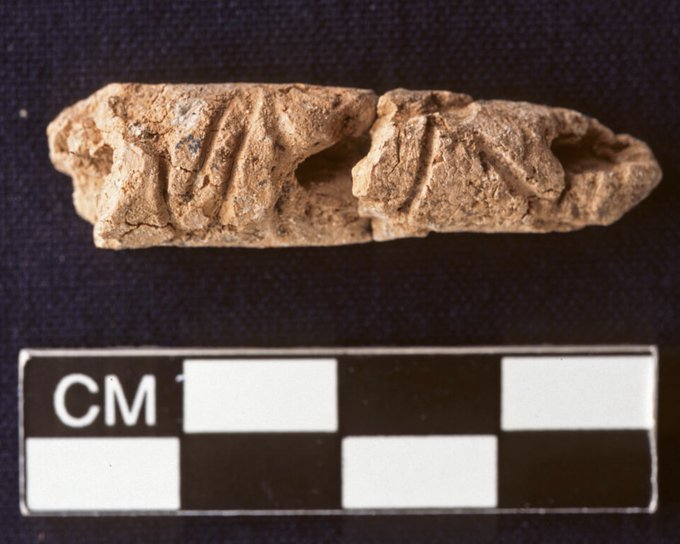
Lets attempt to read the Syrian Brahmi. Note that we are making several assumptions including the Brahmi script, the usage of diacritics and the corpus here is just these 3 cylinders. We are also forced to make a choice regarding broken characters. This means that the reading is a best-attempt and not authoritative. I feel the same anxiety moving the script origin from 1800 BCE to 2300 BCE that Harry Falk must have felt when he saw the Sri Lankan inscriptions dated to 600 BCE, which he believed were invented in 3rd BCE by Ashoka.
All 3 can be read using the Sri Lankan old Brahmi orthography reading from R to L:
1. cylinder o-3d and o-3a combined:
(𑀭) 𑀞? 𑀉 𑀰 𑀩 𑀕𑁅
गौबहुत��� "The one with abundant cows"
Note that the old Brahmi <g> had a shorter leg on the left side in image 4. The two strokes at its bottom are likely to be <au> diacritic. The <r> seems to be broken off into its own piece into o-3d
2. cylinder o-3b
𑀚? 𑀧 𑀞 𑀜 𑀏
एनतप(ज) "(son of) the burner of sins"
It is not clear if there is a <ja> at the end, but the meaning changes only slightly
3. cylinder o-3c
𑀬 𑀏? 𑀕
गेय "The praised one"
The <y> is a very clear glyph used in Sri Lankan Brahmi even though looks different from the Ashokan Brahmi used in the unicode font.
Note that EVERY single letter here is old Brahmi of the variety found in Sri Lanka. It is unambiguous.
Note that the depth of 8+ meters agrees with the estimated age of 8K years of age. So the C14 test must be accurate. This is very very interesting and implies the following:
1. There was a settlement near Lucknow around 8500-7500 BCE, similar time as the earliest Harappan sites.
2. They had BRW pottery
3. They invented PGW around 7500 BCE
4. They moved west and settled near Haryana some 5000 years later.
PGW has gone back in time from 700 BCE to 2600 BCE and now to 7500 BCE and origin has shifted East.
Siyapur, a historic city near Lucknow (7582 BCE)
In Siyapur, the Black and Red Ware (BRW) culture layer has been carbon dated around 10108 BP or 7582 BC.
Kerala is only state in india with lowest number of Biharis.
Just look at cleanliness and Hygiene of India, it is one of the best in india.
Other states should also focus on cleanliness and Hygiene.
THREAD: Journey from Bhimbetka to Sanskrit Wisdom in Ancient Indian History
🐝 The Bond with Bees
At Bhimbetka rock shelters (15,000-11,000 BCE), paintings show humans 🍯 collecting honey from wild bees. These Mesolithic images emphasize the vital role of pollinators in human development before written language.
Depiction of Shri Indra Deva
In the murals of the Kizil central-pillar caves the largest and best-known Buddhist cave site, active between the 5th and 9th centuries CE in present-day Xinjiang, China Indra Deva is shown wearing a crown and marked with a third eye.