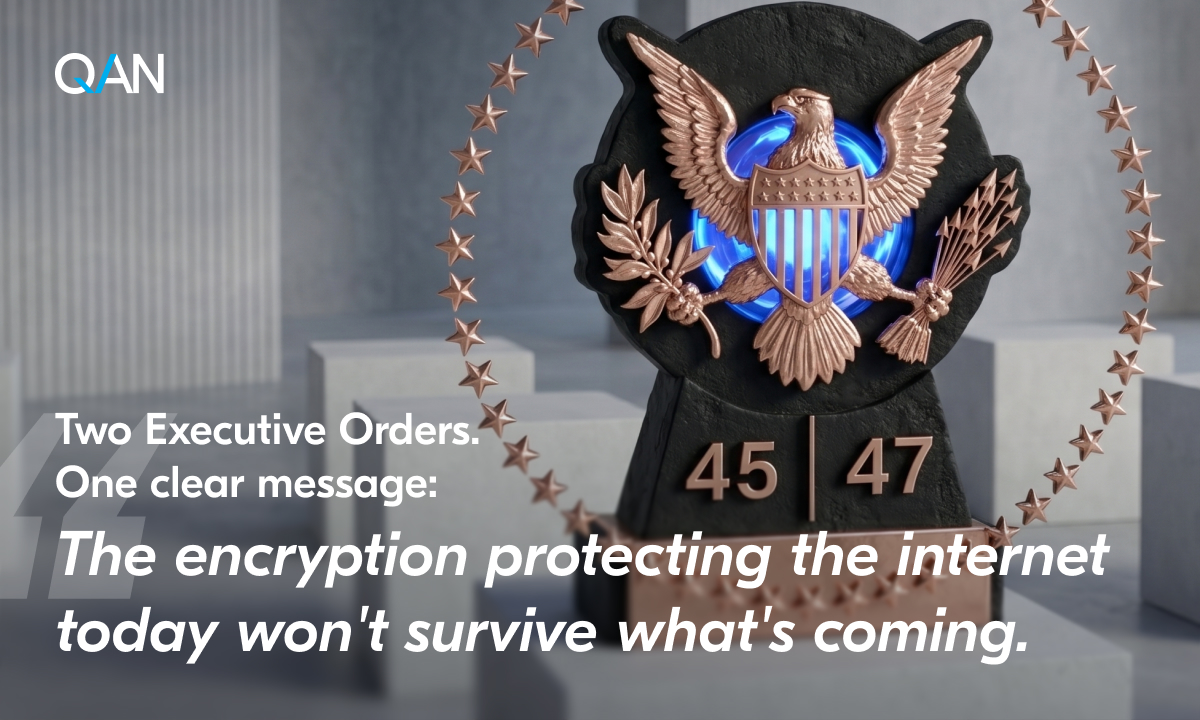
On June 22, 2026, President Trump signed two executive orders affecting post-quantum cryptography and quantum innovation.
EO 1 → "Securing the Nation Against Advanced Cryptographic Attacks"
EO 2 → "Ushering in the Next Frontier of Quantum Innovation"
This is basically the U.S. government declaring that the quantum era has arrived. 🧵👇
It is a Thursday evening in 2030.
Marko, a backend engineer in Berlin is debugging a wallet recovery issue.
A user claims funds were moved without authorization. No phishing. No malware. No leaked seed phrase.
Just a valid signature.
Marko pulls the transaction.
It checks out.
Correct format. Correct curve. Correct verification path. From the protocol’s perspective, nothing is wrong.
But something is.
He traces the wallet history back.
First transaction: 2022.
The moment the public key was revealed on-chain.
After that, years of inactivity.
No rotations. No changes. Just a key sitting there, exposed, forgotten.
Until now.
He opens an internal thread. Someone mentions it quietly.
“Could be quantum-derived.”
No one replies for a minute.
Because if that sentence is true, even once, this is not an incident.
It is a pattern waiting to be found.
Marko looks at the verification result again.
The system did exactly what it was designed to do.
Accept a mathematically valid signature.
It just no longer knows who is behind it.
The myth
"Quantum-safe cryptography is just a stronger version of what we have."
The reality
It’s a completely different foundation.
Different math. Different key behavior. Different tradeoffs.
You’re not upgrading a component.
You’re replacing the ground it stands on.
And most systems were never designed for that kind of swap.
BlackRock Quantum Whitepaper: The Threat & The Hard Truth
Key takeaways:
Quantum computers could break current encryption within years, not decades. BlackRock confirms the timeline has accelerated.
The quantum threat
Shor's Algorithm can break Elliptic Curve Cryptography (ECC), the exact math securing Bitcoin and Ethereum digital signatures. A sufficiently powerful quantum computer could derive private keys from public keys visible on-chain.
Bitcoin's vulnerability
Approximately 35% of the Bitcoin supply (~7M BTC) is currently exposed:
• 1.9M BTC in P2PK/P2TR/P2MS addresses
• 5M BTC in addresses with reused keys
This creates two distinct attack vectors:
At-Rest: CRQC (Cryptographically Relevant Quantum Computers) can steal coins from the 35% of supply even if never spent.
On-Spend: All Bitcoin addresses become vulnerable during the 10-minute mempool window of a transaction.
Quantum is advancing fast
• Google has moved its encryption migration deadline to 2029.
• IBM targets large-scale, fault-tolerant quantum systems by 2029–2033.
• Recent breakthroughs in error correction have pulled timelines forward significantly.
The migration crisis
Governments plan full migration by 2035, BlackRock notes that while technically feasible, coordination is the bottleneck. It requires multi-year timelines that legacy chains simply may not have.
Legacy chain problems
• Bitcoin: Development is relatively decentralized and there is no current consensus on PQ encryption/signature schemes, migration timelines, and the optimal specific implementation mechanisms.
• Ethereum: Requires seven upcoming network updates/hard forks (2026–2029) with massive complexity due to Proof-of-Stake and smart contracts.
• Ecosystem: Exchanges, custodians, and validators must simultaneously upgrade hardware, software, and policies.
Why QANplatform, the post-quantum blockchain wins
We built quantum-resistant cryptography as our foundation, not as a retrofit. No consensus chaos. No 35% of supply at risk. Already defended from day one.
The bottom line
BlackRock states that upgrading cryptographic systems is easier than building a quantum computer. However, they also admit migration is coordination-heavy and slow, while quantum timelines have accelerated to within years.
We don't face this dilemma. We are already secured.
Q-Day favors the future-proof.
9 minutes.
That is the estimated time a primed fast-clock quantum computer could take to solve ECDLP, the Elliptic Curve Discrete Logarithm Problem, the core mathematical problem behind the signature schemes that secure Bitcoin, Ethereum, and many other blockchains.
No buffer. No second chance.
That's fast enough to turn blockchain's security window into a race against time.
Update from @pmjohann Co-Founder and CTO of QANplatform: "I'm happy to announce that QVM is finally ready..." watch the video update! 👇
#QANplatform $QANX
What is lattice-based cryptography?
Most encryption today relies on problems that are hard to solve, but have a hidden shortcut. Quantum computers find that shortcut. Lattice-based cryptography is different, it is built on problems with no shortcut in the foreseeable future, even with accelerating technological development.
Think of it like this. Classical encryption is a combination lock: hard to crack by hand, but a fast enough machine can cycle through every combination. Lattice cryptography is more like a maze with millions of corridors added every second. Even knowing the rules of the maze does not help you navigate it faster.
The underlying problem - finding the shortest path between two points across millions of mathematical dimensions - has resisted attack for decades. No classical computer can brute-force it. No quantum algorithm is known to break it. That is not an assumption. That is a track record.
That is why CRYSTALS-Dilithium and CRYSTALS-Kyber are built on lattices. That is why post-quantum cryptography works.
And that is why we use the NIST-standardized ML-DSA, which is derived from CRYSTALS-Dilithium.
@AltcoinDaily They all had one thing in common:
They were ahead of the curve, as mentioned.
Check out @QANplatform and see what market problems they solve
@AltcoinDaily@QANplatform was early on the quantum narrative.
But is right on time with the explosion of demand as all systems need migration solutions.
Only chain that has come up with innovation.
Much more powerful than legacy chains just trying to convince holders they will upgrade
"QAN is not competing with Ethereum. QAN is extending Ethereum"
A community member created this visual from recent updates.
Innovation for Quantum migration solutions 💥
$QANX $QRL $ABEL $CELL $MCM $XX $NXS $ALGO $HBAR $TRX $USDC $BTC $ETH $ADA $SOL $XRP $IONQ $RGTI
QANplatform May Update: Accelerating Our Ethereum Rebase and Enterprise Readiness
May was a month of decisive action for QANplatform. Following our announcement of a controlled architectural rebase of QANplatform’s core features onto Ethereum’s official implementation we moved immediately from strategic planning to implementation.
With architectural risks mitigated and technical briefs finalized, we are now fully cleared to begin active construction on our next-generation implementation.
Behind the strategic shift lies significant engineering progress. This month, our team resolved complex architectural challenges to ensure a rock-solid runtime and a mature developer ecosystem.
Read the full recap on our blog, link in the comments 🔗👇
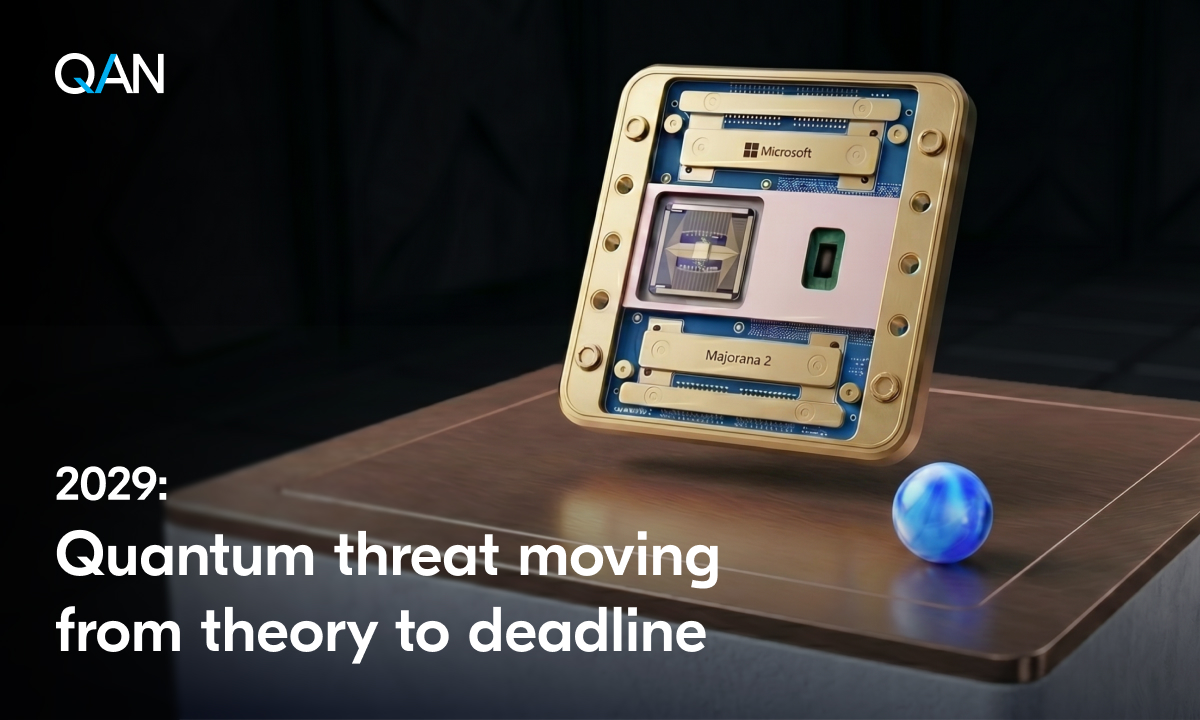
Two tech giants. One timeline: 2029.
Microsoft just unveiled Majorana 2: topological qubits that last 20 seconds (vs. 1-12 milliseconds in Majorana 1).
That improvement is roughly comparable to inventing a phone battery that instead of dying in a day could last for nearly three years on a single charge.
That's a 1,000x reliability leap, built with agentic AI.
Their practical quantum computer target? 2029, the original timeline cut in half.
Google independently set the same year as its internal deadline to complete PQC migration across all systems, warning that quantum computers could break current encryption before the decade ends.
When Microsoft AND Google converge on 2029, that's not a prediction. That's a countdown.
Every blockchain still running on legacy cryptography needs to ask: are you quantum-safe?
The migration window is closing.
There are two main positions on quantum risk to blockchain infrastructure.
One of them requires believing decentralized networks can coordinate a full cryptographic migration under time pressure with no central authority and no enforcement mechanism.
The other one requires starting earlier than feels necessary.
Both positions might seem defensible. But only one survives the reality of decentralized coordination.
Position A: The threat is already active.
"Harvest-now-decrypt-later" means data collected today is already compromised. Chains not building on post-quantum primitives are accumulating debt, not buying time.
Position B: The timeline is long enough for a retrofit.
"Hard forks happen. Ecosystems upgrade." Migration can wait. It is too expensive to over-engineer for a threat years away.
Here is the friction point:
Position B requires a massive bet on coordination.
It assumes that decentralized networks, which lack central authority, enforcement mechanisms, and contain millions of independent wallets, can execute a full cryptographic migration in a compressed window under pressure.
History suggests this is the hardest thing a decentralized network can do.
The industry has mostly let Position B win by default, simply because it is the path of least resistance.
So, a direct question for the builders:
If a protocol must be secure in 2030:
Is it a viable strategy to bet the project's survival on a forced hard fork that requires 100% of the community to coordinate perfectly at the last minute?
Or is the only safe path to build on infrastructure where quantum resistance is native, not retrofitted?
SHA-1 is a cryptographic algorithm that secures digital signatures and certificates across the internet. Deprecating it started with NIST warnings in 2011, a public collision attack demonstration in 2017, and browsers flagging every non-compliant site as insecure. The full migration took the better part of two decades and it is still not universally complete.
Governments have already published quantum migration mandates for federal systems. The US, UK, and Canada have all issued formal PQC migration roadmaps. Bipartisan US legislation introduced in 2025 requires federal agencies to upgrade high-impact systems by January 2027.
That is the SHA-1 playbook running again: mandates, deadlines, enforcement through procurement and regulation.
Blockchain has no browser. It has no regulator with a flag. The enforcement mechanism does not exist.
SHA-1 migration took two decades with all of those tools in place.
Nobody has explained what migration looks like without them.
Ethereum’s strength comes from decentralization, long-term vision, and institutional-grade infrastructure.
qanplatform:native is building in the same direction, but with quantum resistance and enterprise-ready architecture from day one.
If ethereum:native is the current standard, @QANplatform is positioning for the next era of secure, scalable finance.
The building blocks are coming together for the @QANplatform ecosystem! Keep an eye on $QANX over the next few months.
The Builder Liquidity Flywheel https://t.co/lVFj07570b
@coinbureau@MartiniGuyYT
RWAs change the game:
It’s no longer about protecting coins, but legal ownership over decades
A 30-year bond on a quantum-vulnerable chain is a ticking time mismatch between asset duration and cryptographic security
Trillions will flow in before most even price in quantum risk
bitcoin:native ethereum:native
The blockchain industry has metrics for throughput, latency, and finality. It has no metric for developer onboarding friction.
There are metrics the blockchain industry tracks obsessively.
Transactions per second. Block time. Finality. Speed.
Dashboards everywhere. Real-time graphs. Leaderboards.
You know what nobody tracks?
How long it takes a developer to go from "I want to build on-chain" to "I have something deployed that works."
Not the tutorial. The real path. The one with the broken RPC endpoints, the documentation that describes a version nobody runs anymore, the error messages that assume you already know what the error means.
And when you actually ask developers what that journey looked like, the answers are quietly impressive. Not because it was easy. Because they pushed through something that was genuinely hard, and built something real anyway.
The tooling in Web3 is good now in the places that got attention. Wallets, bridges, DEX interfaces.
It is still a maze in the places that matter most. The parts that touch new builders. The onboarding layer. The moment someone capable decides whether the ecosystem is worth their time.
Most of the people who made it through never complained loudly. They just adapted, documented, helped the next person, and kept building.
The developers who are in Web3 earned it. The ones who could have been in Web3 just decided their time was worth more than the friction.
Both of those things are true at the same time.
Every transaction you have ever signed on-chain left a message in a dead language.
Permanently public. Permanently recorded. Safe, because no one could read it.
Shor's algorithm is the translation key.
The messages did not become vulnerable on Q-Day. They were written vulnerable. The translator just had not been built yet.
Everything signed before the quantum transition is archived and waiting.