Introducing Claude Opus 5.5, the first model in our new Claude 5.5 family.
It performs at the level of Claude Fable 5.1 for most tasks, and costs 40% less to run than Opus 5.
Bhai Chandra sahab ke ₹22,000 crores maaf nahi karte to India mein UPI agle 20 saal tak free chal jaata by government’s number of ₹8,000 crores subsidy.
Also NPCI - which runs UPI has ₹6,119 hard cash on its balance sheet and pre tax operating profit of ₹1,900 crores. NPCI apne cash pe and profits par zindagi bhar UPI free chala sakti hai. Government ka kuchh lena dena hi nahi hai. Government earned ₹1,000 crores tax from NPCI last year.
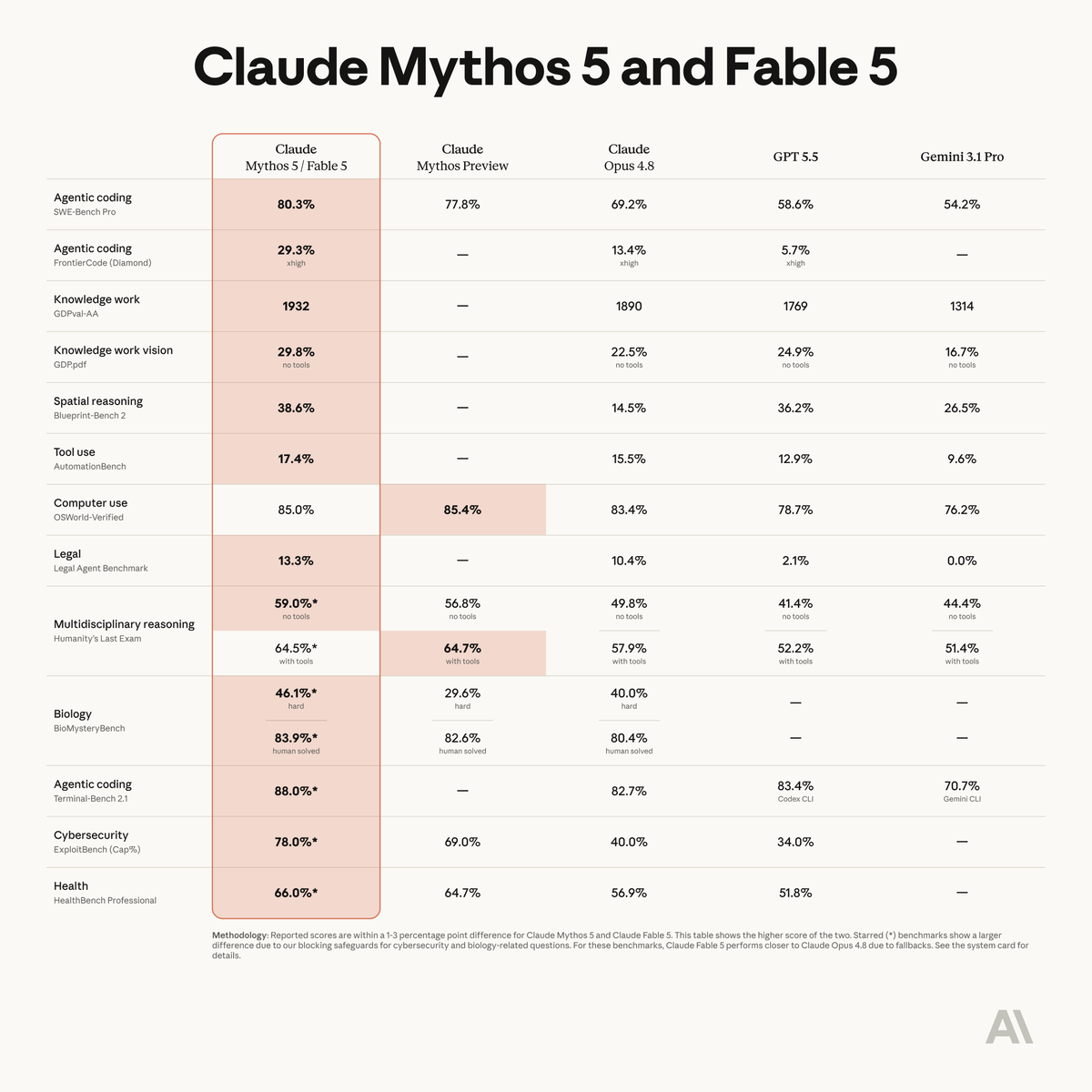
Fable 5 is state-of-the-art on nearly all tested benchmarks, with exceptional performance in software engineering, knowledge work, scientific research, and vision.
The longer and more complex the task, the larger Fable 5’s lead over our other models.
Introducing Claude Fable 5: a Mythos-class model that we’ve made safe for general use.
Its capabilities exceed those of any model we’ve ever made generally available.
As per standard protocols laid by State Government, the MoU signed with Puch AI on 23 Mar 2026 was reviewed.
Necessary details as per SOP were sought from the investor, but they failed to provide them timely. Due diligence showed lack of net worth and credible financial linkages for the project's scale. On directions of the State Government, the MoU is cancelled effective today. No rights or obligations remain.
The MoU has been cancelled in the interest of transparency and highest level of probity in governance, which are in the core of Government of Uttar Pradesh.
#UttarPradesh #InvestUP #Governance #Transparency #EaseOfDoingBusiness #PolicyDriven #Accountability #GoodGovernance #InvestorConfidence #MakeInIndia
@UPGovt
Software horror: litellm PyPI supply chain attack.
Simple `pip install litellm` was enough to exfiltrate SSH keys, AWS/GCP/Azure creds, Kubernetes configs, git credentials, env vars (all your API keys), shell history, crypto wallets, SSL private keys, CI/CD secrets, database passwords.
LiteLLM itself has 97 million downloads per month which is already terrible, but much worse, the contagion spreads to any project that depends on litellm. For example, if you did `pip install dspy` (which depended on litellm>=1.64.0), you'd also be pwnd. Same for any other large project that depended on litellm.
Afaict the poisoned version was up for only less than ~1 hour. The attack had a bug which led to its discovery - Callum McMahon was using an MCP plugin inside Cursor that pulled in litellm as a transitive dependency. When litellm 1.82.8 installed, their machine ran out of RAM and crashed. So if the attacker didn't vibe code this attack it could have been undetected for many days or weeks.
Supply chain attacks like this are basically the scariest thing imaginable in modern software. Every time you install any depedency you could be pulling in a poisoned package anywhere deep inside its entire depedency tree. This is especially risky with large projects that might have lots and lots of dependencies. The credentials that do get stolen in each attack can then be used to take over more accounts and compromise more packages.
Classical software engineering would have you believe that dependencies are good (we're building pyramids from bricks), but imo this has to be re-evaluated, and it's why I've been so growingly averse to them, preferring to use LLMs to "yoink" functionality when it's simple enough and possible.
📢 Open-sourcing the Sarvam 30B and 105B models! Trained from scratch with all data, model research and inference optimisation done in-house, these models punch above their weight in most global benchmarks plus excel in Indian languages.
Get the weights at Hugging Face and AIKosh. Thanks to the good folks at SGLang for day 0 support, vLLM support coming soon. Links, benchmark scores, examples, and more in our blog - https://t.co/DcCG3zlN8p