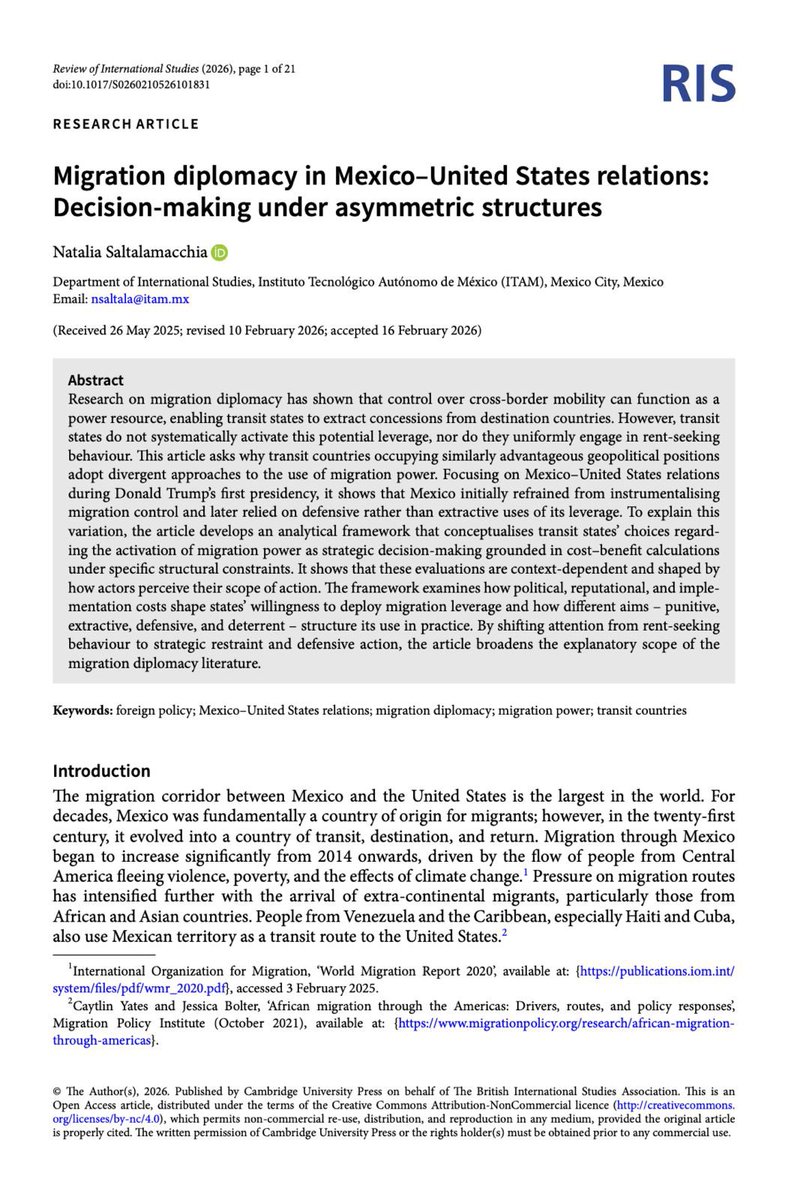
How and when migration is used as leverage between countries?
I am happy to share my new article in Review of International Studies: “Migration diplomacy in Mexico-United States relations: Decision-making under asymmetric structures”
Open access: https://t.co/VftF4SgXdP
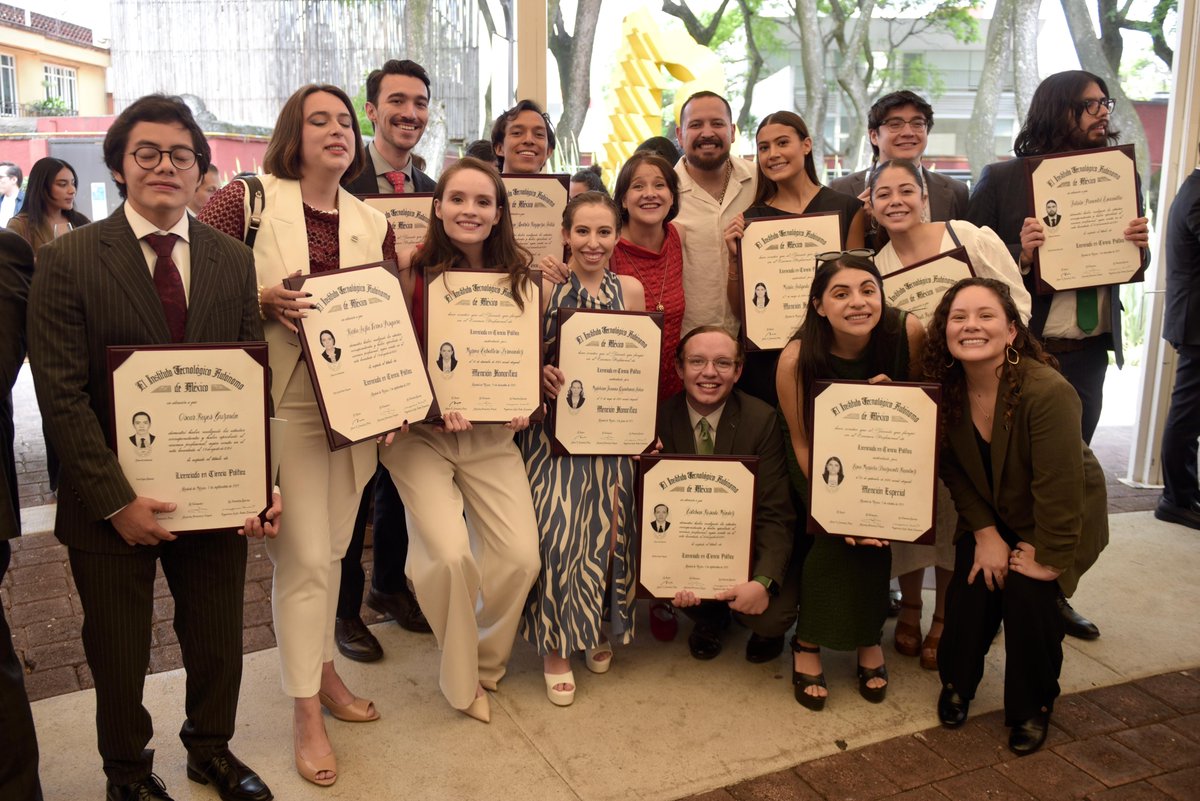
A ustedes, jóvenes titulados del ITAM: el futuro no se hereda ni se espera —se conquista con la mente clara, el corazón en alto y la convicción de que sus sueños no son utopías, sino mapas para transformar el mundo.
¡Felicidades! 💚 Recuerden que el ITAM siempre será su casa.
#ReseñaFAL "Victim Activist in Mexico. Social and Political Mobilization amid Extreme Violence and Disappearances" de @YaelSiman y Matthew Hone por Ernesto E. Rosas Valerio. https://t.co/9RPuyTrIPN
Told @SCMPNews that "China wanted to be seen as an international peacemaker but was cautious about risking its diplomatic capital to advance negotiations if they did not have a high likelihood of success."
1/4
What to Expect at China's Third Plenum Next Week?
History actually suggests plenums are overrated for fundamental change
Xi will deepen his current agenda, but there are some intriguing signals around new policy moves
Highlights from @AsiaPolicy report by Jing Qian & I:
1/25
Just out. Anyone interested in exploring the origins of Global IR, or any label that challenges traditional IR theories and seeks to provide an alternative understanding, should read this collection of Mohammed Ayoob's work, From Regional Security to Global IR: An Intellectual Journey. Edited and with an introduction by Yong-Soo Eun and Amitav Acharya
There is a significant discount on the book at
https://t.co/eDCSzhkrzW
As Barry Buzan writes in a blurb for the book:
"Mohammed Ayoob was doing Global IR long before most in the discipline realized that West-centrism was a problem."
And Michael Barnett notes: "Ayoob was far ahead of the curve in his thinking and is as fresh today as ever."
Ayoob is a true giant in the field. He was the main inspiration for my initial work on IR. One key influence on me was his argument that the Cold War era concept of "national security" (protecting sovereignty and territorial integrity from external military attack) prevailing in the West does not explain the security predicament of Third World countries, where security challenges are primarily internal, stemming from a lack of fit between the territorial and ethnic make up of states and the problem of regime survival. This disjuncture argument, I thought, could apply to other areas of IR, indeed the entire corpus of IR theory as it stood then and to a large extent stands now.
P.S. It so happened that we went (me much later) to the same college/University - Ravenshaw in Cuttack, Odisha. And he was a member of my PhD examination panel in Australia.
I am deeply grateful to Yong-Soo Eun for taking the lead in editing this important collection of Ayoob's essays.
En otro orden de cosas y cumpliendo el mandato de auto-promoción, dejo este artículo que me publicaron en @RRInternacional. Un cierre teórico de un trabajo que vengo haciendo hace mucho enfocado en las relaciones entre sujeto, agencia, poder y soberanía en las RI.
@UNSAM_EPyG
Due to a sudden (minor) illness, I missed today speaking at the Plenary of #EWIS2024 in Istanbul.
But here are some points I was going to make.
1.The Liberal hegemony or US dominated order is ending. Not undermined by other powers but more from within Western nations
2.This is not leading to a multipolar world which is dominated by Great powers. Yet many consequential actors today are not great powers, but others, including regional powers and non-state actors.
3.Cultural and ideological diversity persist and will remain.
https://t.co/BeqQUitZEr connectedness is no longer mainly North-North or North-South, but also South-South.
This is a multiplex, NOT a multipolar, world.
What are the dangers of this new world?
Consistency with the theme of this plenary, i would stress that most conflicts today are domestic and transnational, an important one being rising populism
Why the rise in populism? First, political leaders and parties -even liberal ones- in the West are turning inwards, pandering to anti-immigrant sentiments.
Second, unable to compete and fearful of rise of non-Western nations, they are embracing populism, racism and turning away from inclusive globalism.
What responses are needed?
Building transnational coalitions to oppose populism, and extreme right political movements.
Everyone is focused on power shift, not peaceful change. Reviving peace studies which have fallen through the window, is critical.
We also need to bring about the end of the West vs the Rest divide. As I argue in my book The Once and Future World Order (available to preorder in September), the idea of West was born out of imperialism, exclusion, racism, and warfare.
But the West has no m monopoly on world order building when viewed from a long-term perspective
The current world order has multiple global origins.
The decline of the West - now so much lamented- might be a good thing for world peace and order.
There are many scholars who would blame the Global South for today's conflicts. They would like to "retire" the idea of Global South. I would argue otherwise. Before retiring the Global South, first retire the idea of West. The decline and end of the West as a political construct might be good for the world. We can then also bring about West-Rest reconciliation.
Kudos to @xzibang at @Bloomberg for publishing an elegant guide to the most important institutions and meetings in the Chinese political calendar
Even better, he has examples of how policy statements at different levels have moved markets or affected industries
⬇️for link
Les comparto una nueva publicación "Latin American Involvement in the 21st Century Geoeconomic Turn: a QCA" en @CogitatioPaG disponible en https://t.co/nxbC9fxzde dentro de un special issue sobre las dinámicas geoeconómicas que está imperdible!
Muy lúcido análisis sobre el orden mundial actual
“An updated conception of US leadership -one tailored to a world that has moved on from American primacy- is necessary to minimize enormous risks and pursue new opportunities”
Aprovechen acceso gratis 👇 https://t.co/gQaOSLvr5W
Join us for the next ISA LAC Region virtual event! A panel of experts in #LatinAmerican studies will present on "Missing voices in #InternationalRelations," based on recent publications at @IAJournal_CH. The event will be held in #Spanish. Register: https://t.co/fxlKrp4cAF
No es la economía, es el "hiperoccidentalismo" el núcleo central de este gobierno. Para abrazar esta causa "urbi et orbi", la política exterior es crucial. Acá Juan Tokatlian hace un esfuerzo por explicar este excepcionalismo occidental libertario.
https://t.co/fV4d5Ujc2f
An excellent example of the use of Global IR by Global South scholars to frame their thinking and engage broader IR literature. OPEN ACCESS.
Linking Local Insights to Global IR: Locating Malaysian Contours and Contributions
Cheng-Chwee Kuik and Guido Benny
Journal of Current Southeast Asian Affairs
https://t.co/zpxwC7UjWo
This article traces the trajectories, theoretical propensities, and thematic insights under- lying Malaysian scholarly thinking and writings about international relations (IR). It argues that while their contributions to the Global IR research program have been indirect and implicit, they are not insignificant. The contributions are not claims of exceptionalism but expressions of diverse experiences, perspectives, and narratives that are reflective of the contesting, yet recurring logics significant for understanding and explaining small- and medium-sized states’ behavior in an anarchical world. Three themes are particularly pertin- ent: (1) external policy choices are extensions of internal attributes; (2) small-state outlook on regionalism and multilateralism; and (3) middle-state alignment behavior. Local insights contribute to Global IR by enriching, expanding, and exporting national narratives and regional mindsets into thematic thrusts pertinent for making sense of similar cases else- where, thereby pluralizing the universality and inclusivity of IR concepts and theories.
This chapter, "The rise of multiplexity and a future of world order/s" by M Schoeman, C Alden is among a rapidly growing body of literature that deploys the concepts of multiplexity and Multiplex World to analyze the changing world order and avoid the narrower and tired notions of multipolarity and liberal international order. Part of this book:
https://t.co/Ck6h9Qzi8R
@AmitavAcharya@cjip_journal I read both articles for my Bachelor's thesis on Chinese strategies to build a new hegemony. I hope that, like Asian academics, we as Latin Americans can develop an IR school and new concepts to expand our field.
Regards from Mexico!
Latest issue of @cjip_journal (17/3 2024) has essays on Chinese school of IR Theory by Peter Katzenstein ("Is There a Chinese School of IR Theory?"); and Ren Xiao ("Why there is Now Non-Western International Relations Theory").
The debate started in 2007 when myself & Barry Buzan edited a special issue of International Relations
of the Asia-Pacific @OxfordJournals "Why is there no-Western IR Theory" which is still its most cited article.
(https://t.co/RdbsLJoOEu)
Qin Yaqing's article in the same special issue is the journal's 2nd most cited, & gave the idea of a Chinese IR school international prominence.
I took up the topic again as part of the Global IR agenda in this open access @cjip_journal article in 2019.
(From Heaven to Earth: ‘Cultural Idealism’ and ‘Moral Realism’ as Chinese Contributions to Global International Relations) https://t.co/qtNOj0EKj1 Mine was a sympathetic but critical take on Chinese relationalism and moral realism.
The thing has taken on a life of its own! With many other scholars joining in.
While some may disagree, it gave Asian IR scholarship a much needed theoretical turn, with spillovers into wider IR debates, exactly as we had hoped for in 2007. Hard to think of many other efforts in Asian IR theory which stirred such debate and scholarship.